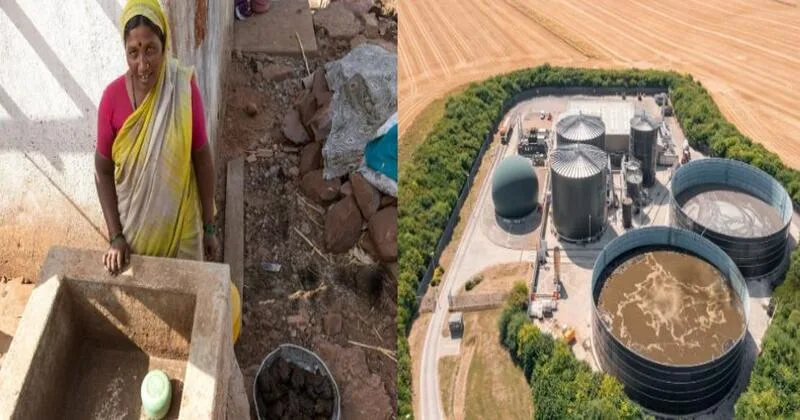
When India launched the Swachh Bharat Mission, cleanliness was framed not only as sanitation but as a civilisational duty. The GOBARdhan (Galvanising Organic Bio-Agro Resources Dhan) scheme, initiated in 2018, represents the next phase of thinking where waste is no longer a liability but an economic asset. Developed in rural India and driven by decentralised energy production, GOBARdhan has transformed cattle dung, agricultural residue and organic waste into biogas, compressed biogas (CBG), thus nutrient-rich bio-slurry is creating a circular economy rooted in villages rather than cities.
This scheme reflects the governance philosophy, which is repeatedly articulated by Prime Minister Narendra Modi, that sustainability must generate livelihoods, not just environmental outcomes. By connecting sanitation, energy security, climate commitments, and rural income, GOBARdhan has emerged as one of India’s most integrated grassroots reforms.
From Swachh Bharat to Circular Economy
GOBARdhan was launched in April 2018 as part of the Solid and Liquid Waste Management (SLWM) component of Swachh Bharat Mission-Grameen (SBM-G). The policy objective was simple: the Indian villages produce massive amounts of biodegradable waste, but there were no organised ways to handle it. The disposal of cattle dung and organic waste in open spaces resulted in methane gas release, groundwater pollution and health hazards. Rural households continued to rely on firewood or subsidised LPG, while farmers were struggling with increased fertiliser prices and deteriorating soil quality.
The program aimed to solve multiple problems simultaneously with a single solution of biogas infrastructure development at the rural, cluster and enterprise levels. By converting organic waste into energy and manure, GOBARdhan embedded the idea of waste to wealth within the Panchayati Raj framework rather than treating it as a top-down energy project.
Institutional Design and Governance Architecture
The Department of Drinking Water and Sanitation under the Ministry of Jal Shakti leads the implementation of GOBARdhan, working in coordination with multiple ministries, including Petroleum and Natural Gas, New and Renewable Energy and state governments. This convergence of multiple ministries is an assurance of the initiative, which ensures that the outcomes of sanitation are properly synchronised with energy markets and fertiliser value chains.
The implementation is divided into three main models:
• Biogas plants in the community or clusters, managed by Gram Panchayats, Self-Help Groups (SHGs) or cooperatives
• Plants set up by bulk waste generators, like dairies or gaushalas
• Entrepreneurial and private sector initiatives, especially for compressed biogas
The financial support offered depends on the size and type of model, with community plants getting assistance proportional to the number of households they serve. A special website called GOBARdhan monitors registrations, progress and operationalisation, marking the beginning of digitalisation in rural waste management.
Scale and Spread: What the Data Shows
As per the official figures, by 27 January 2026, the number of functional CBG projects and community or cluster biogas plants reported by the states is 189 and 979, respectively. Uttar Pradesh is at the forefront of CBG installations, and Chhattisgarh has become a leader in the country in community biogas plants. Madhya Pradesh, Gujarat, Maharashtra, Karnataka, Haryana and Tamil Nadu also feature prominently while indicating that adoption is not confined to one geographic or political region.
Earlier milestones underline steady expansion rather than sudden spikes. By July 2023, over 600 plants were operational, with year-end reviews in 2024 characterising the scheme as a waste-to-wealth success. Parliamentary answer in 2025 further emphasised employment generation, manure supply chains and rural income enhancement as measurable outcomes of the programme.
Why Rural India Needed GOBARdhan
India generates more than 150 million tonnes of cattle dung annually, alongside large volumes of crop residue and organic household waste. Traditionally, much of this biomass remained underutilised or was disposed of in ways that harmed health and the environment. Stubble burning has added another layer of pollution, particularly in northern India, while methane emissions from unmanaged waste contributed to climate risks.
GOBARdhan addresses these challenges through decentralised processing. By producing biogas locally, villages reduce dependence on firewood and LPG. By converting slurry into organic manure, farmers reduce chemical fertiliser use and improve soil structure. These benefits occur within the rural economy instead of being extracted by distant supply chains.
Economic Outcomes at the Grassroots
One of the most important effects of GOBARdhan is in the area of rural livelihoods. Biogas plants provide multiple sources of income sale of cooking gas, the production of CBG for transportation or industrial purposes and the sale of bio-slurry as fertiliser. The report mentions the price of manure between Rs 5 to Rs 10 per kilogram, thus opening up a new market for inputs in agriculture.
Jobs are created throughout the entire chain, from waste collection and biogas production to maintenance and distribution. SHGs and women play an important role in managing biogas plants within the communities, which is also a part of the overall strategies for women’s employment. Through the shift from using imported gas, natural gas will be used in this process. GOBARdhan also contributes towards foreign exchange conservation by relating this activity to national energy security strategies.
Environmental and Public Health Outcomes
Environmentally, GOBARdhan would be helpful in reducing emission levels of greenhouse gases because methane gas emitted into the environment would be captured. It also helps in reducing pollution from the dumping and burning of organic waste. The bio-slurry, which is a byproduct of the biogas plant, helps in increasing the organic carbon content of the soil, increasing water retention capacity and thus facilitating the transition towards natural and organic farming practices.
The health benefits are also important. A cleaner environment in the village means fewer vector-borne diseases, and the availability of clean fuel for cooking means a cleaner indoor environment. The time saved from collecting firewood or handling waste is most beneficial to rural women, thus supporting the social impact component of the program.
Indore Model and Urban-Rural Linkages
The Indore Bio-CNG plant, often mentioned in government communications, is one such example of how urban waste can be used to fuel sustainable systems. The plant processes over a hundred tons of organic waste every day, providing fuel for city buses. The opening of the Indore Bio-CNG plant marked a turning point in the GOBARdhan story, symbolically indicating that sanitation, energy and mobility can be combined in one circular process.
Such models show that GOBARdhan is not confined to rural isolation but can support urban infrastructure while sourcing value from organic waste streams that were earlier considered unmanageable.
Political Messaging and Leadership Emphasis
Prime Minister Modi has repeatedly framed GOBARdhan, gobar se Gobardhan, turning waste into wealth through innovation rooted in Indian conditions. His speeches and public communications have linked the scheme to Aatmanirbhar Bharat, climate responsibility and Swachh Bharat 2.0. The political messaging is not incidental, it positions is decentralised sustainability as the core development strategy rather than a peripheral environmental initiative.
More than 1,100 plants are operational, and targets extending toward several thousand installations, GOBARdhan’s next phase will test its ability to scale without losing decentralised control. Challenges remain initial capital costs, technical capacity and consistent feedstock supply, but the experiences of states like Uttar Pradesh, Gujarat, Chhattisgarh and Madhya Pradesh demonstrate that these barriers are manageable within existing institutional frameworks.
As India moves toward its climate and energy commitments, GOBARdhan offers a template for development that is simultaneously local, sustainable and economically viable. It represents a shift in thinking that rural waste, when governed intelligently, can become a foundation for national resilience.
GOBARdhan is not just a sanitation or energy scheme. It is a redefinition of how India views its villages not as beneficiaries of development but as producers of value for the nation as a whole.