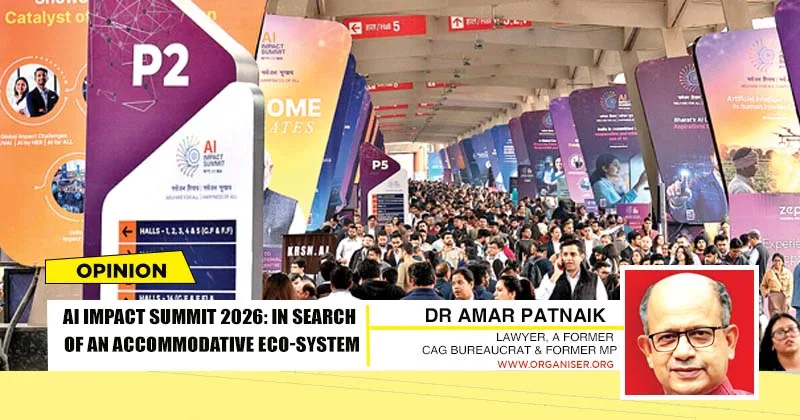
As discussions about Artificial Intelligence’s growth and impact continue to dominate conversations even after conclusion of the recently held India AI Impact Summit 2026 at Bharat Mandapam in Delhi, Bharat has clearly spelt out that the goal of AI implementation should be inclusive, resilient, and responsible economic and social growth. This is in line with the global principle of AI for humanity. The national vision was rightly articulated as welfare and happiness for all.
Bharat has already taken the first step in this direction by releasing a white paper on democratising access to AI infrastructure in December, 2025 by the Office of Principal Scientific to the Government of India. This white paper discusses and shares information on the country’s physical infrastructure, such as data centres, processing units, computational capacity, besides collating information about the existing digital infrastructure and the regulatory and policy environment enabling AI infrastructure. Perhaps the most important takeaway from the paper is its emphasis on using Bharat’s digital public infrastructure to advance the process of democratising access to AI resources. It envisions involvement of private players as well so as to make AI resource – user efficient and ensure its adoption across sectors.
Achieving Economic Growth
In terms of economic opportunities, AI democratisation will lead to algorithm democratisation. This will enable developers and researchers across sectors to use, change and redistribute AI algorithms. This would otherwise have remained restricted due to exclusive proprietary systems. Certain open-source softwares already share their algorithms with everyone making it easier for smaller businesses and individuals to compete who otherwise would not have had the opportunity to match players with greater access to AI resources like compute and data infrastructure. If this is replicated on a larger scale, it will lead to increased employment opportunities across sectors and mostly, in tier II and tier III cities.
Equitable and democratic access to AI will benefit different sectors. For instance, smaller players within the MSMEs and Startups industry often struggle to scale operations due to lack of access to technology such as AI. The larger players deploy AI in the form of AI chatbots for customer service, assessing credit risk for small borrowers, etc which helps them in growing their business. If the smaller players too had access to AI resources, including data, in a more equitable manner, they would also be able to expand and contribute to growth and employment.
Similarly, AI can be leveraged across sectors. Use of AI in Bharat’s agricultural economy can be used to increase crop disease detection, predict market pricing, detect weather patterns, etc, thus boosting production. For instance, a Bangalore based company called CropIn uses an AI tool to monitor crops and data to improve yields.
Equitable Access to AI Resources
A report titled ‘AI for social good: Improving lives and protecting the talent’ released by McKinsey Global Institute in 2024 documented AI’s tremendous potential for driving social growth through SDGs like good health and well being (SDG 3), quality education (SDG 4), etc. In the Indian context, AI-powered tools have been adopted by the Ministry of Health and Family Welfare to screen for TB and diabetic retinopathy. As per the data shared by the Ministry in February 2026, AI tools have been used to support 282 million telemedicine consultations nationwide. The Ministry also uses AI for intensive and comprehensive disease surveillance in its Health Observatory.
Enhancing Accessibility for Divyangs
One of the best uses of AI for social empowerment is its ability to enhance digital accessibility, especially in the context of improving the lives of persons with disabilities (PwDs). For instance, Intel has come out with the Assistive Context Aware Toolkit (ACAT), which allows integration of AI in assistive technology, thereby enabling PwDs to navigate computers with minimal support and movement. Similarly, Indian Institute of Technology, Hyderabad, has released a platform called Swarajability, which utilises AI tools to aid PwDs in finding job opportunities. AI is increasingly being deployed to make the lives of PwDs easier. Similarly, AI is being increasingly used to preserve the cultural identity and languages of Bharat’s tribal and indigenous communities. The Ministry of Tribal Affairs has launched an-AI powered translation and linguistic preservation platform called Adi-Vaani to document, preserve and promote tribal languages and dialects.
In order to fully utilise AI for driving economic and social growth, and unlock its full potential, the current gap in digital literacy and access to digital resources have to be addressed. The mere access to AI resources is not sufficient—it is critical to first impart digital literacy skills to facilitate AI’s use. Individuals, small players, and Government officials should be able to engage with AI tools while knowing their risks, algorithmic biases and shortcomings. This is only possible if they are able to access adequate infrastructure such as digital devices, electricity and internet connectivity which is required for engaging with AI tools. In the absence of these tools, the existing inequalities will only exacerbate the gap between large and small players and skilled and unskilled ones will widen.
The Government has strived to improve digital literacy in the country through schemes like Pradhan Mantri Gramin Digital Saksharta Abhiyaan (PMGDISHA), which has empowered 6 crore rural households with digital literacy skills. As AI’s use expands across the country, it must continue to implement similar schemes and initiatives at scale and on a continuing basis, as these will go a long way in promoting equitable access to AI resources. At this juncture, tapping into AI’s potential by simplifying access to AI resources and equipping our population with digital literacy skills will shape the inclusiveness of AI growth in our country.
Another challenge when it comes to democratising AI is the lack of public access to adequate and updated data/ data centres which are essential for training AI models and developing indigenous models. (at the ongoing AI Impact Expo Summit) OpenAI launched a new initiative called ‘OpenAI for India’ in collaboration with the Tata group to improve India’s AI infrastructure. The initiative will focus on developing local, AI ready data centres. The government must promote similar initiative to address the challenge of inadequate data centres to train AI models in the country.
India is on the right track when it comes to working towards democratising AI resources.