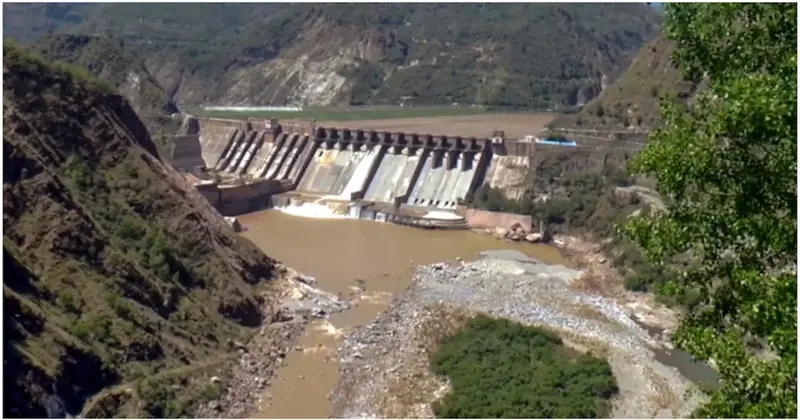
An Islamabad datelined story published in Pakistani newspaper Dawn on March 2, Monday claims that India is investing around $60 billion on storage projects along the two major Western Rivers, the Jhelum and the Chenab. It adds that these dams could soon become a “lethal weapon” against Pakistan, potentially causing both floods and droughts. It is outright propaganda as no storage dam is being built on either of the rivers named in the report. However, this propaganda needs to be repelled as it is apparently being prepared as an instrument to villify India in various international forums.
Incidentally, no new project has been announced by India for the last few years and the ongoing projects on Chenab and Jhelum are all Run of the River(RoR) projects. Be it Ratle and Sawalakot on Chenab or Uri II on Jhelum, these projects were RoR and use minimum pondage for producing electricity. India is allowed to store 3.6 Million Acre Feet(MAF) of water on the Western Rivers and Pakal-Dul project, under construction for almost a decade, will store barely 0.1 MAF(point 1 MAF) of water in its reservior.
False Propaganda
According to the Dawn report, these views regarding alleged storage dams being made by India were expressed at a recent federal-provincial dialogue on water storage projects. The report has attributed these views to Water and Power Development Authority(WAPDA) Chairman Lt Gen Muhammad Saeed (retired). Lt Gen Saeed(retd) reported that India’s $60bn investment plan was estimated to increase New Delhi’s storage capacity on these rivers to between 55 and 60 days, up from around only 15 days at present.
Interestingly, no timelines, locations of these dams allegedly being constructed by India and flagged by the WAPDA Chairman have been mentioned in the report. It goes without saying that this is all devious false propaganda. “Such capacity could cause drought in Pakistan, given a nearly two-month window to stop normal flows, particularly when crops need crucial water downstream”, a participant at the briefing told Dawn. The alleged participant who told these things to the newspaper reporter has not been named.
“Conversely, India can trigger floods at will during monsoon or heavy rainfall by releasing stored water, something it has been doing recently even with its existing 15-day storage capacity”, he added. Therefore, Pakistan must urgently build large reservoirs as preparedness measures to capture floodwaters for use when India disrupts flows, and to hold substantial quantities in case of sudden discharges to avoid devastation.
Flood Reserviors
The WAPDA Chairman stressed that Pakistan would need new flood reservoirs to conserve surplus water and mitigate potential shocks. An official said Pakistan must aggressively develop water storage to capture repeated annual floodwaters that otherwise flow into the sea. Weaponisation of river flows by India through ongoing investments, the official warned, could pose existential challenges.
The fact of the matter is that of the 135 MAF of water that Pakistan gets from Indus, Jhelum and Chenab, more than half, over 60 MAF, is wasted in Pakistan due to thefts and irrigation inefficiencies. Besides, enough storage dams have not been created to use its share of water efficiently.
Held on February 17, a fortnight ago, the session was presided over by Water Resources Minister Mian Moeen Wattoo and attended by the Occupied Jammu Kashmir(POJK) PM and Gilgit Baltistan CM, but not the provincial chief ministers. The Dawn report said that Pakistan PM Shehbaz Sharif had also asked chief secretaries and irrigation secretaries to attend. Sindh’s irrigation minister and secretary warned that Pakistan was already water deficient and that river flows did not justify a large dam.
They added that lower riparians were not receiving enough drinking water under the current situation and that additional dams could aggravate conditions. Therefore, detailed feasibility and economic assessments should be prepared before taking any decision. They also noted that projects developed in urgency in response to Indian actions might not prove to be a bankable solution — perhaps an indirect reference to the Neelum-Jhelum Hydropower Project built by a Chinese firm that remains mostly out of order.
Gilgit Baltistan
The Gilgit Baltistan leadership suggested the region should be granted membership of the Indus River System Authority(IRSA) to ensure national representation, or at least observer status to participate in decision-making. It needs to be mentioned here that the largest hydropower station of 4,500 MW capacity is being built in Gilgit Baltistan only at Diamer Basha. Being built by a Chinese company, Gilgit Baltistan has absolutely no say in its execution.
The POJK PM said given his area’s status as the source of river flows, it would welcome more dams, storage facilities and hydropower projects. However, he stressed the need for financial incentives so that the local population not only took pride in its contributions but also benefitted economically. The construction of Mangla dam in Mirpur town of POJK under the Indus Waters Treaty(IWT) had led to large scale displacement of local population. However, the dam provides irrigation facilities to downstream Punjab and the electricity produced is also exported.
This systematic exploitation of POJK’s water resources has fed discontent in the region as there were long power cuts extending to as many as 16 hours a day. Besides, the Federal government did not pay any royalty to the POJK government leaving it starved of resources, making it beg for even small amounts.
Punjab, Sindh Differ
The Dawn report said that Punjab fully supported new flood storage projects and offered to sit down with Sindh’s leadership, providing assurances and institutional guarantees to address grievances and reservations. A year ago, Punjab and Sindh were at loggerheads, just as they are today, with the former digging six canals to divert Indus waters to Cholistan area. Sindh had opposed it tooth and nail but surrendered before Punjab as the all-powerful Pakistan Army had backed the plans. Things, however, changed and Punjab was forced to abruptly stop taking Sindh’s waters after India put Indus Waters Treaty (IWT) in abeyance on April 23 last year.
Khyber Pakhtunkhwa demanded that its Chashma Right Bank Canal lift-cum-gravity project be developed at the earliest, noting that the province had been unable to utilise its water share without it. The Wapda chairman assured representatives that tenders had already been issued and that the project would be prioritised. Separately, Wapda is believed to have finalised four medium-sized storages on the Chenab near Jhang, Chiniot, Sargodha and Wazirabad. Estimated to cost around Rs300bn, it would provide a combined storage capacity of about 4.5 million acre feet.