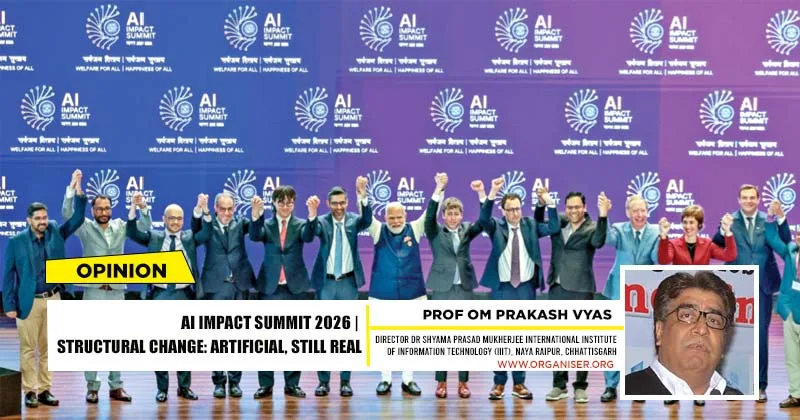
AI Impact Summit 2026 | Structural Change: Artificial, still real
June 26, 2026
  • Read Ecopy
  • Circulation
  • Advertise
  • Careers
  • About Us
  • Contact Us
Android AppiPhone AppArattai
Organiser
  • ‌
  • Bharat
    • Assam
    • Bihar
    • Chhattisgarh
    • Jharkhand
    • Maharashtra
    • View All States
  • World
    • Asia
    • Europe
    • North America
    • South America
    • Africa
    • Australia
  • Editorial
  • International
  • Opinion
  • RSS @ 100
  • More
    • Op Sindoor
    • Analysis
    • Sports
    • Defence
    • Politics
    • Business
    • Economy
    • Culture
    • Special Report
    • Sci & Tech
    • Entertainment
    • G20
    • Azadi Ka Amrit Mahotsav
    • Vocal4Local
    • Web Stories
    • Education
    • Employment
    • Books
    • Interviews
    • Travel
    • Law
    • Health
    • Obituary
  • Subscribe
    • Subscribe Print Edition
    • Subscribe Ecopy
    • Read Ecopy
  • ‌
  • Bharat
    • Assam
    • Bihar
    • Chhattisgarh
    • Jharkhand
    • Maharashtra
    • View All States
  • World
    • Asia
    • Europe
    • North America
    • South America
    • Africa
    • Australia
  • Editorial
  • International
  • Opinion
  • RSS @ 100
  • More
    • Op Sindoor
    • Analysis
    • Sports
    • Defence
    • Politics
    • Business
    • Economy
    • Culture
    • Special Report
    • Sci & Tech
    • Entertainment
    • G20
    • Azadi Ka Amrit Mahotsav
    • Vocal4Local
    • Web Stories
    • Education
    • Employment
    • Books
    • Interviews
    • Travel
    • Law
    • Health
    • Obituary
  • Subscribe
    • Subscribe Print Edition
    • Subscribe Ecopy
    • Read Ecopy
Organiser
  • Home
  • Bharat
  • World
  • Operation Sindoor
  • Editorial
  • Analysis
  • Opinion
  • Culture
  • Defence
  • International Edition
  • RSS @ 100
  • Magazine
  • Read Ecopy
Home Bharat

AI Impact Summit 2026 | Structural Change: Artificial, still real

With largest youth population in the world, a robust IT services ecosystem, expanding digital public infrastructure & a vibrant startup culture, Bharat has strong foundational advantages. This is the reason why it is all set to take the next step, which requires a strategic shift—from a consumer of AI tools to becoming a creator of AI technologies, IP & governance frameworks

Prof Om Prakash VyasProf Om Prakash Vyas
Mar 2, 2026, 09:00 pm IST
in Bharat, Opinion
Follow on Google News
FacebookTwitterWhatsAppTelegramEmail

Artificial Intelligence (AI) has moved from the realm of research laboratories to the centre of global economic and strategic discourse. Over the past decade, what once seemed like an ambitious technological aspiration has rapidly positioned itself as a defining force of the 21st century.

A major inflection point came in 2017 with the introduction of the transformer architecture, which significantly enhanced how machines process language, images, and complex data. Early public excitement centered on conversational AI systems capable of answering questions, drafting content, translating languages, and engaging in human-like dialogue. But today’s AI systems extend far beyond conversation.

Modern Artificial Intelligence applications can assist in medical diagnostics, generate software code, optimise logistics networks, accelerate drug discovery, analyse satellite imagery, support financial forecasting, and power autonomous systems. Increasingly, AI functions as a decision-support layer across industries—augmenting human capability, improving efficiency, and enabling predictive planning.

AI is not merely another technological upgrade; it represents a structural shift in how economies function. Much like electricity in the industrial era or the Internet in the digital age, AI is a general-purpose technology with cross-sector impact. It reshapes production models, transforms governance processes, and redefines competitive advantage. Organisations that successfully integrate AI into their workflows are seeing gains in productivity, cost efficiency, and innovation speed. Data-driven decision-making is replacing intuition-based processes, and predictive analytics is enhancing planning accuracy across sectors. For nations, AI capability increasingly correlates with economic resilience and geopolitical influence.

Bharat’s Strategic Opportunity

For Bharat, the rise of AI presents a historic opportunity. With a youthful population, a robust IT services ecosystem, expanding digital public infrastructure, and a vibrant startup culture, the country has strong foundational advantages.

However, the next step requires a strategic shift—from being primarily a consumer of AI tools to becoming a creator of AI technologies, intellectual property, and governance frameworks. Leadership in AI will not be determined only by adoption rates but by innovation capacity, research depth, and policy influence.

Moving up Value Chain

AI has the potential to directly address some of Bharat’s most pressing development challenges. In healthcare, AI-powered diagnostic tools can support early detection of diseases and expand telemedicine services. In agriculture, predictive analytics and climate advisory systems can improve crop yields and reduce risk. In education, personalised AI tutors can help bridge learning gaps. In governance, data-driven systems can enhance transparency, resource allocation and service delivery. When deployed responsibly and at scale, AI can significantly improve access, efficiency, and inclusion.

Bharat’s global reputation has long been built on IT services. The AI era offers an opportunity to move higher in the value chain by developing AI products, platforms, and domain-specific solutions.

Indigenous research, models trained on Bharatiya languages, and AI systems tailored to local industries can create global competitiveness. Solutions built for Bharat’s complexity—multilingual populations, diverse socio-economic conditions, and large-scale public systems—can serve as models for other developing nations facing similar challenges. Exporting AI solutions designed for inclusion and affordability could position

Bharat as a trusted partner in the Global South.

Beyond Metros

For AI to truly become transformative, its development must extend beyond metropolitan centres. Tier-2 and Tier-3 cities represent significant talent reserves and innovation potential. Strengthening AI ecosystems in these regions can create a more balanced and inclusive growth model.

Establishing AI research hubs in State universities and technical institutions can decentralise innovation. Encouraging startups outside major metropolitan clusters can reduce regional disparities. Developing AI tools in regional languages can expand accessibility and participation.

These regions are also closely linked to sectors such as agriculture, MSMEs, logistics, and local governance—areas where AI-driven optimisation can produce immediate and measurable impact.

A geographically distributed AI mission would not only democratise opportunity but also broaden the national innovation base.

Building Human Capital

Technology alone will not determine success. The decisive factor will be human capital. A nation prepared with AI-literate citizens, skilled engineers, informed policymakers, and adaptive institutions will be better positioned to lead.

Artificial Intelligence is rapidly becoming a defining policy frontier. It influences economic competitiveness, social inclusion, and strategic autonomy. Countries that act with clarity and long-term vision will shape not only markets but also norms and standards.

For Bharat, the path forward is clear: transition from AI user to AI creator; from technology adopter to agenda-setter; from participant to global thought leader. If pursued with inclusiveness, investment in human capital, and a strong emphasis on regional participation, AI can evolve from a technological advancement into a national transformation. n

Topics: Artificial Intelligence (AI)Building Human CapitalAI systems
Prof Om Prakash Vyas
Director Dr Shyama Prasad Mukherjee International Institute of Information Technology (IIIT), Naya Raipur, Chhattisgarh [Read more]
ShareTweetSendShareSend
✮ Subscribe Organiser YouTube Channel. ✮
✮ Join Organiser's WhatsApp channel for Nationalist views beyond the news. ✮
Previous News

PM Modi discusses Gulf stability, Indians safety with Saudi Crown Prince and Bahrain King

Next News

Pakistani military officers spreading false propaganda; alleges India building storage dams on Jhelum, Chenab

Related News

AI for Her: Striving for gender inclusivity

Elixis–W, Bharat’s first Industirial humanoid robot by Addverb technologises

AI Impact Summit 2026: Scalability, replicability and adaptability

EU lawmakers pass landmark artificial intelligence regulation

Load More

Latest News

Y.D. Manjunath, Additional Excise Commissioner and brother-in-law of Karnataka PWD Minister Satish Jarkiholi

ED raids Karnataka Excise Dept officials: Rs 13.3 Cr seized, Minister Satish Jarkiholi’s brother-in-law under scanner

Former -DMK Minister EV Velu (File Photo)

Tamil Nadu: Anti-graft agency raids 13 locations linked to ex-DMK Minister EV Velu over alleged contract irregularities

Government introduces AIR SUVIDHA portal following WHO Ebola emergency for international travellers

The Emergency: India’s darkest chapter, the struggle for democracy and the ban on the RSS

Exposing Western Media’s Climate Hypocrisy: When Europe burns it’s just weather, When India heats up it’s a crisis

Rahul Gandhi’s 2018 Panama Papers Remark: Congress leader apologetic in MP High Court, but political fallout continues

UP Govt orders audit of various coaching centres that are illegally constructed

Lucknow Coaching Fire: UP CM Yogi Adityanath orders statewide fire safety audit, forms special teams across districts

India’s education debate needs clarity, not noise

Scuffle at the Tiruvananthapuram Municipal Corporation on June 25

Keralam: Nine BJP councillors injured as CPM protest demanding Mayor’s resignation turns violent at Thiruvananthapuram

India's textile ambitions are being woven through local manufacturing strengths, innovation, sustainability and an expanding global trade footprint

National Textile Export Roadmap 2030: India’s strategic push for a $100 billion global textile presence

Load More
  • Privacy
  • Terms
  • Cookie Policy
  • Refund and Cancellation
  • Delivery and Shipping

© Bharat Prakashan (Delhi) Limited.
Tech-enabled by Ananthapuri Technologies

  • Home
  • Search Organiser
  • Bharat
    • Assam
    • Bihar
    • Chhattisgarh
    • Jharkhand
    • Maharashtra
    • View All States
  • World
    • Asia
    • Africa
    • North America
    • South America
    • Europe
    • Australia
  • Editorial
  • Operation Sindoor
  • Opinion
  • Analysis
  • Defence
  • Culture
  • Sports
  • Business
  • RSS @ 100
  • Entertainment
  • More ..
    • Sci & Tech
    • Vocal4Local
    • Special Report
    • Education
    • Employment
    • Books
    • Interviews
    • Travel
    • Health
    • Politics
    • Law
    • Economy
    • Obituary
  • Subscribe Magazine
  • Read Ecopy
  • Advertise
  • Circulation
  • Careers
  • About Us
  • Contact Us
  • Policies & Terms
    • Privacy Policy
    • Cookie Policy
    • Refund and Cancellation
    • Terms of Use

© Bharat Prakashan (Delhi) Limited.
Tech-enabled by Ananthapuri Technologies