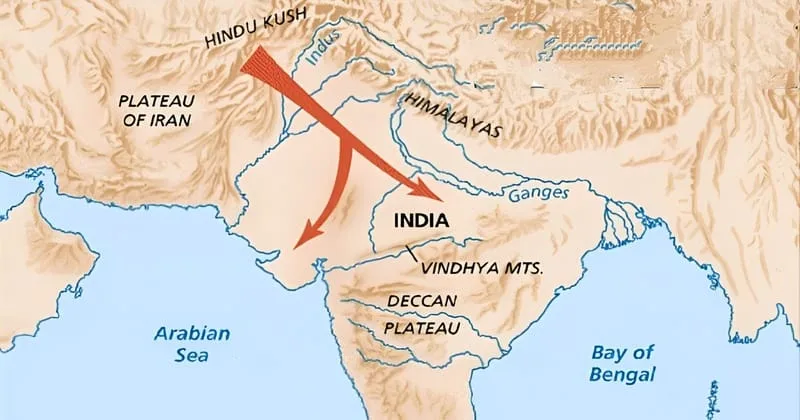
The history of Bharat has, for over a century, been hostage to a narrative constructed not by the soil or its people, but by the pens of colonial administrators and linguists. The “Aryan Invasion Theory” (AIT) remains one of the most successful psychological operations in modern history. It posited that around 1500 BCE, a race of light-skinned, warlike nomads called “Aryans” descended from the Central Asian Steppes, conquered the indigenous, darker-skinned “Dravidians,” destroyed the sophisticated Indus Valley Civilisation, and established a repressive social hierarchy.
This narrative was never a neutral historical inquiry; it was a weapon of statecraft designed to fracture the identity of Bharat. By casting the North and South as ancient enemies, one the conqueror and the other the victim, the British Empire sought to justify its own presence as the “new civiliser” while ensuring that the diverse people of the subcontinent remained divided by an imagined ancestral trauma. Today, in 2026, the arrival of advanced genomic science, interdisciplinary archaeology, and the study of ancient intermixing has finally dismantled this colonial lie, replacing a story of bloodshed with the reality of an eternal civilizational synthesis.
The Colonial Architect: Why the British Invented the Invasion
To understand why the Aryan Invasion Theory was so vigorously promoted, one must look at the political landscape of 19th-century colonial Bharat. The British were acutely aware that they were a tiny minority ruling over a vast, ancient civilisation. To maintain control, they needed more than just military might; they needed to delegitimise the indigenous claim to the land. By creating the “Aryan” and “Dravidian” categories, they effectively told the people of Bharat that they were all foreigners in their own home. If the “Aryans” were previous invaders from the West, then the British were simply the latest in a long line of European or Eurasian “civilisers” taking their rightful place at the helm of the subcontinent.
Prominent colonial scholars like Max Müller, who, despite his linguistic brilliance, never visited Bharat, conflated language families with biological races. This was the fundamental original sin of Indology. Müller himself later tried to backtrack, admitting that “Aryan” referred to a language group and not a bloodline, but the damage was already done. The British administrative machinery, particularly the census officials like Herbert Hope Risley, used pseudo-scientific methods like anthropometry to categorise the people of Bharat into rigid racial boxes. By measuring noses and skulls, they attempted to map the “Aryan-Dravidian” divide onto the existing social fabric. This was a masterstroke of psychological warfare. It convinced a significant portion of the population that their sacred texts, their social structures, and their very ancestry were products of a foreign conquest. This created a sense of “historical grievance” that the British could exploit to prevent a unified national uprising. The “invasion” was not a fact discovered; it was a division manufactured to serve the Crown.
The Deep Time of Synthesis: Lessons from the Neanderthal Genome
One of the most powerful tools in debunking the AIT is the study of “deep time” genetics, which proves that human history is defined by intermixing rather than isolation. The colonial theory relied on the idea of “pure” races clashing. However, the discovery of the Neanderthal genome and its presence in modern humans has completely shattered the concept of racial purity. Tens of thousands of years before the Bronze Age, as early modern humans migrated out of Africa into Eurasia, they encountered and interbred with Neanderthals.
Today, nearly every person in Bharat carries approximately 1 per cent to 2 per cent Neanderthal DNA. This genetic signature is a permanent record of an ancient embrace that occurred long before any linguistic or regional identities existed. If modern humans carry the DNA of an entirely different hominid species, the idea that “Aryans” and “Dravidians” could have remained biologically distinct or that one “invaded” the other without prior millennia of contact is scientifically illiterate.
This ancient intermixing proves that the human story is a vast, interconnected web. By the time the supposed “invasion” was to have occurred in 1500 BCE, the people of Bharat were already the product of countless layers of migration and blending that had been ongoing for over 40,000 years. This deep-rooted intermixing means that the “purity” sought by colonial race theorists never existed. We were already a synthesised people long before the first Harappan brick was laid.
The Genetic Tapestry: From Invasion to “Pulsed” Migration
The most decisive blow to the colonial invasion theory comes from the field of ancient DNA (aDNA) research. In the last decade, massive genomic studies have shown that there is no evidence of a sudden, violent replacement of populations in Bharat. Modern science reveals that the people of Bharat are a sophisticated blend of three primary ancestral groups: the Ancient Ancestral South Indians (AASI), the Iranian-related agriculturalists, and the Steppe pastoralists.
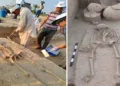
Landmark studies between 2019 and 2025 have fundamentally reshaped this timeline. The 2019 Rakhigarhi Study (Shinde & Narasimhan) was a watershed moment. Researchers successfully sequenced the genome of a woman from the Indus Valley Civilisation (IVC) and found zero Steppe ancestry. This finding was revolutionary; it proved that the people who built the world’s most advanced ancient cities were indigenous and did not possess the genetic markers of the so-called “Aryan” invaders.
Subsequent research, including the 2025 UC Berkeley/LASI-DAD study of over 2,700 complete genomes, confirms that “Steppe” DNA did not arrive as a violent wave. Instead, it entered the subcontinent in a “pulsed” manner between 1900 BCE and 1500 BCE. This was not a military conquest but a gradual diffusion over many centuries, a process geneticists call “admixture.” This mixing was so thorough that there is no group in Bharat today that can claim to be “purely” one thing or another. The genetic distance between a person in the North and a person in the South is remarkably small. We are a single genetic continuum, rendering the old political rhetoric of “invaders versus indigenous” obsolete.
Archaeology and the Myth of the Warlike Aryan
If a violent invasion had occurred around 1500 BCE, the archaeological record of Bharat would be littered with evidence of burned cities, mass graves, and a sudden, total break in material culture. Yet, excavations at major sites like Rakhigarhi, Mohenjo-Daro, and Harappa show no such signs of catastrophe. There are no layers of ash from city-wide fires, and no skeletons showing signs of military trauma on a mass scale.
Instead, archaeology shows a gradual transition and cultural continuity. The decline of the great urban centres of the Indus-Saraswati Civilisation was not caused by the swords of an invading army, but by environmental shifts. Recent excavations at Sanauli (UP) between 2018 and 2024 have added a new layer to this debate. The discovery of copper-plated chariots and sophisticated warrior burials dating back to 2000–1800 BCE challenges the idea that “Aryan-style” warfare was imported from the Steppe. Instead, it suggests that a highly advanced, horse-utilising culture was already developing indigenously within the Ganga-Yamuna Doab, overlapping with the late Harappan period. The technology of the chariot, often cited as the weapon of the “Aryan invader,” was already home-grown in the heart of Bharat.
The Saraswati River: The Physical Link to the Vedic Past
One of the most significant archaeological findings of the late 20th and early 21st centuries is the identification of the paleo-channel of the Saraswati River. For years, colonial historians either dismissed the Saraswati as a mythical river or sought to locate it outside Bharat. However, the ISRO-led ‘Saraswati Project’ has utilised advanced satellite imagery and ground-penetrating radar to confirm that a massive river once flowed through northwestern Bharat.
The latest satellite data reveals a complex network of paleochannels spanning from the Himalayas to the Rann of Kutch. These channels correlate perfectly with the descriptions in the Rig Veda, which praises the Saraswati as the “greatest of rivers,” flowing “unbroken from the mountains to the sea.” ISRO’s research has mapped over 1,500 Harappan-era sites, the vast majority of which are located not on the banks of the Indus, but along the dried-up bed of the Saraswati (the Ghaggar-Hakra system).
This geographic reality provides a physical link to the Vedic past. The fact that the Harappan civilisation flourished on the banks of the Saraswati and declined precisely when the river dried up (around 1900 BCE) suggests that the “Vedic” and “Harappan” people were the same. There was no “Vedic Dark Age” between the fall of Harappa and the rise of the Mahajanapadas; there was simply a period of ruralisation and eastward movement as the river system failed. The people didn’t disappear; they moved toward the more fertile Gangetic plains, carrying their Vedic rituals and civilizational memory with them.
The Linguistic Fallacy: Languages Move, People Mix
A central pillar of the colonial lie was the idea that because North Indian languages are Indo-European and South Indian languages are Dravidian, there must have been a racial conquest. This is a fundamental misunderstanding of how linguistics works. Languages can spread through trade, religion, and social prestige without a corresponding “invasion.”
In Bharat, the interaction between the Sanskrit and Dravidian languages shows thousands of years of mutual influence. Sanskrit is full of “Dravidian” loanwords and structural features, and vice versa. This “linguistic area” effect only happens when populations live side-by-side in peace for millennia. If there had been a violent “Aryan” conquest, we would expect to see a total linguistic rupture. Instead, we see a beautiful, complex weaving of sounds and meanings. The fight was never between the languages; the fight was between those who wanted to use those languages to divide a nation.
Furthermore, the antiquity of Sanskrit and its deep philosophical roots within the geography of Bharat suggest it was a refined lingua franca developed within the subcontinent’s intellectual ecosystem. The “out of India” linguistic models, supported by the presence of IVC-related genetic markers in Central Asia, suggest that Indian culture and language likely moved outwards during the height of the Harappan era, rather than being imported during its decline.
The Persistence of the Lie: Political Manipulation in the Modern Era
Despite the overwhelming scientific evidence, the ghost of the Aryan Invasion Theory persists because it is politically useful. Divisive actors, often funded by external interests, continue to use this outdated colonial construct to create “them vs. us” narratives. In some regions, political platforms are still built on the idea that “Aryan” culture is a foreign imposition that must be resisted. This rhetoric ignores the fact that every person in Bharat shares the same ancestral components. It is a form of “neo-colonialism” where the divisions created by the British are maintained by modern interests to prevent national cohesion.
By keeping the “Aryan-Dravidian” fight alive, these actors distract from the shared goals of development and national strength. They rely on the fact that scientific papers are complex, while the narrative of “conquest and victimhood” is emotionally charged and easy to sell. However, as Bharat enters 2026, a more informed generation is beginning to question these tropes. They see that the “clash” was never real, but the synthesis was. The cultural heritage of the North and the South, from the Sanskrit mantras to the classical traditions of the South, are two lungs of the same body. To attack one as “foreign” is to suffocate the whole.
Beyond the Bronze Age: A History of Continuous Admixture
The focus on the “Aryan” period often ignores the fact that Bharat has been a crossroads of humanity for much longer. Genomic studies show that after the initial synthesis of the three main ancestral groups, there were subsequent infusions from Greeks, Scythians, Kushans, Huns, and later, Islamic and European groups. However, none of these movements changed the fundamental genetic core of Bharat’s population. The “melting pot” of Bharat has an incredible capacity to absorb and integrate.
The intermixing was so profound that geneticists have found that endogamy, the practice of marrying within a community, only became a rigid feature of Indian society about 1,500 to 2,000 years ago. Before that, for thousands of years during the supposed “Vedic” and “Sangam” periods, the social structure was incredibly fluid. People from different ancestral backgrounds married, lived, and built this civilisation together. The “caste system” as a rigid, birth-based racial hierarchy was a much later development, and one that was solidified and codified by British census laws to better manage the population. Reclaiming our history means reclaiming this period of fluid synthesis.
Reclaiming the Unified Soul of Bharat
The colonial lie of the Aryan invasion was a wall built to keep the people of Bharat from seeing their own reflection in each other. It was a narrative of “blood and soil” designed to make brothers look at each other as enemies. It was the intellectual justification for the “Divide and Rule” policy that saw the British extract trillions of dollars from the subcontinent while its people were busy debating their “racial” origins.
Today, that wall has been torn down by the sheer weight of scientific truth. We now know that the story of Bharat is not one of invasion and bloodshed, but one of movement, merger, and the magnificent synthesis of diverse peoples into a single, enduring civilisation. The genetic data, from the ancient Neanderthal intermixing to the Bronze Age migrations, confirms our shared ancestry. Archaeology confirms our shared history. The Saraswati River, once a “myth,” is now a geographic reality that binds the Vedic and Harappan worlds together.
We are entering an era where our heritage is no longer defined by the borders drawn in London, but by the genetic and spiritual bonds that have existed for over 50,000 years. The discovery of the Sanauli chariots, the Rakhigarhi genomes, and the satellite mapping of the Saraswati are not just scientific milestones; they are acts of decolonisation. They return the agency of history to the people of Bharat.
The Future is Synthesis
There is no “Aryan” and no “Dravidian” in the eyes of the DNA molecule or the archaeological record; there is only the eternal continuity of Bharat. Reclaiming this truth is an act of historical justice and national healing. We are finally moving past the colonial divisions into a future where the North and South stand together as the twin pillars of a unified civilizational powerhouse.
The strength of Bharat has always been its ability to hold a multitude of identities within a single, unified whole. By debunking the AIT, we are not just correcting a history book; we are liberating the minds of over a billion people. We are telling every child in Bharat that they are not the descendants of an “invader” or a “victim,” but the heirs to the most successful experiment in human synthesis in history. The lie of the conqueror is dead; the truth of the brother is the future. Bharat, as a civilizational state, is finally coming home to itself, unified by blood, by soil, and by an unbreakable spirit that predates the very concept of “race.” The waters of the Saraswati may have dried on the surface, but the civilisation it nurtured flows through the veins of every Indian today, from Kashmir to Kanyakumari. The synthesis is eternal.