Following the November 10, 2025, Red Fort blast, investigations by multiple central and state agencies have increasingly focused on Al-Falah University (AFU), Faridabad, and its parent body, the Al-Falah Charitable Trust. What began as a terror probe has widened to include alleged financial irregularities, regulatory misrepresentation, questionable land deals, environmental violations, and governance issues.
On February 16, 2026, AFU approached the Punjab and Haryana High Court challenging sections of the Haryana Private Universities (Amendment) Act, 2025, which allows the state to take control of a private university under certain circumstances, including national security concerns. The petition contests Sections 44B and 46 as arbitrary and violative of constitutional protections under Articles 14, 30, and 300A. The next hearing is scheduled for 6 April 2026.
From Engineering College to Full-Fledged University
Founded in 1997 as the Al-Falah School of Engineering and Technology in Dhauj, Faridabad, the institution became a private university in 2014 after recognition by the University Grants Commission (UGC). Managed by the Al-Falah Charitable Trust, registered in Okhla, Delhi, AFU expanded its campus from 30 acres to over 70 acres through land acquisitions from local villagers.
Initially operating as a cluster college, AFU secured approvals from the All India Council for Technical Education (AICTE) and maintained affiliations with Guru Jambheshwar University, Hisar, and later Maharshi Dayanand University, Rohtak.
Medical College and Hospital Expansion
Al-Falah University launched its medical college in 2016, admitting its first MBBS batch in 2019. The college currently offers 200 MBBS seats and 50 MD seats, with annual MBBS fees around Rs 16 lakh, and MD fees ranging from Rs 2.5 lakh for Anatomy to nearly Rs 30 lakh for Paediatrics.
Al-Falah Hospital, which started as a dispensary in 1997, has grown into an 800-plus-bed super-speciality facility providing emergency and multidisciplinary care. Admissions are conducted through Haryana’s Department of Medical Education and Research.
Red Fort Blast and the “White-Collar” Terror Connection
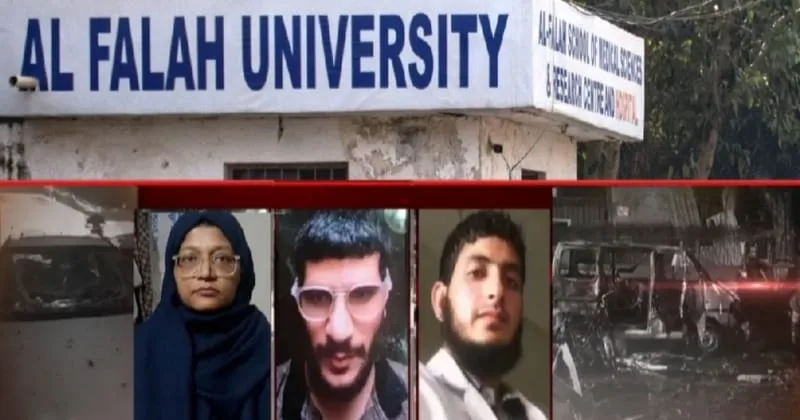
The November 10, 2025, Red Fort blast marked a major turning point. An explosives-laden car killed 12–15 people and injured over 20. Investigations by the National Investigation Agency (NIA) and Delhi Police Special Cell identified Dr Umar ul Nabi, an assistant professor at AFU’s medical college since May 2024, as the suicide bomber.
Subsequent campus raids reportedly recovered electronic devices and coded diaries from hostel rooms linked to medical staff. Authorities also arrested Dr Muzammil Ganaie, a junior resident in general medicine, and Dr Shaheen Saeed, an associate professor of pharmacology, in connection with the probe. Investigators traced the Hyundai i20 used in the blast to the university campus days before the attack.
In January 2026, the Enforcement Directorate filed a chargesheet citing alleged hiring lapses, including appointments made without mandatory police verification, violating National Medical Commission norms. The term “white-collar terror module” entered official discourse as agencies scrutinised professional networks, financial flows, and institutional compliance gaps.
On November 13, 2025, the Delhi Police Crime Branch registered two FIRs against Al-Falah University (AFU), alleging fraudulent claims regarding NAAC accreditation and recognition under Section 12B of the UGC Act, 1956.
NAAC had previously awarded ‘A’ grades to AFU’s constituent schools, Engineering (2013–2018) and Education & Training (2011–2016), but both accreditations lapsed without renewal. In November 2025, NAAC issued a show-cause notice over the display of expired grades, which the university subsequently removed. Investigators allege that such representations were used to attract students and create a false impression of regulatory compliance. AFU currently holds no valid NAAC accreditation.
On November 18, 2025, the Enforcement Directorate arrested AFU’s founder and chairman, Jawed Ahmed Siddiqui, on charges of money laundering. The ED estimates over Rs 415 crore as alleged proceeds of crime, reportedly generated through inflated contracts and financial diversions to companies linked to family members. Income tax data shows voluntary contributions rising from Rs 30.89 crore in FY 2014–15 to Rs 89.28 crore in FY 2022–23.
The ED’s chargesheet also alleges the use of over 70 “on-paper” doctors with minimal attendance to secure approvals from the National Medical Commission, fabrication of hospital patient data, and arranging fake patients through ASHA workers before inspections. Senior administrative approvals allegedly facilitated payments to simulate clinical activity. If proven, these points to systemic manipulation of regulatory frameworks.
Scholarship Funds and Section 12B Status
Despite lacking Section 12B recognition, AFU reportedly received substantial minority scholarships, including over Rs 10 crore in 2016 and Rs 6 crore in 2015 from the Ministry of Minority Affairs, along with Rs 1.10 crore from the All India Council for Technical Education for students from Jammu and Kashmir.
The Al-Falah Charitable Trust, established on 8 September 1995, is headed by Jawed Ahmed Siddiqui, who also serves as Chancellor of Al-Falah University. Other trustees include Mufti Abdullah Qasimi as Vice-Chairman and Mohammad Wajid as Secretary.
Siddiqui maintains connections with nine companies spanning education, finance, software, and energy sectors, many sharing a registered address at Al-Falah House, Jamia Nagar, Okhla. Several of these entities became inactive after 2019. The ED’s “Dead Man Land” case alleges acquisition of over 50 land parcels in Delhi through forged General Powers of Attorney, including some executed in the names of deceased individuals. A 2013 sale deed valued the consolidated transfer at just Rs 75,000 plus demand drafts, figures described by investigators as legally untenable. Siddiqui had previously faced arrest in 2001, and in 2003, the Delhi High Court rejected his bail plea in a separate forgery-linked case.
On January 5 2026, the Haryana State Pollution Control Board ordered the closure and sealing of a construction site on the AFU campus, citing a lack of clearances and exceeding permissible BOD and COD effluent limits. In November 2025, the Association of Indian Universities suspended the university, citing noncompliance with its standards.
As court proceedings continue and investigative agencies file supplementary charge sheets, Al-Falah University faces simultaneous legal, reputational, financial, and administrative turbulence. The case highlights the intersection of higher education governance, national security, financial compliance, and minority rights within India’s constitutional framework.