
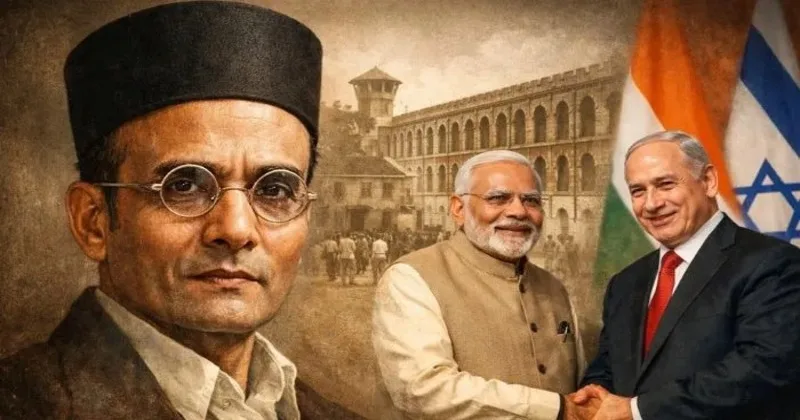
Today marks punyatithi of Swatantryaveer Vinayak Damodar Savarkar, a thinker whose ideas continue to shape debates on nationalism, civilisation and strategic foresight in Bharat. In a striking coincidence of history, Prime Minister Narendra Modi’s state visit to Israel unfolds at a moment when Savarkar’s early writings on Jewish nationhood appear unusually relevant. Long before formal diplomatic ties and decades before Israel emerged as a sovereign state, Savarkar had articulated a vision of civilisational solidarity between Hindus and Jews — two ancient peoples bound by memory, homeland and historical struggle.
For many readers in both Bharat and Israel, Savarkar’s support for Jewish nationhood remains a little-known chapter. Yet as early as 1922–23, in Hindutva: Who is a Hindu?, Savarkar wrote with remarkable clarity about Jewish sovereignty. At a time when the idea of Israel was still uncertain and global leaders hesitated to endorse Zionism openly, Savarkar’s statement revealed both ideological conviction and historical foresight.
Global Context: Zionism, Europe and Savarkar’s Intellectual World
Savarkar’s engagement with the Jewish question did not arise in isolation. The late nineteenth and early twentieth centuries were shaped by profound upheavals in Europe. The Dreyfus Affair in France exposed how deep-rooted anti-Jewish prejudice persisted even within societies that claimed to uphold modern democratic ideals. Around the same period, Theodor Herzl’s Der Judenstaat (“The Jewish State”) articulated the idea of a sovereign homeland for Jews, inspiring the modern Zionist movement.
in London, where Savarkar stayed at India House during his revolutionary years, was one of the major centres of Zionist activism. Though detailed records of his personal interactions remain sparse, his writings suggest that he was deeply aware of Jewish nationalist thought and its intellectual foundations. The parallels he drew between Jewish history and Hindu civilisational identity were not superficial; they reflected an understanding of how dispersed communities sustain cultural memory across centuries.
Savarkar wrote Hindutva during a turbulent period marked by the Khilafat movement and the Malabar Hindu massacre — that profoundly shaped his thinking on national identity and theological politics. Within this broader context, his references to Jews were not incidental. He repeatedly invoked the Jewish experience to explain his ideas of pitrubhumi(fatherland) and punyabhumi(holy land), arguing that the emotional and spiritual connection of a people to their ancestral geography forms the basis of national consciousness.
Fatherland, Holy land and the Jewish Example
Savarkar’s reflections on Jews often centred on the complex relationship between diaspora communities and their ancestral homeland. He observed that Jewish communities scattered across the world had expressed gratitude toward the countries where they prospered, yet their historical and spiritual attachment to Israel remained equally powerful. For him, this duality illustrated how civilisations sustain identity even when geographically dispersed.
He argued that nations are shaped not merely by political arrangements but by shared memories and sacred geography. In this sense, Zionism represented a civilisational movement analogous to his own vision of Hindutva. Savarkar believed that if Hindus were to achieve political sovereignty rooted in cultural identity, the Jewish people’s struggle for a homeland offered a powerful example of resilience and historical continuity.
His writings also reflected a keen awareness of the dilemmas faced by diaspora communities. He raised questions about divided loyalties and the emotional bonds between Jews living in Western countries and the emerging Jewish homeland — questions that, in his view, highlighted the enduring pull of civilisational identity.
Support for Israel’s creation and strategic insight
When the United Nations voted in November 1947 to partition Palestine and create a Jewish state, Savarkar emerged as one of the few prominent Bhartiya leaders to publicly welcome the decision. In a statement issued in December 1947, he described the establishment of Israel as the culmination of centuries of Jewish suffering, sacrifice and perseverance. Drawing upon Biblical imagery, he compared the moment to the story of Moses leading his people to a promised land — a powerful metaphor that underscored his admiration for Jewish resilience.
Savarkar’s statement also revealed his understanding of international politics. He argued that historical justice supported the Jewish claim to their ancestral land and criticised attempts to portray Zionism as illegitimate. In his view, the Jewish presence in Palestine predated Islam by centuries and the creation of Israel represented not only a geopolitical event but a civilisational restoration.
His critique extended to Bharat’s foreign policy under Jawaharlal Nehru, which opposed the partition of Palestine. Savarkar questioned the logic of alienating Israel in pursuit of Arab goodwill, especially when many Arab nations had supported the Muslim League’s demand for Pakistan. He saw Israel as a potential strategic ally in a region marked by ideological conflict and warned that ignoring military preparedness and geopolitical realities could prove costly for Bharat — a prediction that later commentators would revisit in light of subsequent regional conflicts.
Israel as a model of national strength
Savarkar’s engagement with Israel did not end with its creation. Writing in Kesari in 1954, he cited Israel as an example of a nation that emphasised military service, strategic preparedness and domestic arms production. Israel demonstrated, in his view, how a small nation could survive through unity, technological innovation and defence strength.
This emphasis on strategic self-reliance echoed his broader belief that national security must rest on strong armed forces and indigenous capabilities. He repeatedly warned that Bharat needs to learn from such examples, predicting that adversarial alliances could emerge if the nation failed to strengthen its military infrastructure.
From Savarkar’s vision to Modi’s diplomacy
As Prime Minister Modi’s visit to Israel deepens cooperation in defence, technology, agriculture and innovation, the historical echoes of Savarkar’s ideas become striking. Israeli Prime Minister Benjamin Netanyahu’s recent remarks highlighting the civilisational friendship between Bharat and the Jewish people — and his acknowledgment that Jews found refuge in Bharat without persecution — resonate with Savarkar’s belief that the two civilisations share a unique bond.
Savarkar’s writings anticipated a future in which Bharat and Israel would recognise each other not merely as strategic partners but as civilisational allies rooted in ancient traditions and shared experiences of survival. While diplomatic realities have evolved over decades, the intellectual foundation he articulated — one that emphasised cultural identity, historical memory and national resilience — remains relevant in contemporary geopolitics.
Remembering Savarkar on his death anniversary
Sixty years after his passing, Savarkar’s reflections on Zionism offer a window into a lesser-known dimension of Bhartiya political thought. He stands among the earliest leaders who openly supported Jewish nationhood, recognising both its moral legitimacy and strategic potential. Whether viewed through the lens of ideology, history or diplomacy, his writings reveal a thinker who engaged deeply with global currents while rooted firmly in Bhartiya civilisational discourse.
Today, as Bharat and Israel strengthen their partnership on the world stage, remembering Savarkar’s perspective adds historical depth to a relationship often discussed only in contemporary terms. His vision reminds us that the bonds between nations are not forged overnight; they emerge from ideas, experiences and intellectual exchanges that precede formal diplomacy by decades.
On this day of remembrance, Savarkar’s legacy invites readers to revisit a chapter of history where the struggle of one ancient people inspired another — a story of civilisational dialogue that continues to shape the evolving partnership of Bharat and Israel in the twenty-first century.