Speaking the truth, listening to the truth, accepting the truth, and walking on the path of truth form the foundational principles of the Sikh Religion. It is the method of becoming one with the Divine—by walking on the Guru’s path. The Sikh Panth is not the name of a new set of religious rituals or a system of ceremonial worship. It emerged as a human revolution and a moral awakening against a society divided by fear, hatred, caste hierarchy, falsehood, and oppression. The greatest contribution of Guru Nanak Dev Ji to humanity was not the creation of an institution, but a living process that transforms an ordinary human being into a higher moral being—an angelic presence in society.
Guru Nanak Dev Ji did not place God in distant heavens. For him, God is Ik Onkar—fearless and without enmity—dwelling within every human being. The Divine is discovered through inner reflection and by recognising the same divine light in every other human being. In an era marked by violence, inequality, and rigid social divisions, this vision was revolutionary and unprecedented.
“Truth is the medicine for all; it washes away sin.” (Ang 468)
Truth is not merely a moral virtue; it is the remedy for social decay and human suffering. Even today, the solution to the challenges confronting the Sikh Panth lies in understanding truth, reflecting upon it, shaping collective policy around it, and living by it in practice.
The Sikh Religion, at its core, is a journey from human to angelic consciousness. History repeatedly shows how societies lose this path—and the consequences that follow.
One of the most compelling aspects of Sikh history is the transformation of even the most hardened criminals through the teachings of Guru Nanak Dev Ji. Sajjan Thug, who murdered travellers; Bhumia Chor, notorious for dacoity; and Koda Rakshas, feared as a human monster—all were transformed not through fear or punishment, but through inner awakening. Guru Nanak placed a moral mirror before them. They did not see demons, but misguided human beings capable of redemption. This realisation gave birth to repentance, humility, and moral rebirth. They became servants of society and protectors of the innocent. This was the Sikh method: reform, not retribution.
These transformed individuals did not withdraw from society. The Sikh Panth has never advocated renunciation or asceticism. From Guru Hargobind Sahib’s doctrine of Miri-Piri to Guru Gobind Singh Ji’s creation of the Khalsa, the Sikh Religion shaped saint-soldiers—individuals spiritually elevated, morally disciplined, and socially responsible—who stood against tyranny and defended human dignity.
These warriors of conscience were never aggressors. They were defenders of the oppressed, standing against Mughal tyranny, forced religious conversions, and mass violence. The martyrdoms of Guru Arjan Dev Ji and Guru Tegh Bahadur Ji did not weaken the Sikh Panth; they strengthened its moral resolve. Sikh arms were raised not for conquest, but to protect the poor and restrain the tyrant.
The Sikh rule under Baba Banda Singh Bahadur and Maharaja Ranjit Singh stands as one of the most secular and progressive governance models in Indian history. Particularly under Maharaja Ranjit Singh, Muslims, Hindus, and Sikhs occupied high offices; religious freedom was guaranteed; mosques, temples, and gurdwaras were protected; and justice prevailed above sectarian identity. This was not accidental—it was the political manifestation of Guru Nanak’s vision of Halemi Raj and Begampura.
Tragically, this enlightened rule did not collapse due to external invasions alone, but because of internal disunity. The British colonial power did not merely defeat the Sikhs militarily; it systematically attacked the philosophical foundations of the Sikh Panth. Understanding that Sikh strength lay in unity, faith in the Guru, spiritual independence, and ethical clarity, the British deliberately promoted loyalist elites, dismantled the legacy of Maharaja Ranjit Singh, weakened Gurmukhi education, distanced Sikhs from Gurmat, and encouraged ritualism and personality-based religious authority. Gradually, the angelic ideal of Guru Nanak was reduced to ceremony, intermediaries, and institutional power struggles.
Although the British left India in 1947, the mindset of subjugation remained. The Sikh kingdom of Lahore and the legacy of Maharaja Ranjit Singh—including his granddaughter, Princess Bamba—were abandoned without any sustained collective struggle for restoration. Post-Independence, the Sikh Panth suffered further under visionless and self-serving leadership, often aligned with national parties without strategic clarity. Guru Nanak’s universal vision was replaced by narrow identity politics, fear-based mobilization, and a perpetual narrative of insecurity. The result was a collective loss—moral, political, and intellectual.
This vacuum proved disastrous for Sikh youth. Alienated from the core philosophy of the Sikh Religion, sections of youth were exploited by extremist ideologies—Naxalism, separatism, and foreign-sponsored agendas—where anger replaced ethics and violence was projected as religious duty. This was a complete distortion of Gurmat. The Sikh Panth, which has never been anti-Hindu, anti-Muslim, or anti-India, began to be misrepresented. A fundamental question arises: Can an angel be a terrorist?
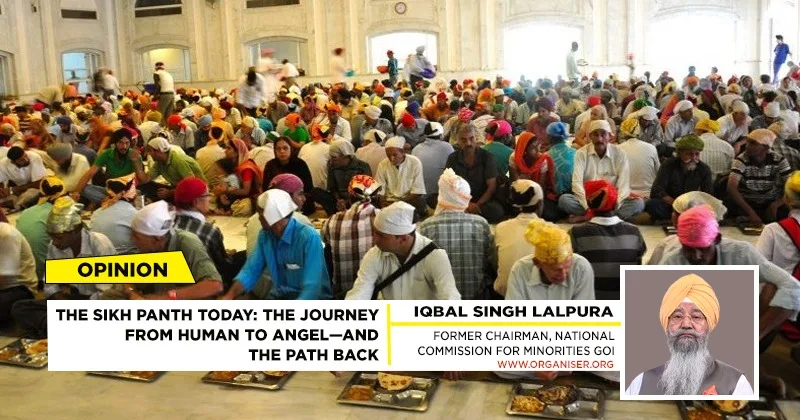
The Sikh Religion rests on two inseparable pillars—Simran and Seva. A gurdwara is not merely a place of ritual worship; it is a social institution dedicated to service, equality, and moral awakening for all humanity. Yet today, Sikh life has been confined largely within gurdwara walls.
In truth, the gurdwara is a community center, langar is a living experiment in equality, kirtan is moral education, and Rehat is disciplined living—not empty ritual. When practice degenerates into ritualism, its soul is lost. The essence of the Sikh Panth has always been liberation from hollow customs. Unfortunately, even the Gurdwara Reform Movement of the 20th century was structurally limited. Today, management battles revolve around power rather than service, while vast national resources remain underutilised for education and authentic propagation.
A return to the original philosophy and moral stature of the Sikh Panth may appear difficult—but it is not impossible. The Gurus have already defined the angelic code of life. If Sajjan Thug could transform, if Koda Rakshas could awaken, there is no reason the Sikh Panth cannot reclaim its ethical and spiritual leadership.
What is required is a renewed connection with Guru Nanak’s philosophy, rejection of fear-based politics, cultivation of ethical leadership, and a conscious effort to reconnect youth with Sikh history and thought. India is sanctified by the footsteps of the Gurus across its length and breadth; faith in this shared civilizational heritage must be restored.
Let us consciously plan the re-emergence of the angelic ideal of the Sikh Religion. Let us silence those who brand Sikhs with the label of terrorism. The Sikh Panth was not born to create victims, but to raise fearless, compassionate, and principled human beings—those who stand against oppression, protect the weak, speak truth, live truthfully, and embody Nirbhau and Nirvair.
The journey from human to angel is Guru Nanak Dev Ji’s greatest gift to humanity. Turning away from it is not destiny—it is deviation. Let us reflect, plan, and move forward with resolve—for humanity, for India, for Guru Nanak’s vision, and for the eternal Chardi Kala of the Sikh Panth.