The Vedic period, the most glorious era of Indian history, was a time when the flow of knowledge based on Vedic verses preached acceptance to the entire world. The right to choose one’s method of worship and way of life according to intellectual freedom was like a democratic system. A society that learned from Vedic verses like “Ekam Sat Vipra Bahudha Vadanti” (Truth is one, the wise call it by many names) welcomed and respected all forms of worship. The Sapta Sindhu region of the Vedic period, which was the centre of Vedic knowledge, guided the entire society towards unity and harmony.
Later, the region that became Punjab was guided by Gurbani, whose foundation was the wisdom of Sri Guru Granth Sahib Ji. The wheel of time continued to turn, but from time to time, spiritual and religious philosophies emerged to awaken and establish harmony in Indian society. The sacred verses of Sri Guru Granth Sahib Ji, “Ek Noor Te Sab Jag Upjya” (From one light, the whole world was created), eliminated all kinds of communal discrimination and established a sense of belonging, thus binding the entire society together.
During the Bhakti movement, while on one hand, Sikhism was gaining acceptance in Punjab, educated by the wisdom of the first Guru of the Guru tradition, Sri Guru Nanak Dev Ji, on the other hand, the Mughal invader Babur was forcibly propagating his religion at the point of the sword and carrying out massacres in the name of religion. Witnessing such widespread atrocities, Indian society, especially Punjabi society, suffered moral damage. In this dark period, Sri Guru Nanak Dev Ji chose the path of social harmony based on spirituality and succeeded. Sri Guru Nanak Dev Ji was the only saint of the Bhakti movement who opposed Babur’s atrocities.
“Khurasan Khasmana Kia Hindustan Daraiya. Aapai Dosu Na Dei Karta Jamu Kari Mugalu Charaiya. Eti Maar Pai Karalane Tain Ki Dard Na Aaiya.” (Khorasan was devastated, Hindustan was terrified. The Creator does not blame Himself, He sent the Mughal as the messenger of death. Such a massacre took place, did you not feel any pain?)
By opposing ideological differences, Guru Nanak Dev Ji also taught Babur a lesson in unity – Awaal allah noor opaya kudtat ke sab bande, Ek noor te sab jag upjaya kon bhale kon mande.
“First, Allah created light, and all beings are His creations; from that one light, the whole world was created, so who is good and who is bad?”
However, a foolish invader like Babur ignored Guru Ji’s words and initiated the dark game of religious conversion, which resulted in ideological differences between the Guru tradition of Punjab and the Mughals, differences that persisted from Guru Nanak Dev Ji and Babur to Guru Gobind Singh Ji and Aurangzeb. Thousands of sacrifices ultimately defeated the Semitic religious forces, but Semitic ideology had already taken root in the soil of Punjab.
History of Forced Conversions
Historical accounts of the 1947 partition of India document widespread incidents of forced conversions, sexual violence, and massacres of Hindus and Sikhs by Muslim mobs in the Rawalpindi division of Punjab province (present-day Pakistan). There are also ongoing reports and concerns regarding alleged forced conversions of minority women in contemporary Pakistan. The violence during the 1947 partition was an early example of ethnic cleansing. Sikh and Hindu men, women, and children faced brutal violence, and many were given the ultimatum to convert to Islam or die. According to eyewitness accounts, in the village of Thoha Khalsa, more than 90 Sikh women committed mass suicide by jumping into a well to escape abduction, rape, and forced conversion by Muslim mobs. Millions of women from all communities (Hindu and Sikh) on both sides of the border were abducted, raped, and forcibly converted and married to their abductors.
In recent years, there have been frequent reports from Pakistan concerning the forced conversion of minor girls and young women from minority communities (including Sikhs and Christians) to Islam. In 2019, the alleged abduction and forced conversion of a Sikh girl in Nankana Sahib, Pakistan, sparked protests among the Sikh community globally and prompted India to take action. Human rights activists say that the lack of strong anti-forced conversion laws in Pakistan, coupled with systemic discrimination and patriarchal social structures, makes minority women and girls particularly vulnerable to abduction, forced marriage, and forced conversion, which are often part of schemes to extort money.
Soft Conversion
The “soft conversion” style employed by European missionaries refers to influencing people through humanitarian aid, education, and healthcare services, rather than directly forcing them to convert. This approach focuses on building trust within the community and gradually integrating the teachings of the European religion into their lives.
The main strategies of “soft conversion” include:
Education and Healthcare: Missionaries establish schools, colleges, and hospitals, particularly for poor and marginalised communities. People are attracted by the better facilities and education offered through these institutions.
Humanitarian Aid and Social Work: Basic necessities, food, clothing, and financial assistance are provided to poor, helpless, and underprivileged communities. Religion is propagated under the guise of social work and aid.
Miracles and Healing Meetings: In some cases, people are attracted by claims of curing illnesses through ‘miracles’ or ‘healing meetings’.
Cultural Inclusion: Elements of local culture are incorporated into the practices of the European religion, such as dramas or hymns about the lives of revered figures, so that the new religion does not seem alien.
Residential Facilities and Aspirational Values: Rural youth are encouraged to live in missionary hostels in cities with the promise of better education and English language courses, where they are also given training in religious texts.
Personal Relationships: Missionaries often live among the communities, share meals with them, and build personal relationships, making it easier to gain their trust.
Drug Abuse
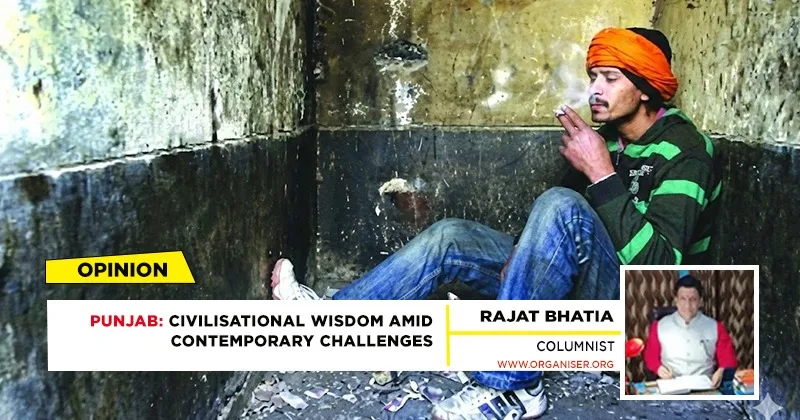
The issue of drug abuse in Punjab is a serious and long-standing problem, often described as an epidemic. The state is a major transit point for drugs, as well as a significant consumer base. This problem affects all sections of society, especially the youth, and factors such as geographical location, unemployment, and alleged political and police corruption are major contributing factors. Previous studies have indicated high rates of substance abuse. A 2015 AIIMS study estimated that there were over 200,000 opioid addicts in the state. A 2022 survey found that 15.4 per cent of Punjab’s population was involved in some form of substance abuse, and 35% of the households surveyed had at least one person suffering from a substance use disorder. The most common drugs are opium-derived products (raw opium, poppy husk, and heroin), followed by pharmaceutical drugs. Heroin, locally known as “chitta,” remains popular despite its high price. Synthetic drugs like crystal methamphetamine have also entered the market. The problem is widespread among young adults aged 15-35 years. While men are the primary consumers, the number of women involved in drug trafficking and abuse is also increasing. High unemployment, economic stagnation, peer pressure, and a historical/cultural tolerance for certain substances (such as opium and alcohol) are major contributing factors. The illicit trade also fuels other crimes such as theft, robbery, and snatching to finance expensive habits.
Punjab’s geographical location near the “Golden Crescent” (Afghanistan, Pakistan, Iran) makes it a vulnerable entry point for drugs smuggled across the Indo-Pakistan border, often using methods such as drones, tunnels, or concealing them in agricultural equipment.
Both the central and state governments have launched various initiatives to tackle the crisis, focusing on law enforcement and treatment-prevention. There has been an increase in arrests of traffickers and dealers, and a rise in the seizure of drugs and drones used in smuggling. However, allegations of corruption and the involvement of police and politicians in the drug trade persist. The government operates de-addiction centers and runs programs such as the “Drug-Free India Campaign” and “Buddy Program” in schools to raise awareness. However, treatment facilities still have significant shortcomings, and many centers lack resources.
Community-driven efforts, such as “Stop Drugs” committees and anti-drug marches organized by the governor, have also emerged. Despite these efforts, the problem remains a major challenge, with recent reports indicating a significant increase in drug-related police cases and a high number of deaths due to substance abuse.
Migration
Punjab is experiencing a very high rate of international emigration, creating a situation of dual migration. Major destinations for migrants within Punjab include Ludhiana, Jalandhar, and Amritsar. The reasons for this migration include a lack of jobs in the states of origin, poverty, and the desire for better living conditions.
Notably, there is also an increase in the Muslim population of Bangladeshi origin and the appearance of new mosques in the landscape.
Punjab, the ‘sword arm’ of India, which has ideologically and valiantly protected Indian society, is now caught in foreign machinations, causing immense damage to Punjabiyat (the soul of Punjabi society). The Punjabi society is being radicalized on ideological and religious grounds, contrary to its inherent nature, thus undermining social harmony. A section of the society that follows the principle of unity inspired by ‘Ek Onkar’ has now become a supporter of separatist ideology, which is completely contrary to the wisdom of Gurbani. At such a time, the wisdom of Gurbani and Vedic knowledge can guide Punjab in the right direction so that Punjab can become prosperous once again.