Ranjit Singh Birth Anniversary: Honouring the Lion of Punjab
June 12, 2026
  • Read Ecopy
  • Circulation
  • Advertise
  • Careers
  • About Us
  • Contact Us
Android AppiPhone AppArattai
Organiser
  • ‌
  • Bharat
    • Assam
    • Bihar
    • Chhattisgarh
    • Jharkhand
    • Maharashtra
    • View All States
  • World
    • Asia
    • Europe
    • North America
    • South America
    • Africa
    • Australia
  • Editorial
  • International
  • Opinion
  • RSS @ 100
  • More
    • Op Sindoor
    • Analysis
    • Sports
    • Defence
    • Politics
    • Business
    • Economy
    • Culture
    • Special Report
    • Sci & Tech
    • Entertainment
    • G20
    • Azadi Ka Amrit Mahotsav
    • Vocal4Local
    • Web Stories
    • Education
    • Employment
    • Books
    • Interviews
    • Travel
    • Law
    • Health
    • Obituary
  • Subscribe
    • Subscribe Print Edition
    • Subscribe Ecopy
    • Read Ecopy
  • ‌
  • Bharat
    • Assam
    • Bihar
    • Chhattisgarh
    • Jharkhand
    • Maharashtra
    • View All States
  • World
    • Asia
    • Europe
    • North America
    • South America
    • Africa
    • Australia
  • Editorial
  • International
  • Opinion
  • RSS @ 100
  • More
    • Op Sindoor
    • Analysis
    • Sports
    • Defence
    • Politics
    • Business
    • Economy
    • Culture
    • Special Report
    • Sci & Tech
    • Entertainment
    • G20
    • Azadi Ka Amrit Mahotsav
    • Vocal4Local
    • Web Stories
    • Education
    • Employment
    • Books
    • Interviews
    • Travel
    • Law
    • Health
    • Obituary
  • Subscribe
    • Subscribe Print Edition
    • Subscribe Ecopy
    • Read Ecopy
Organiser
  • Home
  • Bharat
  • World
  • Operation Sindoor
  • Editorial
  • Analysis
  • Opinion
  • Culture
  • Defence
  • International Edition
  • RSS @ 100
  • Magazine
  • Read Ecopy
Home Bharat

Maharaja Ranjit Singh Birth Anniversary: The lion of Punjab who forged a fearless & united Bharatiya empire

On Maharaja Ranjit Singh’s birth anniversary, the nation remembers the visionary ruler who united Punjab and built one of the strongest indigenous empires of Bharat. Known as the ‘Lion of Punjab,’ his reign symbolised courage, secular governance, and resistance against foreign domination

WEBDESKWEBDESK
Nov 13, 2025, 01:40 pm IST
in Bharat
Follow on Google News
FacebookTwitterWhatsAppTelegramEmail

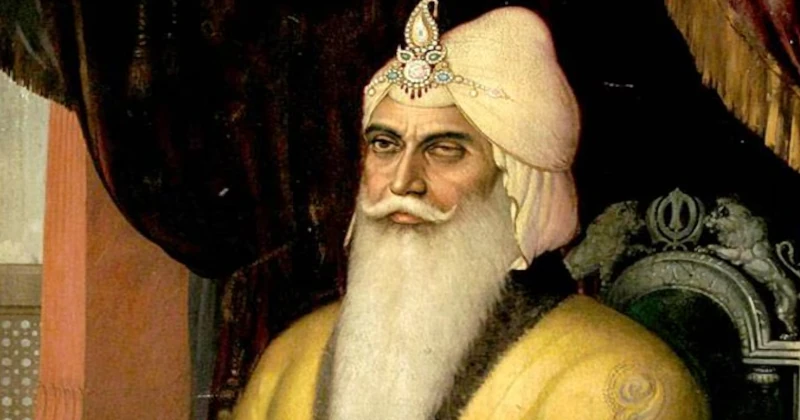
Maharaja Ranjit Singh, the legendary “Sher-e-Punjab” (Lion of Punjab), was born a man who rose from a small Sikh confederacy in Gujranwala to forge one of the most formidable empires of the 19th century. Revered as a unifier, reformer, and warrior-king, Ranjit Singh transformed a land torn by internal conflicts and foreign invasions into a powerful, secular, and prosperous Sikh Empire one that stood as a bulwark against Afghan incursions and a crucial ally of the British in India.

Born on November 13, 1780, to Sardar Maha Singh and Raj Kaur of the Sandhawalia Jat Sikh family, Ranjit Singh’s early life was marked by struggle and resilience. He survived smallpox as an infant but lost vision in his left eye. By the age of 10, he was already fighting alongside his father; by 12, he was leading armies; and by 21, he was proclaimed the Maharaja of Punjab.

Ranjit Singh inherited the leadership of the Sukerchakia Misl, one of the 14 Sikh confederacies (misls) that dominated Punjab after the decline of the Mughal Empire. Amidst a fractured landscape of constant wars between Sikh, Muslim, and Afghan rulers, he emerged as a master strategist who united the Sikh misls under a single banner a monumental achievement in an era of political fragmentation.

At 17, Ranjit Singh’s leadership shone when he repelled the Afghan ruler Shah Zaman’s invasion of Punjab in 1797–98. His decisive victory at the Battle of Amritsar (1798) turned him into the de facto protector of the region. When Afghan armies attempted another invasion, Ranjit Singh used a mix of guerrilla tactics, scorched-earth strategies, and psychological warfare to force them back across the Khyber.

In 1801, at the age of 21, Ranjit Singh declared himself Maharaja of Punjab in a ceremony sanctified by Baba Sahib Singh Bedi, a descendant of Guru Nanak. He minted new “Nanakshahi” coins in honour of the Sikh Gurus, symbolising both spiritual and political sovereignty.

Before Ranjit Singh’s rise, Punjab was divided among 12 Sikh misls, a few Muslim chiefs, and British interests hovering around the Sutlej River. Through a blend of military skill and diplomacy, he annexed Amritsar (1802) from the Bhangi misl, Kasur (1807) from Afghan chiefs, and later Multan (1818) and Kashmir (1819) from Afghan control.

His conquests culminated in the Battle of Shopian (1819), where he defeated Afghan rulers to bring Kashmir and the Jhelum Valley under the Sikh flag. In 1837, his forces clashed with Afghans at the Battle of Jamrud, defining the western boundaries of the Sikh Empire.

Under his command, Punjab stretched from the Khyber Pass to the Sutlej, and from the Himalayas to Multan a domain larger than most princely states of India combined.

Ranjit Singh’s diplomatic brilliance matched his battlefield acumen. In 1809, he signed the Treaty of Amritsar (Minto-Metcalfe Treaty) with the British East India Company, agreeing to restrict his forces north of the Sutlej in return for British non-interference. The treaty allowed him to focus his energies on the northwest, capturing Peshawar and Kashmir without facing British intervention.

Rather than confrontation, Ranjit Singh pursued a calculated coexistence with the British a rare act of strategic foresight that preserved Punjab’s sovereignty for decades.

Ranjit Singh’s court known as the Darbar Khalsa reflected the pluralistic ethos of India. His administration was a model of secular governance:

  • Dhian Singh, a Hindu Rajput, served as his Prime Minister.
  • Fakir Azizuddin, a Muslim, was his Foreign Minister.
  • Dina Nath, another Hindu, managed the treasury.

Ranjit Singh’s rule saw no forced conversions, no communal discrimination, and complete freedom of faith. He rebuilt the Harmandir Sahib (Golden Temple) in Amritsar with gold and marble, and also patronised Hindu temples and mosques, including the Mai Moran Masjid.

His reign became an era of artistic and architectural revival. The Maharaja’s generosity extended far beyond Punjab in 1839, he donated the famed Koh-i-Noor diamond (received from Afghan ruler Shuja Shah Durrani) to the Jagannath Temple in Puri, Odisha, symbolising his deep respect for India’s spiritual heritage.

The Maharaja’s Khalsa Army was one of the most formidable in Asia, integrating Sikhs, Hindus, Muslims, and Europeans. French generals like Jean-Baptiste Ventura and Jean-François Allard were brought in to modernise training, artillery, and strategy along Napoleonic lines.

Also Read: J&K: DGP orders attachment of Pakistani agent Mian Abdul Qayoom’s Srinagar property for aiding Hizbul Mujahideen

He transformed a loosely organised warrior militia into a disciplined modern army. His artillery known as the “Fauj-i-Khas”, was feared across Central Asia. Soldiers were paid from the royal treasury, not from local taxes, ensuring loyalty and professionalism.

Ranjit Singh’s administration embodied fairness and discipline. He abolished corrupt tax farming, introduced uniform civil justice, and promoted public works, roads, and trade routes. He strengthened fortifications across Punjab and invested in irrigation and agricultural infrastructure.

Though he did not reform the Jagir (land revenue) system a factor that later contributed to instability after his death his governance laid the foundation for one of the most prosperous regions of pre-colonial India.

Maharaja Ranjit Singh passed away on June 27, 1839, at the age of 58, leaving behind a powerful yet fragile empire. Without his unifying leadership, Punjab’s political elite fragmented. His son, Duleep Singh, ascended the throne with Rani Jindan as regent, but internal factionalism and British interference led to the Anglo-Sikh Wars (1845–1849), ending in the annexation of Punjab by the British Empire.

Yet, even in decline, the Sikh Empire under Ranjit Singh remains one of India’s most remarkable historical models of secular power, military might, and cultural unity.


Topics: Ranjit Singh Birth AnniversarySikh EmpireSikh FamilyLion of PunjabMaharaja Ranjit Singh
ShareTweetSendShareSend
✮ Subscribe Organiser YouTube Channel. ✮
✮ Join Organiser's WhatsApp channel for Nationalist views beyond the news. ✮
Previous News

Al-Falah University Founder Jawad Ahmad’s shady past exposed; Medical college involved in terror activities

Next News

Australia warns of intensifying Chinese cyber threat to critical infrastructure

Related News

The Sikh Panth Today: The journey from human to angel—and the path back

Colonial Mindset: The unfinished chapter of India’s freedom

Maharaja Ranjit Singh

Death anniversary of Maharaja Ranjit Singh: Sikh Emperor who kept British at bay during four decades of his rule

Maharaja Hari Singh, a true patriotic Indian, betrayed by Nehru

A tribute to Maharaja Hari Singh, a true patriotic Indian, betrayed by Nehru to prop up Sheikh Abdullah

Canada: Statue of Maharaja Ranjit Singh defaced in Brampton; Sikh leaders express outrage

Maharaja Ranjit Singh Ji

Remembering Sher-e-Punjab Maharaja Ranjit Singh on his death anniversary – Know about this great legend

Load More

Latest News

RBI revokes registration of 135 NBFCs over regulatory violations; 125 financial entities were from West Bengal

Prime Minister Narendra Modi

Even the US bows to PM Modi’s long-standing leadership!

A representative image

A Decade of Revolution: 25 crore out of poverty, 15.8 crore homes with tap water – How Govt schemes changed lives

India–Myanmar Civilisational Connect: Significance of President U Min Aung Hlaing’s visit to India

French President Emmanuel Macron and Prime Minister Narendra Modi(File Photo)

India-France Rafale Deal: Paris backs Make-in-India; Assures tech transfer & weapon integration ahead of PM Modi visit

Representative Image

From Undersea Titans to Unstoppable Missiles: How Bharat became an invincible nuclear superpower

(Left) French President Emmanuel Macron (Right) PM Narendra Modi

PM Modi, Macron to launch India Innovates 2026: Why the France conclave is key for deep-tech start-ups

Keralam: After Munambam, Waqf Board moves to reclaim 634 acres in Kannur’s Taliparambu

Established in 1986, the Bharat Hindu Samaj temple serves as a major centre of worship for Hindus from Cambridgeshire, Norfolk, Lincolnshire and Leicestershire

UK Hindu mandir challenges council’s sale of 40-year-old worship site to Islamic organisation, calls decision unlawful

Arrested Bangladeshi national Mumtaz Begum with fake details.

Keralam ATS arrests Bangladeshi national Mumtaz Begum; fake Aadhaar network through Akshaya centres under investigation

Load More
  • Privacy
  • Terms
  • Cookie Policy
  • Refund and Cancellation
  • Delivery and Shipping

© Bharat Prakashan (Delhi) Limited.
Tech-enabled by Ananthapuri Technologies

  • Home
  • Search Organiser
  • Bharat
    • Assam
    • Bihar
    • Chhattisgarh
    • Jharkhand
    • Maharashtra
    • View All States
  • World
    • Asia
    • Africa
    • North America
    • South America
    • Europe
    • Australia
  • Editorial
  • Operation Sindoor
  • Opinion
  • Analysis
  • Defence
  • Culture
  • Sports
  • Business
  • RSS @ 100
  • Entertainment
  • More ..
    • Sci & Tech
    • Vocal4Local
    • Special Report
    • Education
    • Employment
    • Books
    • Interviews
    • Travel
    • Health
    • Politics
    • Law
    • Economy
    • Obituary
  • Subscribe Magazine
  • Read Ecopy
  • Advertise
  • Circulation
  • Careers
  • About Us
  • Contact Us
  • Policies & Terms
    • Privacy Policy
    • Cookie Policy
    • Refund and Cancellation
    • Terms of Use

© Bharat Prakashan (Delhi) Limited.
Tech-enabled by Ananthapuri Technologies