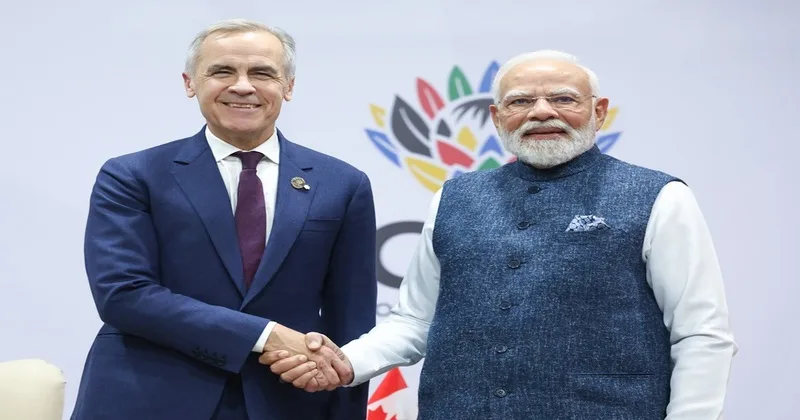
Canada has espoused a major diplomatic reshuffle with India and has officially declared that India is not linked to any violent crimes committed in the country. This statement is considered as a pivotal strategic course correction, in the path of recalibrating the bilateral ties with India. With this statement, Ottawa has rectified the diplomatic errors and misdeeds committed during the era of Former Prime Minister Justin Trudeau and a new chapter has been carved in India-Canada bilateral relations, ahead of Prime Minister Mark Carney visit to India.
A senior Canadian official from the Mark Carney government has ascertained that Ottawa is no longer worried about interference or repression by the Indian officials or agents in Canadian soil. The Carney government is accelerating for a major diplomatic revamp and reset of the strategic relations with India which had hit rock bottom during the Justin Trudeau government over the killing of Khalistani activist Hardeep Singh Nijjar, who was declared as a terrorist by the Indian government in 2020. Trudeau had alleged that Indian government officials and agents had involved in the killing of the Khalistani activist. However, this allegation was baseless and could not be proved by the then Canadian government.
The senior officials from the Mark Carney cabinet were holding a media briefing ahead of the Prime Minister visit to India. During the briefing, the officials confirmed that the dark clouds encompassing the India-Canada relations have been diluted and Ottawa and New Delhi are prepared to recalibrate the relations for bilateral benefit. Drastic progress has been championed in the security and defence relations. On these lines, recently India and Canada inked a security agreement during the visit of National Security Advisor(NSA) Ajit Doval to Ottawa.
As per the agreement, India and Canada have agreed to cooperate to strengthen the national security architecture and counter Khalistan or other extremist threats that are a prickle on the cordial bilateral relations. NSA Ajit Doval and his Canadian counterpart have agreed to appoint law enforcement liaison officers who are exclusively aimed at handling mutual security concerns, ensure swift information exchange on transnational extremism & other organised crimes and ultimately leverage diplomatic trust. “I really don’t think we’d be taking this trip if we thought these kinds of activities were continuing”, a senior Canadian official stated ahead of PM Carney’s visit to India.
PM Carney visit & importance for India in Canada’s geopolitical calculus
Canadian Prime Minister Mark Carney is set to visit India from February 27 to March 2. India is the first stop over among the 3 nation visits of the Canadian Prime Minister that also includes Japan and Australia. Under the PM Carney administration, Ottawa is embarking on a major diplomatic reshuffle with India. A series of diplomatic exchanges have been witnessed between New Delhi and Ottawa to reset the ties, including the latest security agreement. This reset escalated post the steep diplomatic crisis witnessed during the Trudeau regime over baseless allegations towards the killing of Khalistani activists that saw even the expulsion of High Commissioners from both the capitals.
The latest bilateral reconfiguration initiated by Ottawa also testifies the importance ascertained by Canada towards India in its foreign policy playbook. Amid spiking trade, tariff and other geopolitical uncertainties, Canada deems India as a credible, trusted and resilient strategic partner to navigate across the chaotic landscape. One of the major outcomes anticipated during the meeting between Prime Minister Narendra Modi and his Canadian counterpart is the official commencement of the FTA negotiations between New Delhi and Ottawa.
An FTA with Canada is the latest among the series of trade deals sealed by India lately, including European Union, USA etc. Currently, India-Canada bilateral trade stands at USD 7.8 billion and India enjoys surplus balance of trade by exporting goods worth USD 4.5 billion. This includes pharmaceuticals, gems & jewellery, automobile parts etc. During PM Carney visit, agreements are also expected on agriculture cooperation, clean energy, critical minerals etc. with the aim of strengthening the global supply chain against any political or economic shocks.
Most importantly, an agreement will be signed regarding transfer of uranium from Canada to India. Canada has a rich repository of the strategic mineral of Uranium. Purchasing this could yield India’s ambitions towards nuclear power projects, which is indeed a goal towards nourishing clean energy paradigm. On the other hand, by exporting uranium to India, Canada will gain a large and credible market for its resources. Thus, India and Canada will herald a new and renewed phase of strategic relations during PM Carney visit, to march beyond the challenges posed by the volatilities of the geopolitical landscape.