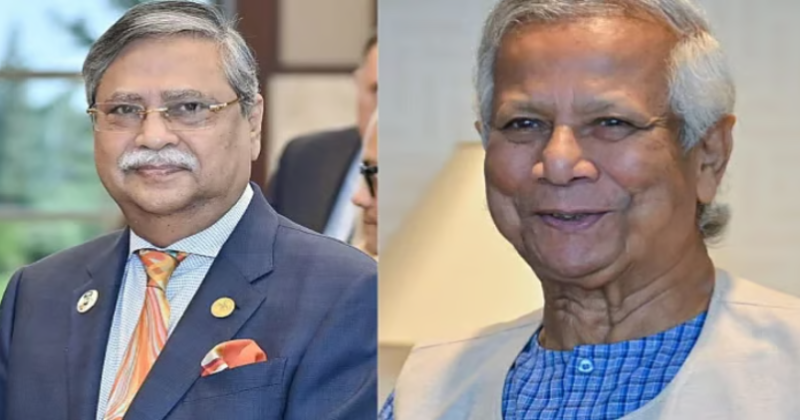
The President of Bangladesh Mohammed Shahabuddin, while speaking to a private media platform of Bangladesh, enumerated the political misdeeds and atrocities of Muhammad Yunus, the Chief Advisor of the interim government, who was apparently at the helm of Dhaka since the ouster of the Sheikh Hasina regime by a massive student uprising in August 2024. President Mohammed Shahabuddin exclaimed that Yunus violated the constitutional norms and completely sidelined the President. No critical state matters were updated to the President and was completely isolated during the interim regime.
Muhammad Yunus, during the interim administration also attempted to curtail the role and importance of the President in the political landscape of Bangladesh, the President added while giving an interview to the Bengali daily Kaler Kantho. Muhammad Yunus being a Chief Advisor did not accord any institutional respect to the constitutional positions. As the Chief Advisor and head of the interim government, Yunus did not keep the President updated and informed about key developments in the state including foreign visits, agreements signed, policy decisions taken etc. “Repeated attempts were made to politically and administratively isolate me”, said the President of Bangladesh.
“The constitution says that whenever he goes on a foreign visit, he must meet the President after returning and inform me in writing about the discussions and outcomes. He travelled abroad 14 to 15 times but did not inform me even once. I knew nothing about it. Such a state agreement must be communicated to the President. That is a constitutional obligation. But he neither informed me verbally nor in writing”, the President exclaimed.
The President of Bangladesh initiated the process of the formation of the interim government of Bangladesh and appointed Muhammad Yunus as the Chief Advisor, post the dethrone of Sheikh Hasina regime. However, later Yunus isolated and neglected the very President of the country who authorised his appointment, said President Mohammed Shahabuddin. “I was the source of the process through which he became chief adviser, yet he never coordinated with me. He did not come to see me even once and tried to keep me completely in the dark”, the President asserted.
“A letter was prepared saying I was extremely busy with state work and therefore could not attend. No discussion was held with me before preparing it. Does a President remain that busy under our constitution?”, questioned President Mohammed Shahabuddin referring to the official invitations received from Kosovo and Qatar. Yunus drafted the letter without consulting the President. “They did not want my name to appear anywhere. They tried to keep me in darkness so that people would not know or recognise me”, the President stated while claiming how his name and attendance was deliberately thwarted from university convocations and other important national events, which was traditionally presided by the President/Head of the State.
Presidents photographs were deleted and attempt to remove from office
During the interview, Bangladesh President Mohammed Shahabuddin reiterated that in one of the instances the photograph of the President was removed from the Bangladeshi missions abroad after an official objected to it. “Across the world, embassies and high commissions display the President’s photograph because the President represents the state. That long-standing tradition ended overnight. Perhaps the first step toward removing me”, the President said.
The President also explained how press freedom was curbed under the Yunus regime. The Press Secretary, Deputy Press Secretary and the Assistant Press Secretary were removed from the position for political reasons. In a major assertion, the President also said that, during Yunus rule, there was also an attempt to remove him through unconstitutional means and instil former Chief Justice in the President position. Ultimately, the President of Bangladesh reiterated that despite all the political atrocities and misdeeds he will strive to preserve constitutional continuity and political order in the country.