
Journalism hinges on public trust—one that demands accuracy, context, and impartiality. Their role is not only to divulge information but also to distinguish fact from whimsy and bias, causation from coincidence, and accountability from narrative convenience. As soon as these distinctions blur, journalism risks becoming a substitute courtroom in which insinuation becomes judgement.
The first warning sign is tone. When reporting depicts a political leader as embittered, “vindictive”, infers about the leader’s character and intent, and uses the picture to foretell a nation’s political trajectory, it reads more like an adjudication than reporting. Such a style of journalism is not grounded in verifiable facts; rather, it relies on conclusions drawn with a predisposed motive, in which readers are directed to interpret any new information as corroboration of an already formed verdict. This is how trial by media happens through moralistic language.
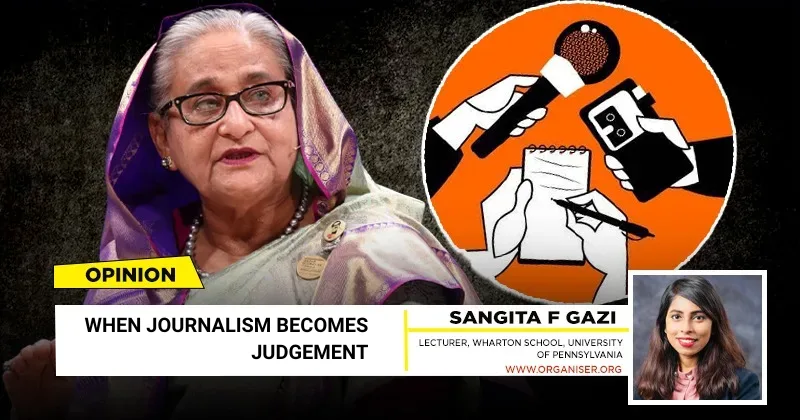
The recent Netra News article on Sheikh Hasina exemplifies this problem. This article examines Hasina’s alleged off-stage speaking as a primary catalyst for the present crisis in Bangladesh, analysing a series of audio recordings attributed to her and contrasting them with her public interviews aimed at international audiences. The narrative pivots on a series of inflammatory statements, such as “eye for an eye,” “guerrilla warfare,” and “revenge,” which they tried to connect with selected violent incidents. The article insinuates that the alleged call from Sheikh Hasina “renewed” political turmoil, and even that there are “signs her wishes were fulfilled.” Yet, at no point does it prove one begets the other.
One cannot help but wonder about the methodological choice the journalistic piece resorted to in preparing and executing this report. Since August 2024, Sheikh Hasina has been making regular public statements to the victims and their families through the official Facebook and YouTube accounts of the Awami League. Her thirty interviews also appeared on various international news platforms. However, all official and easily available statements are exempted, and the few audio recordings of questionable authenticity are emphasised.
Moreover, rather than maintaining a clear distinction between correlation and causation, the text jumps from the proximity of the dates to a very strong statement of causation based on intuition and uses the dates in a way that has nothing to do with evidence of transmission, organisation, or command. A disputed set of recordings is given the status of a master key in unlocking a very complex crisis scenario, while rival explanations and facts are pushed into the background. From a journalistic standpoint, basing the character and intent of a political leader on a limited, disputed set of recordings while omitting publicly available information is questionable.
Netra News article on Sheikh Hasina
The broader political environment is inconvenient for a simple “Hasina speaks, Awami League kills” narrative. Despite Netra’s visible attempt to portray the Awami League as the agent of violence, the reality speaks the opposite. Since the fall of Sheikh Hasina’s government, the interim government has established an explicit policy of immunity for those who made the uprising successful, despite their explicit confession to killing police officers and destroying public properties. The indemnity policy solidified a version of “victor’s justice” that is inherently inconsistent with the principle of equality of accountability before the law. At the same time, a broader policy of political repression is underway against leaders, activists, and alleged supporters of the Awami League and affiliated wings through police arrests, murders, lynching and numerous mob attacks that seem tolerated, or even assisted, by the state, and custodial deaths.
Two different issues: Authenticity and Agency
The article conflates two different issues: authenticity and agency. With regard to the first, it quotes forensic analysis conducted by the Tech Global Institute, which concludes that there is no conclusive evidence of AI editing and that the overwhelming majority of recordings likely contain Hasina’s voice. But “probably genuine” is not the same as “causally decisive.” This would require proof that certain individuals received such messages and interpreted them as operational mandates rather than as statements of anger and grievance. None of this is demonstrated.
Regarding the element of agency, the article omits the contemporaneous realities that complicate the simple “Hasina Speaks: Awami League Kills” narrative: the widespread burning and looting of Awami League offices, the destruction of the historic site of Bangabandhu Sheikh Mujibar Rahman’s residence on Dhanmondi 32, and continuing human rights abuses against party members and activists. At a governmental level, missions such as “Operation Devil Hunt” and “Operation Devil Hunt 2.0” have primarily focused on Awami League politicians and activists, with the interim government hinting at an arrest even when there are no charges against the person. In practice, even individuals, including academics, economists, journalists, and former bureaucrats, merely labelled as Awami League sympathisers, have been jailed and charged under terrorism statutes.
Even when individuals are not arrested, their civil, political, and socio-economic rights can still be stripped away. Students affiliated with the Bangladesh Student League (BSL)—the student organisation of the Awami League—often face indiscriminate criminal charges and campus entry bans, preventing them from attending classes or taking examinations. In many instances, their academic certificates are revoked.
The street political scenario in Bangladesh also paints a quite different picture. Unlike students and activists who claimed to be stakeholders in the July uprising and occupied the streets, there is no clear pattern of sustained, organised street clashes initiated by the Awami League. So far, only a small procession by a few members has been observed, and there is no convincing evidence of a centrally directed campaign of retaliation.
These events complicate the idea of a one-directional chain in which Hasina speaks, and her supporters act in a coordinated, violent bloc. They suggest instead a fragmented conflict in which Awami League infrastructure and rank-and-file members are often targets rather than agents. In any serious effort to connect the alleged recordings to acts of violence, it is necessary to account for this imbalance and to ask why the base of the would-be instigator is so much more likely to be the object of repression than the subject of retribution.
Moreover, phrases like “as these calls spread, Bangladesh slid into renewed turmoil” simplify complex events into a single narrative, connected only by time. In this narrative style, the overlapping timelines often lead to assumptions about moral and political responsibility without providing evidence of the underlying organisational pathways or command structures.
Netra’s treatment of the transcripts raises questions
In the ordeal of depicting a visceral image of Sheikh Hasina, Netra’s treatment of the transcripts raises questions. Netra admits its reliance on automated transcription and translation software, which “may contain errors” and does not necessarily translate to human-translated versions. However, the article arrives at conclusions about Hasina’s intentions and orders to commit violence on the basis of the mediated transcript. Ambiguous and noisy data are treated as an exact transcript of criminal intentions.
This literalism also applies to the parsing of statements made by Hasina and her son, Sajeeb Wazed Joy. Joy’s remarks that a boycott of the Awami League in electoral politics would “lead to more bloodshed” or that a failed state could follow in Bangladesh are represented as a call to create chaos. In terms of the broader meaning of the statement, it can clearly be seen as a high-level political prediction—that a challenge to a major party will destabilise the state—rather than a promise to create unrest.
The same holds for Hasina’s “license to kill”, saying, which is stated in the context of dealing with hundreds of murder cases. In a political system in which the filing of criminal charges against political opponents is a recognised modus operandi, the saying is laced with bitter irony in regard to the assignment of the murder label by virtue of an accusation. This irony is transformed into a virtual boast by Netra.
The most pressing question is Netra’s neutrality. Honest journalism always requires the projection of a complete and balanced picture of the nation, without any pre-judgement and moral bias. However, since August 2024, Netra has failed to publish even a single report regarding the systemic persecution, indiscriminate police arrest, denial of bail, custodial deaths, and human rights abuses involving the members of the Awami League and its affiliates.
This is not an argument against scrutiny. Leaders should be held accountable for troubling speech, public or private. However, responsible journalism must resist simplistic narratives and convenient methodological choice, especially amid messy, violent, and deeply unequal realities—where an entire political party is marginalised, silenced, and subjected to widespread violence. The most responsible journalism in such moments does not ask, “Whose words can we blame?” It asks, “What structures enabled this, who holds power now, and who is paying the price?” Anything less risks confusing narrative coherence with truth and judgement with evidence. Such journalism perpetuates cycles of political retribution, undermining Bangladesh’s stability and prospects for a sustainable democratic transition.
[Sangita F Gazi is a Lecturer at the Wharton School, University of Pennsylvania and a Transatlantic Technology Law Fellow at Stanford Law School. Previously, Sangita was an Assistant Legal Advisor at the US Department of Justice-OPDAT at the US Embassy in Dhaka. Views expressed are solely those of the author.]