

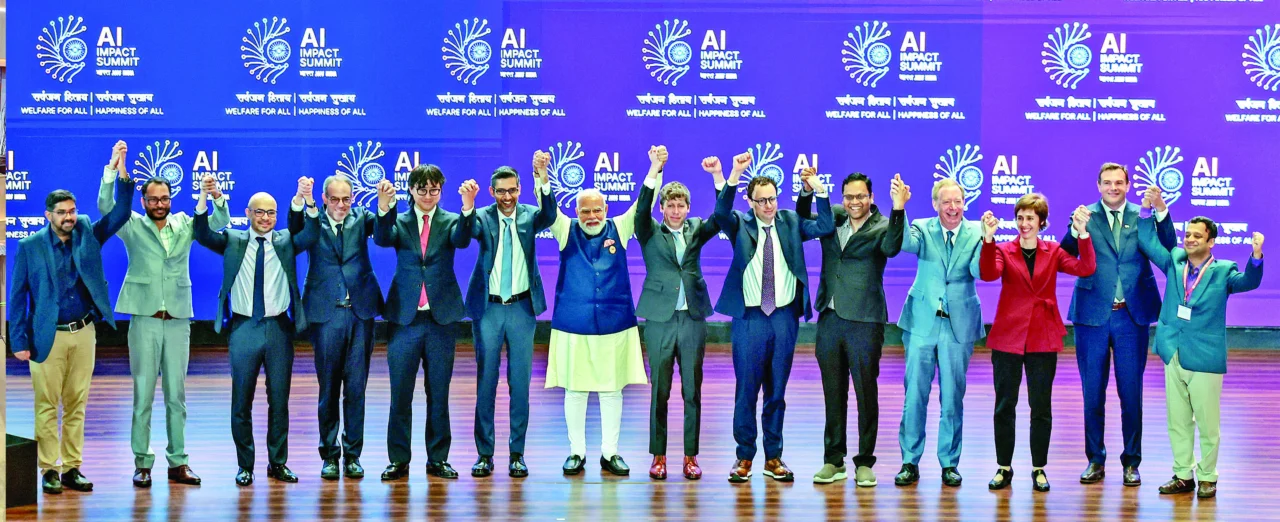
“In human history, every few centuries, a decisive turning point arrives. That turning point does not merely mark time—it resets the direction of civilisation. The pace of progress changes, and the paradigms of thinking, understanding, and working are transformed. What is fascinating is that when we stand in the middle of such transformation, we often fail to grasp its true impact,” said Prime Minister Narendra Modi on February 19 while inaugurating the India AI Impact Summit 2026 at Bharat Mandapam in New Delhi, which was organised from February 16 to February 20.
Addressing the gathering on the occasion, PM Modi said that when language was first written, no one foresaw that written knowledge would become the backbone of future systems. When Guglielmo Marconi first transmitted wireless signals, few could have imagined that one day the entire world would be connected in real time. Artificial Intelligence is a similar transformative chapter in human history. What we see today—what we predict today—is only an early signal of its true impact. AI is not just making machines intelligent; it is exponentially expanding human capability. The difference this time is that both the speed and the scale of transformation are unprecedented.”
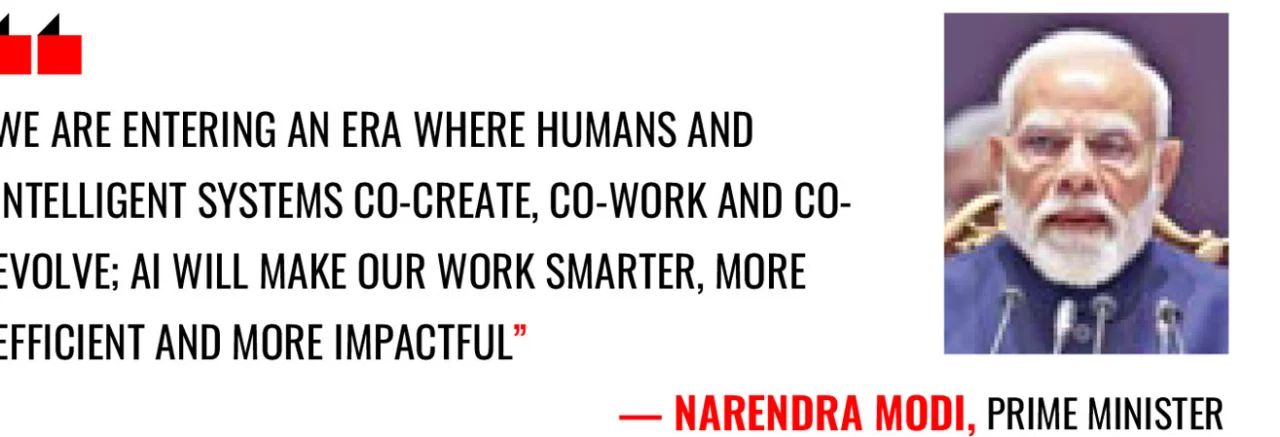
“We are entering an era where humans and intelligent systems co-create, co-work and co-evolve; AI will make our work smarter, more efficient and more impactful,” said PM Modi.
PM’S ‘MANAV’ Vision For AI
To promote a human-centric approach to AI, the Prime Minister presented the MANAV framework:
● M-Moral and Ethical Systems: Ethical considerations and moral responsibility should guide AI systems
● A-Accountable: Governance must ensure accountability with transparent rules and oversight
● N- National Sovereignty: Data generated within a country should belong to that nation and remain under its jurisdiction
● A- Accessible and Inclusive: AI systems should be accessible to all sections, and they should be a multiplier, not a monopoly
● V – Valid and Legitimate: AI must be lawful, reliable, and verifiable under the rule of law
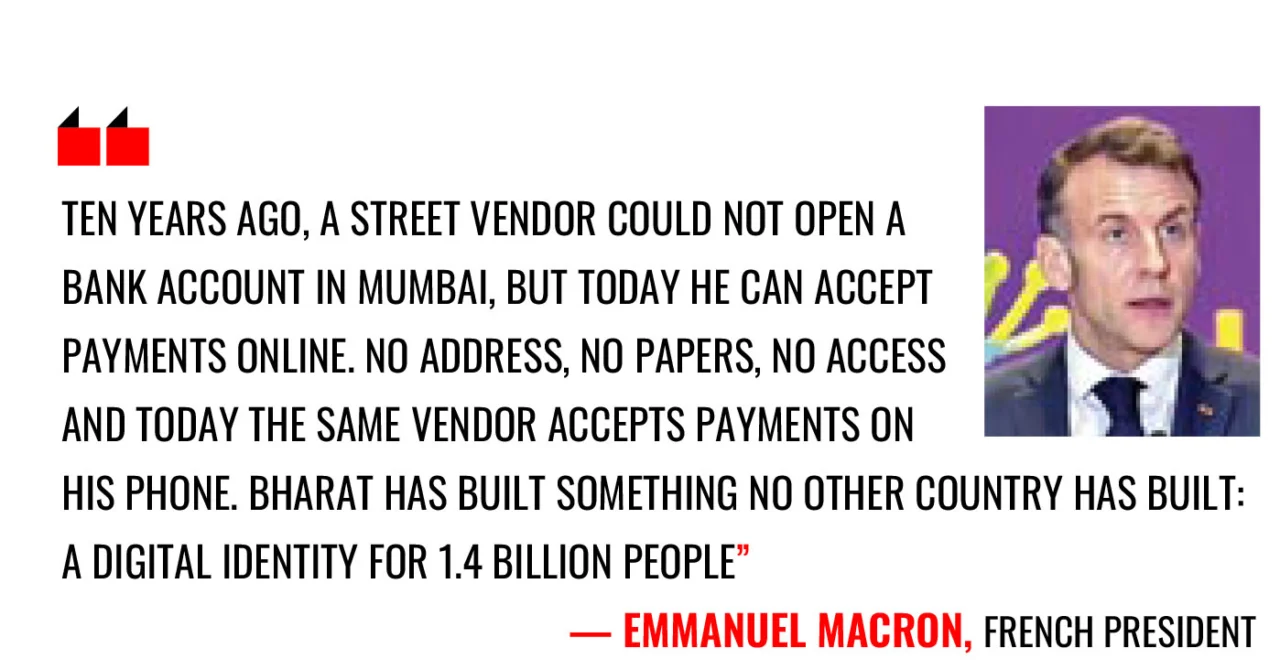
Praising Bharat’s digital leadership, French President Macron, while delivering a keynote address, said that ten years ago, a street vendor could not open a bank account in Mumbai, but today he can accept payments online. “No address, no papers, no access and today the same vendor accepts payments on his phone. Bharat has built something no other country has built: a digital identity for 1.4 billion people,” he added.
Pointing out that Bharat has built a digital identity for 1.4 billion people, President Macron said it’s something that no other country in the world has built. “A payment system that now processes 20 billion transactions every month. A health infrastructure that has issued 500 million digital health IDs. Here are the results. They call it the India Stack Open Interoperable Sovereign. That is what this summit is about. We are clearly at the beginning of a huge acceleration, and you perfectly described it during your interventions,” he added.
Earlier on February 16, PM Modi inaugurated India AI Impact Expo, underscoring Bharat’s commitment to responsible and inclusive AI.
Here, it is worth noting that the summit was anchored in three foundational pillars, known as Sutras — a Sanskrit term meaning ‘guiding principles’. These three Sutras are People, Planet, and Progress. The AI Impact Summit was structured around seven Chakras: Human Capital, Inclusion for Social Empowerment, Safe & Trusted AI, Resilience, Innovation and Efficiency, Science, Democratising AI Resources, and AI for Economic Growth & Social Good. These Chakras represent key areas of multilateral cooperation that channel collective efforts towards inclusive and sustainable societal outcomes
The Summit witnessed an unprecedented participation with over 20 Heads of State, 50+ Ministers, and 500 global AI leaders. Bringing together policymakers, technology companies, innovators, academia, and industry leaders, the summit seeks to translate global AI deliberations into actionable development outcomes under the IndiaAI Mission and the Digital India initiative. On February 19, Prime Minister also delivered the inaugural address, setting the tone for enhanced global cooperation and advancing Bharat’s vision for inclusive, trusted, and development-oriented Artificial Intelligence.
At the India AI Impact Summit 2026, Jio Intelligence showcased Jio Arogya AI, an AI-powered clinic model designed to accelerate, optimise, and make early health screening faster, smarter, and more accessible across Bharat.
From minute-level health screening and multilingual Voice AI Doctor interactions to smart diagnostics and specialist referrals, the vision is to turn primary health centres into AI-enabled clinics, especially in remote regions. With integration of portable X-ray, ECG, online consultations and digital medicine ordering, Jio Arogya AI aims to bridge the gap between early screening and specialist care and bring quality healthcare closer to every Bharatiya.
Jio Shiksha, part of the Jio AI Stack, replaces heavy school bags with e-books, equips teachers with interactive digital screens, and tracks student performance in real time.
Jio Sanskriti AI: This was the showstopper. Jio has used HoloTube technology to create digital holographic avatars of characters from the Mahabharata, such as Arjuna. You ask a question, and the avatar responds first in Sanskrit, then gives a Hindi translation.
Jio’s strategic push into AI positions it to capitalise on Bharat’s increasing digital adoption and the Government’s emphasis on indigenous technological development.
Rahul Vatts, chief regulatory officer, Bharti Airtel, said AI is at the core of the company’s operations, and underlined that Airtel is broadly focusing on four areas with this technology: consumer experience and protection; network optimisation; operational efficiencies; and delivering differentiated services.
Self-organising networks (SON) have helped Airtel reduce call drops, make handover algorithms smarter, and enable better traffic steering, Vatts said. He said that with AI-driven efficiencies, the telco expects a 3-4 per cent drop in energy consumption over the coming years.
“Airtel’s AI-enabled mobile network has further stopped 71 billion suspected spam calls, nearly 9 million spam SMS, and blocked more than 800,000 links,” Vatts said. Airtel has developed a system for fake OTP and fraud calls, also.
Airtel also highlighted that its AI systems will help in preventing fake OTP scams and fraud calls, strengthening user safety and digital trust.
Making Governance Easy
Last year, news from Maharashtra reported that the State Police had partnered with Microsoft to implement an advanced AI-powered investigation platform, MahaCrimeOS AI, to combat the rising tide of cybercrime, financial fraud, and other complex crimes. Later in December, it was announced that this would be rolled out across all 1,100 police stations in the State. Notably, Crime OS was also one of the summit’s centres of attraction. While briefing on how it works, one of the experts said that Crime OS AI is partnered with Microsoft. Our solution is focusing on the law enforcement agents. It is the investigation copilot. So, how we can speed up the investigations, how we can support a police officer, is the core idea of our product. It is easy to operate. Any police officer can access. This is a web app. Once we deploy the product to the department, they can ingest a complaint into the product, which then suggests a guided investigation path. They can execute the path, and it will automatically perform the analysis and build the person of interest profile for the suspect. We run the evals on all of the frontier models. Our orchestrator agent will run the evals on all the models and bases, as well as the internal and client testing. We try to keep it as accurate as possible.
Boosting Farm Sector in Digital Way
AI is also having a significant impact on agriculture. Microsoft and AgriPilot.ai have come together to boost AI driven farming solutions. AgriPilot.ai is an AI-driven Click2cloud platform that provides precision agriculture solutions via IoT, satellite imagery, and ML to optimise crop management, soil health, and irrigation. While talking to Organiser, Prashant Mishra, founder and CEO of Click2Cloud, said that AgriPilot.ai offers real-time, data-driven insights in local languages, helping farmers increase yields notably in sugarcane and exotic vegetables while promoting sustainability.
Protecting Bharat’s Sovereignty
One of the attractions was BharatGen, a flagship government-funded initiative under the Department of Science & Technology. Launched to create sovereign, multimodal AI models tailored for Bharat’s diverse linguistic and cultural landscape, it is led by IIT Bombay and a consortium of premier academic institutions.Here are the key activities and initiatives of BharatGen as of early 2026:
Development of Multilingual AI Models & Tools (Sovereign AI)
● Multilingual LLMs
● Speech Technologies
● Vision-Language Models
● Domain-Specific Models
● Open Source & Access
Creating a chain of data centres
Schneider Electric, a French multinational corporation and a global leader in energy management and industrial automation, focuses on sustainability, electrification, and digitisation for homes, buildings, data centres, and industries. The company operates in over 100 countries and employs 160,000+ employees. They provide AI-powered software, IoT-enabled systems (EcoStruxure), and services to enhance operational efficiency.
Devashish from Schneider Electric says the company is involved in end-to-end design and execution of data centres. We design traditional and AI workload data centres with high-density rack designs, with rack densities exceeding 100 kilowatts. We design from grid to chip and even chip to chiller. We are working in all the states and also getting the government’s support. We have built data centres in states like Maharashtra, Karnataka, and Tamil Nadu, as well as in other states. The demand is rising and rising and rising. When asked who the clients are, he says CNSP segment customers, cloud and service providers like CoLOS, and large internet giants like AWS, Microsoft, and Google are the major customers. Two enterprise customers, HP and Intel, are all these enterprise customers. Devashish informs that Bharat and China remain the company’s largest clients.
Open AI Pavilion
Among all the stalls, the OpenAI pavilion was full of people due to its daily use. People were using it hand-to-hand, exploring real-time applications and conversational AI tools. Visitors were particularly curious about Sora, experiencing
AI-generated video capabilities and discussing its creative and professional potential. Startups and organisations such as Vahan.ai, Ksham Innovation, Rocket Learning, Rightwalk Foundation, Digital Green and Noora Health showcased AI-led interventions spanning jobs, accessibility, education, development and public health.
Google Cricket Coach
Then came the pavilion of Google. At the India AI Impact Summit 2026, it showcased an AI-powered cricket coach, allowing visitors to bat against an AI-driven bowling system and gain data-driven insights into technique and performance. Google AI is working across multiple fronts, from Gemini and its broader AI ecosystem to several real-world deployments, but the cricket AI coach stood out as a unique and experiential attraction at the summit. This AI system not only detects flaws in a player’s batting technique but also provides real-time corrective feedback like a professional coach. It identifies where a batter went wrong, what improvements are needed, and offers precise suggestions.For this AI system, Google has set up a special cricket pitch inside the Expo Centre. During a trial demonstration, the AI coach delivered performance feedback within just two minutes. Young players visiting the pavilion are given a chance to bat. As soon as a shot is played, high-definition cameras and advanced sensors installed in front of the pitch capture and analyse key technical aspects.
Nasscom AI Initiatives
NASSCOM AI is a focused initiative aimed at establishing Bharat as a global hub for Artificial Intelligence innovation, adoption, and skill development. It serves as a collaborative platform that engages government, enterprises, startups, and academia to foster a responsible AI ecosystem.
Key aspects of Nasscom AI include programmes like AI Gamechangers (showcasing impactful AI use cases), AI for Business Grand Challenge, and sector-specific CoEs (Centres of Excellence) to drive innovation. Skill-Building: Initiatives such as AI Pathshala and the AI-Assisted Developer Marathon to train talent.
The rapid development of artificial intelligence (AI) globally presents significant opportunities for Bharatiya companies and will not adversely impact their businesses, Nasscom AI Head Ankit Bose said. He said instead of job cuts, Bharat will witness job transformations as roles evolve with the growing adoption of AI.
Having said that, the AI Impact summit has not only projected Bharat as one of the key leaders in the area of AI, but also demonstrated the advanced AI infra developed under the Modi Government. Now, wonder why most of the global companies are rushing to invest in Bharat’s AI push.