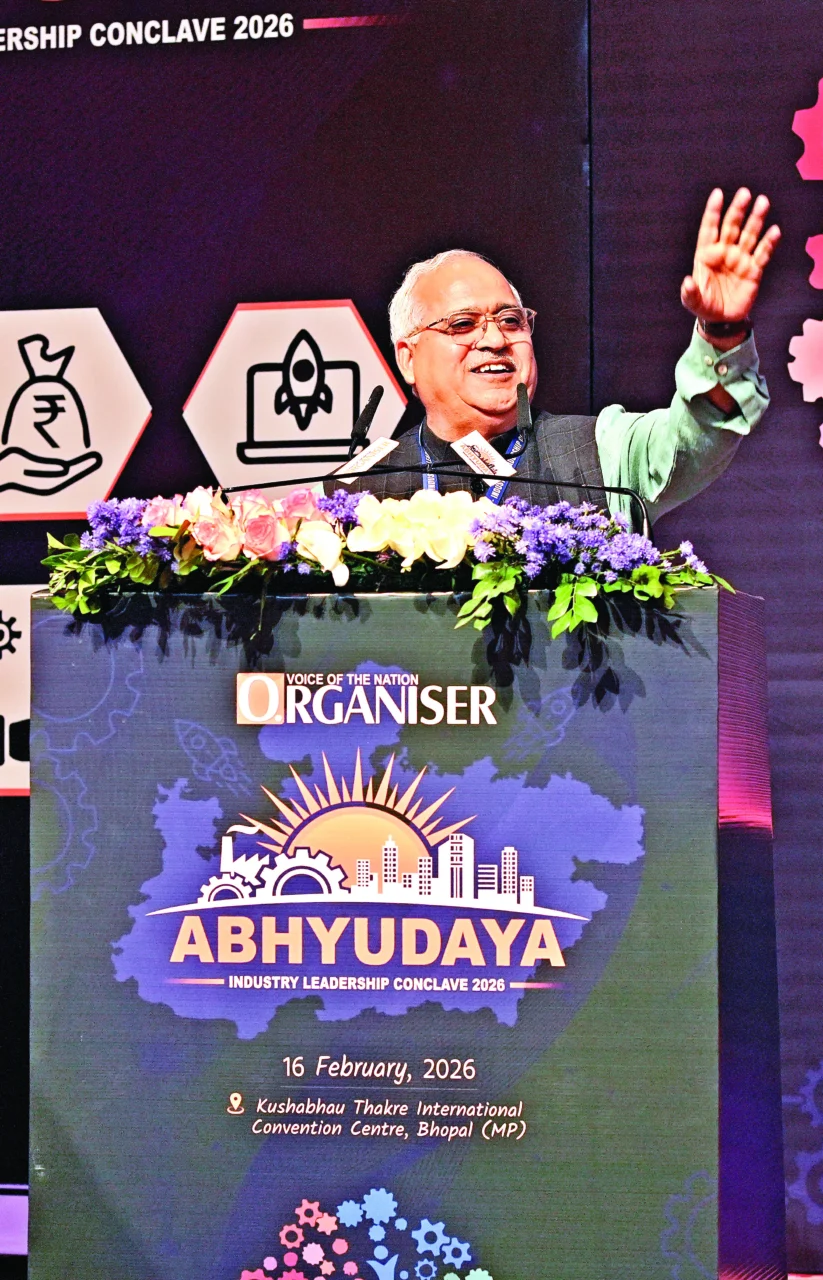
“The term Abhyudaya goes beyond materialistic development. It encompasses ethics, tradition and rootedness in one’s civilisational foundations, and reflects the spirit of Swadeshi,” remarked Satish Kumar, National Co-Organiser of Swadeshi Jagaran Manch, while addressing the Abhyudaya – Industry Leadership Conclave 2026 at the Kushabhau Thakre International Convention Centre in Bhopal on February 16.
However, he observed that this Sanskrit term is not as commonly used today as the phrase “Viksit Bharat @ 2047.” As Bharat approaches 100 years of Independence in 2047, he emphasised the necessity for individuals, society, nations and even global humanity to define clear goals for progress. A nation, he noted, must set a target towards which collective efforts are directed, thus the term “Viksit Bharat @ 2047” articulated by the Government.
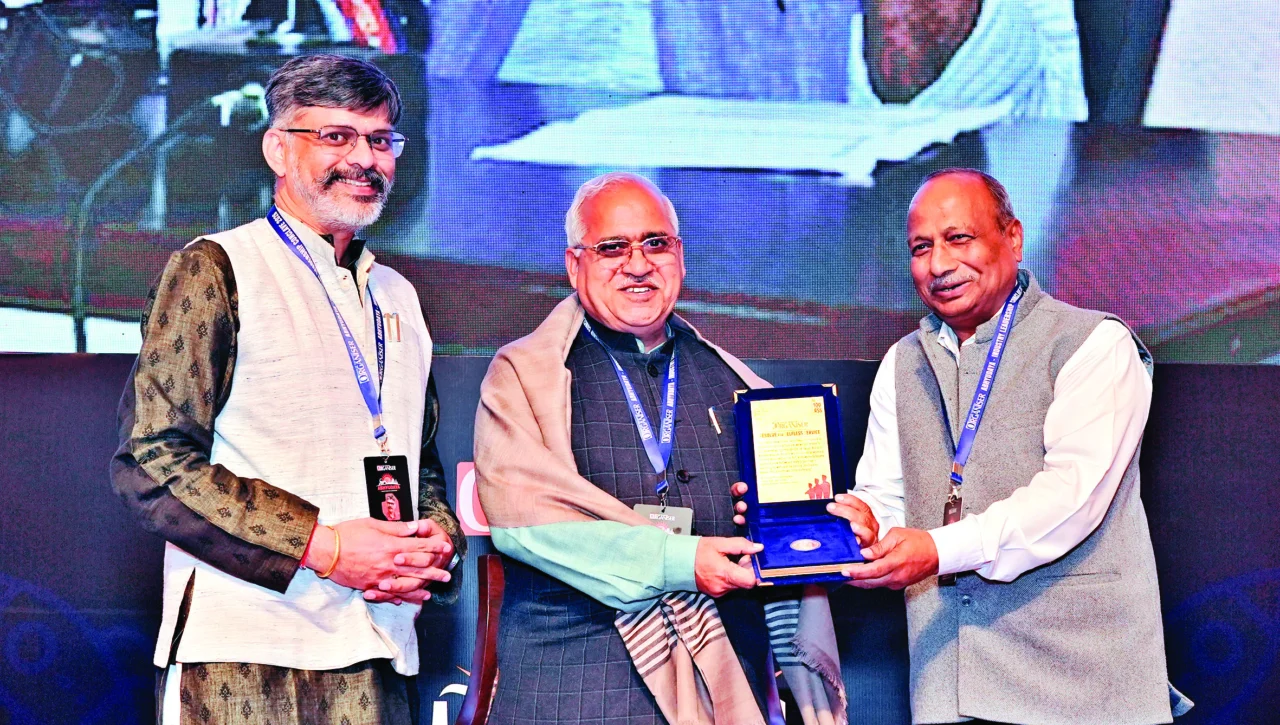
Recalling Pandit Deendayal Upadhyaya’s articulation of Ekatma Manav Darshan (Integral Humanism) in the 1960s, he pointed out that the concept evolved into a Bharatiya model of development. While the present Government refers to this vision as “Viksit Bharat @ 2047,” Organiser describes it as Abhyudaya, and Swadeshi Jagaran Manch has adopted the expression “Samruddh aur Mahan Bharat @ 2047.”
He recounted that deliberations held last year at Swadeshi Shodh Sansthan concluded that “Viksit Bharat” should not imply becoming another America or Europe. It was therefore, considered necessary to expand the idea and infuse it with a distinct Bharatiya ideological perspective, leading to the formulation of “Samruddh aur Mahan Bharat @ 2047.”
Elaborating further, Kumar outlined eight pillars for building a prosperous and great Bharat, identifying youthful and dynamic demography as the first. A nation, he asserted, is not merely land; while the Moon has land and Mars may hold possibilities of life, they are not nations. What defines a nation is its people. Fortunately, he said, Bharat today is the most populous country in the world.
He contended that the West constructed a narrative portraying large populations and families as obstacles to development, arguing that increasing population strains jobs, infrastructure and resources. Thus, population was portrayed as a burden on development.
While Western nations adopted this approach, the same mindset, he lamented, spread to Bharat beyond reasonable limits. He drew attention to the demographic crisis now visible in several countries, including China, whose GDP growth has fallen below 4.6 per cent despite strong infrastructure and higher R&D spending than Bharat. The underlying cause, he maintained, is an ageing population, with China’s numbers declining by nearly 3.3 million annually.
He explained that when families are young, both consumption and production remains high, whereas ageing populations experience decline in both. Research, he added, shows a direct relationship between GDP and demographic age structure. Where populations are young and vibrant, GDP growth follows; where they are not, economic decline is inevitable. Bharat’s GDP growth rate of around 7.3–7.4 per cent, he argued, is fundamentally driven by its demography. While leadership and Government schemes play a role, the primary reason, he underscored, is that Bharat is not only the most populous country but also the youngest.
Describing Bharat as a young and vibrant nation, Kumar stated that its youth produce and consume at high levels, making strong GDP numbers inevitable. However, he cautioned that global warning signs are already visible. On China’s decline, which began around 2021, he attributed to its Total Fertility Rate (TFR), now at approximately 1.1. Japan stands at 1.3, most of Europe between 1.3 and 1.4, the United States at around 1.5, Singapore at 1.2, and South Korea at a critically low 0.76. Consequently, he noted, many of these countries are deeply concerned about their future.
Turning to Bharat, Satish Kumar observed that while the situation remains comparatively stable, the TFR has dropped below the replacement level of 2.1 to around 1.91. This, he stressed, must be raised above 2.1 to sustain long-term economic growth and prosperity.
He referred to concerns expressed by N Chandrababu Naidu and M K Stalin in the Assembly, and highlighted that RSS Sarsanghchalak Dr Mohan Bhagwat has repeatedly emphasised that families and nations prosper where there are at least three children. This, Kumar remarked, forms the foundation of prosperity and happiness for both family and nation, and public policy must align accordingly.
Identifying the second pillar as full employment orientation, he clarified that favourable demography alone is insufficient. Without skills, entrepreneurship, employment, education and good health, population size cannot ensure prosperity. The population, he asserted, must be educated, skilled, well-nourished and enterprise-oriented. He argued that GDP is not the true measure of societal happiness. Employment, he maintained, is the primary material determinant of well-being. For the past 250 years, employment has been narrowly equated with salaried jobs, particularly Government jobs, a colonial-era mindset that persists, especially in rural Bharat. This flawed paradigm, he concluded, must change. Outlining the third pillar, Kumar emphasised that Bharat must once again become the world’s leading economy. Citing economic historian Angus Maddison’s research on global economic history in his book The World Economy : A Millennial Perspective, he noted that from 0 to 1600 CE, nearly one-third of global production originated in Bharat. Referring to economist Utsa Patnaik’s work on colonial extraction, he recalled that Britain drained approximately 44.5 trillion dollars from Bharat between 1752 and 1935—wealth equivalent to one-and-a-half Americas. This figure, he added, excludes earlier invasions by Babur, Genghis Khan, or the French and Portuguese, underscoring the immense economic strength Bharat once possessed.
Nations, he concluded, are not built merely through Government policies or leadership, but through the collective willpower of the people. It is in this context that MSMEs and entrepreneurship, he underlined, acquire central importance. Bharat, he noted, has the world’s largest MSME sector, comprising nearly 7.2 crore units—numbers unmatched globally. MSMEs contribute 46–47 per cent of exports and, after agriculture, provide employment to nearly 18 crore people, while also playing a vital role in infrastructure creation and export growth.
Highlighting entrepreneurial character of Bharat’s youth, he observed that even today, excluding weekends, around 725 companies are registered every working day. MSMEs, he added, continue to strengthen exports and the broader economy.
Elaborating further, Satish Kumar identified the fourth pillar of a prosperous and great Bharat as an impregnable security structure and an undefeatable defence system. Referring to the Sangh Prarthna—Ajayyancha vishwasya deheesha shaktim (grant us invincible strength)—he explained that this reflects a deep civilisational understanding. Even with economic strength, employment, favourable demography and a righteous society, greatness cannot endure without power. Without robust security, he warned, no economy can remain strong for long.
He recalled that Bharat was once prosperous, but successive invasions resulted in large-scale plunder because defence preparedness was inadequate. Even the work of Bhagwan Ram, he pointed out, could not proceed without strength; righteousness alone could not compel Ravan to release Mata Sita.
This principle, he remarked, remains as relevant today as it was thousands of years ago. Whether dealing with neighbours such as China or Pakistan, an emerging Bangladesh, or major global powers, survival in the international system, he maintained, demands the strongest possible defence structure.
He noted that the global dominance of the United States rests not only on economic strength but also on military capability. The US defence budget, he observed, stood at around one trillion dollars earlier and was raised to nearly 1.5 trillion dollars after Donald Trump assumed office. China ranks second with roughly 350 billion dollars, followed by Russia at about 135 billion dollars, and Bharat at approximately 110 billion dollars. However, he emphasised that security today extends beyond external defence, with internal security emerging as an equally critical component.
The fifth major pillar, he stated, is leadership in Science and Technology. Sustained GDP growth and holistic development, he asserted, are impossible without innovation-driven education, Science and Technology ecosystems. While Europe and America initially built wealth through colonial exploitation, their continued prosperity, he argued, stems from sustained leadership in Science and Technology. Over the past 200 years, most major inventions have emerged from the West, and nearly 31 per cent of America’s income today comes from Intellectual Property Rights. Therefore, when AI summit is held in Delhi, Bharat, he contended, must evaluate its global role. Although Bharat is currently ranked third or fourth globally in artificial intelligence, this is insufficient. Ethical dimensions must be considered alongside technological advancement. Technology, he cautioned, must remain under human control; otherwise, humanity risks becoming slaves to it. This process, he observed, is already visible as algorithms increasingly influence choices on platforms such as Facebook and WhatsApp.
The sixth pillar, he outlined, is environmentally friendly development. The dominant development model followed by the West and China, he remarked, is based on environmental destruction, and copying technology. China’s path, he noted, closely mirrors that of Europe and US. In contrast, Bharat sustained itself as a developed civilisation for millennia without destroying nature. Environmental harmony, he emphasised, is embedded in Bharat’s civilisational DNA.
The seventh pillar, he stated, is a global vision rooted in Vasudhaiva Kutumbakam. The world, he posed, will respect Bharat not merely for wealth or military power—attributes also possessed by America and Europe—but for its contribution to humanity and its vision for global well-being.
Recalling the ideas of Dattopant Thengadi, he explained that the Western worldview treats the world as a marketplace, while Bharat views it as a family in which all have the right to live. This outlook, he added, was reflected in the G20 Summit slogan, Vasudhaiva Kutumbakam.
The eighth and final pillar, he concluded, is the enrichment of Bharat with high life values. Material prosperity alone, he argued, is insufficient if families and societies lack moral and ethical grounding. Values such as service, harmony and strong family bonds provide continuity and strength to a nation.
Nations are not built merely through government policies or leadership, but through the collective willpower of the people
Anchored in these eight pillars, he asserted, Bharat is advancing steadily toward 2047. As the world’s fastest-growing economy and home to nearly 18 per cent of the global population, the nation is rising rapidly. Quoting Victor Hugo, he remarked, “Nothing can stop an idea whose time has come.” The time of Bharat, he concluded, has arrived.
Speaking on the occasion, Prafulla Ketkar, Editor of Organiser, observed that following the Madhya Pradesh Government’s Industrial Promotion Policy in 2025, the idea emerged to initiate serious deliberation in Bhopal on industry-related issues, particularly MSMEs.
Drawing inspiration from the Rashtriya Swayamsevak Sangh, Organiser began its journalistic journey. Whether it was national security, the restoration of democracy during the Emergency, the Ram Janmabhoomi movement, or the idea of Swadeshi, especially in terms of policy intervention within the English intelligentsia, Organiser has played a strong and impactful role.
Abhyudaya, he explained, signifies auspicious growth. It is not development at the cost of others; it is development founded on ethics. Progress must take place, but its foundation must be moral. The goal, therefore, is to achieve Abhyudaya and present a Bharatiya model before the world. In this endeavour, small and medium industries have a crucial role, he concluded.