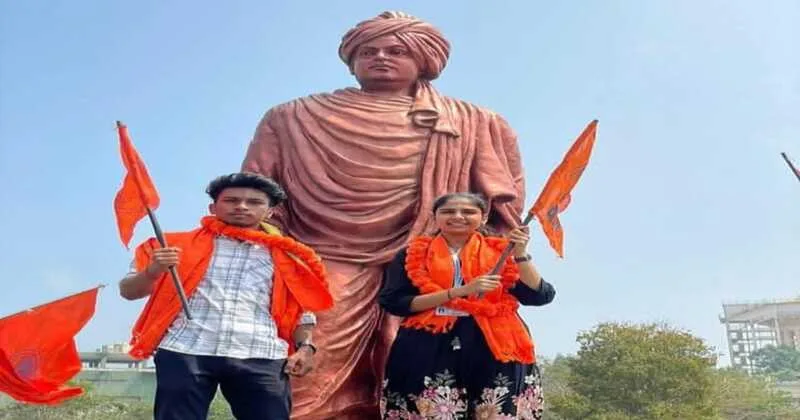
KASARAGOD: The Akhil Bharatiya Vidyarthi Parishad (ABVP) registered a significant breakthrough in campus politics on February 20, clinching the Joint Secretary and Executive Councillor posts in the Student Union elections at the Central University of Kerala (CUK). KJ Aparna, a first-year MSc Yoga Therapy student, won the Joint Secretary post on the ABVP panel by a decisive margin, while Vikas Kumar Nayak, a third-year student of the Integrated Teacher Education Programme, was elected Executive Councillor. The outcome is being viewed as a landmark moment in the university’s electoral history, long associated with Left-aligned student leadership.
Breaking a long-standing left stronghold
ABVP leaders described the result as a turning point for CUK, which has traditionally been regarded as a stronghold of the Students’ Federation of India (SFI). The organisation said the verdict reflected growing student dissatisfaction with previous union functioning and a desire for a welfare-oriented alternative. In a statement released after the results, ABVP claimed that students had voted for a shift away from what it called confrontational campus politics, and towards what it framed as constructive engagement focused on academic growth, dialogue, and student welfare. The group said it would work closely with the university administration to address everyday student concerns, improve campus facilities, and promote an atmosphere conducive to learning and holistic development.
The Kerala victory also adds momentum to ABVP’s recent electoral performances in student unions across the country, including at Delhi University, University of Hyderabad, and Panjab University. ABVP karyakartas argue that these outcomes point to a broader national trend, with students increasingly aligning themselves with the organisation’s “Nation First” narrative.
Leaders react as ABVP eyes wider campus gains
ABVP National Secretary Shravan B Raj termed the CUK result “resounding and historical,” thanking the student community for what he called a clear mandate. Congratulating newly elected representatives KJ Aparna and Vikas Kumar Nayak, he also acknowledged the efforts of party volunteers who campaigned for the victory.
He alleged that the previous SFI-led union had failed to adequately address student issues and had slowed the university’s progress. According to him, this dissatisfaction played a decisive role in students’ decision to place their trust in ABVP. Shravan B Raj further claimed that the latest outcome could signal the beginning of a larger transformation on campus, predicting that ABVP would secure a comprehensive mandate in future elections. “Students have shown that they want accountable leadership and a union that prioritises their needs,” he said, adding that ABVP would work to create an academic environment centred on deliberation, skill-building, and social responsibility. He also reiterated the organisation’s commitment to encouraging youth participation in the national development vision.
Newly elected Joint Secretary Aparna echoed similar sentiments, stating that students had embraced ABVP’s ideology and expressed confidence in its leadership through what she described as a historic mandate. She said the results demonstrated a clear aspiration for proactive representation and a student body-focused agenda.
“Our victory reflects the desire for progress-driven campus politics,” Aparna said, adding that the Student Union would be treated as a platform to resolve grievances and promote inclusive growth. She also criticised the outgoing leadership, asserting that students had rejected what she characterised as intolerant and regressive approaches.
ABVP leaders said the organisation would now prioritise regular engagement with students, transparency in its functioning, and initiatives to improve academic and extracurricular opportunities. Plans include forums for student dialogue, advocacy on infrastructure issues, and programmes designed to enhance employability and community involvement.
With celebrations breaking out across sections of the campus following the announcement of results, observers note that the CUK elections may mark a broader realignment in student politics in Kerala’s central university space. Whether this momentum translates into sustained influence remains to be seen, but for now, ABVP’s twin victories have unmistakably reshaped the political landscape at the Central University of Kerala.