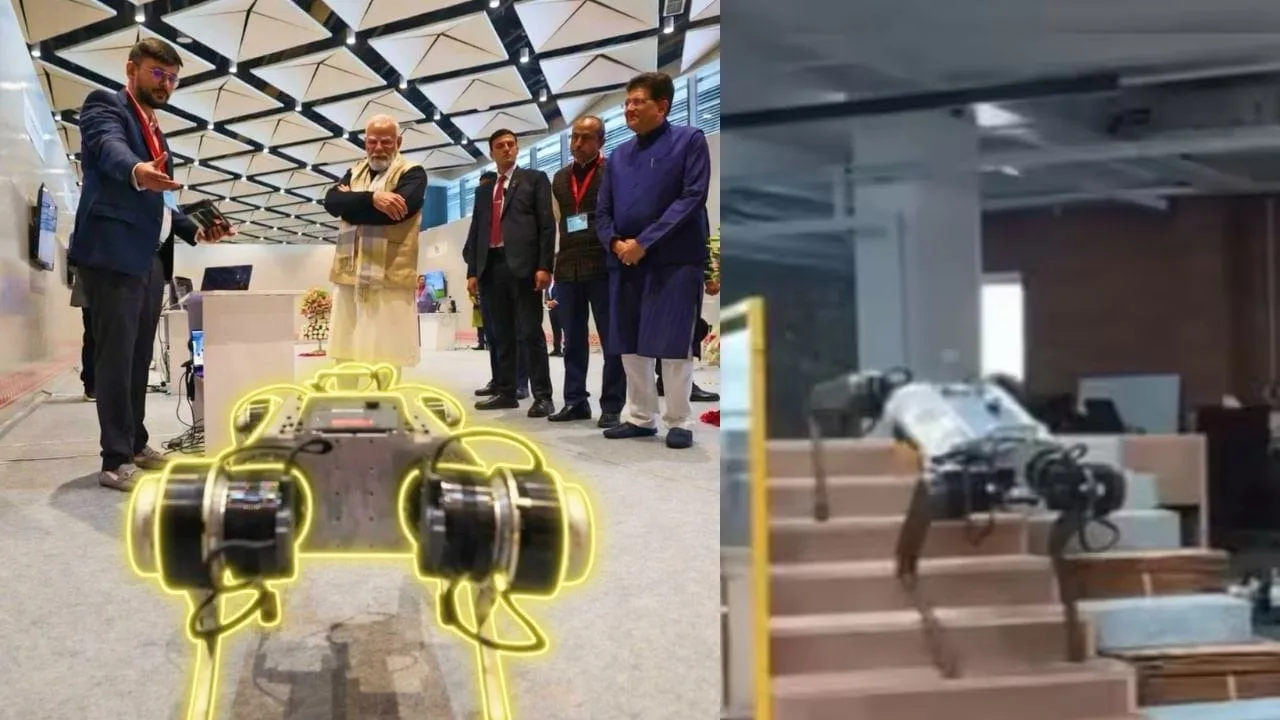
Bengaluru : Bengaluru-based robotics startup General Autonomy has unveiled India’s first fully indigenous robotic dog, ‘Param’, at the India AI Impact Expo 2026 held in New Delhi. The company described Param as “India’s most powerful locally built robotic dog”, marking a significant milestone in the country’s robotics and artificial intelligence ecosystem.
Unlike semi-assembled robotic platforms that rely on imported core components, Param has been designed and built from the ground up by Indian engineers. The company emphasised that the robot is not merely assembled in India but is entirely conceptualised, engineered and manufactured domestically, underscoring a push toward technological self-reliance.
Honoured to present our robot dog PARAM to the Hon’ble PM of India Shri @narendramodi, in the presence of @PiyushGoyal, at the #NationalStartupDay2026 Deep Tech showcase by @DPIITGoI @startupindia.
PM’s advice to our founder @frdahsan: take care of PARAM in Delhi winters! pic.twitter.com/FHGi464Lue— General Autonomy (@GeneralAutonomy) January 17, 2026
The project was completed within a span of just seven months. The development team leveraged prior experience from building a humanoid robot prototype, adapting key learnings in mobility, balance and AI-driven navigation to create Param.
According to the company, the robotic dog combines advanced mechanical engineering with intelligent software systems, enabling it to operate autonomously in complex environments.
The robot is capable of independent navigation and can dynamically alter its path by identifying and avoiding obstacles. It can climb stairs up to 30 centimetres in height and manoeuvre through tight spaces using a specialised “crab walk” movement. The robot is also equipped with self-balancing technology that allows it to regain posture and stand up automatically if it falls.
Enough of this nonsense!
Presenting PARAM: India's most powerful indigenous robot dog. Not assembled, not bought, BUILT IN INDIA, built by INDIANS. For our nation, for our century, for our world!
Jai Hind! 🇮🇳@narendramodi @adgpi @AshwiniVaishnaw @GoI_MeitY @startupindia pic.twitter.com/Djwuvzksne— General Autonomy (@GeneralAutonomy) February 18, 2026
This was showcased to PM Narendra Modi during the 10-year celebrations of the Startup India initiative. The PM reportedly appreciated the innovation and its potential applications across sectors
Industry observers note that quadruped robots like Param are increasingly being deployed globally for industrial inspections, hazardous environment operations, defence reconnaissance and research missions. General Autonomy said Param is designed to support factory inspections, disaster response operations in unsafe zones, border surveillance and scientific research projects.
The unveiling of Param comes at a time when India is seeking to reduce dependence on foreign robotics platforms, particularly from China and other global suppliers that dominate the quadruped robotics segment. By developing an entirely indigenous solution, the company aims to position India as a competitive player in the global robotics market.
Experts believe such innovations reflect the broader growth of India’s deep-tech startup ecosystem, especially in Bengaluru, often referred to as the country’s technology capital. With increasing government support for AI, robotics and semiconductor manufacturing, startups are moving beyond software services into high-end hardware innovation.
General Autonomy said it plans to continue refining Param’s capabilities, including enhanced payload capacity, improved sensor integration and AI-powered analytics for real-time decision-making. The company is also exploring partnerships with defence agencies, industrial players and research institutions to deploy the robotic dog in pilot projects.
As India advances toward its vision of becoming a developed nation, initiatives like Param highlight the growing convergence of artificial intelligence, robotics and indigenous innovation. The successful development of a fully homegrown robotic dog within a short timeframe signals the country’s ambition to compete globally in next-generation technologies while strengthening domestic manufacturing and design capabilities.