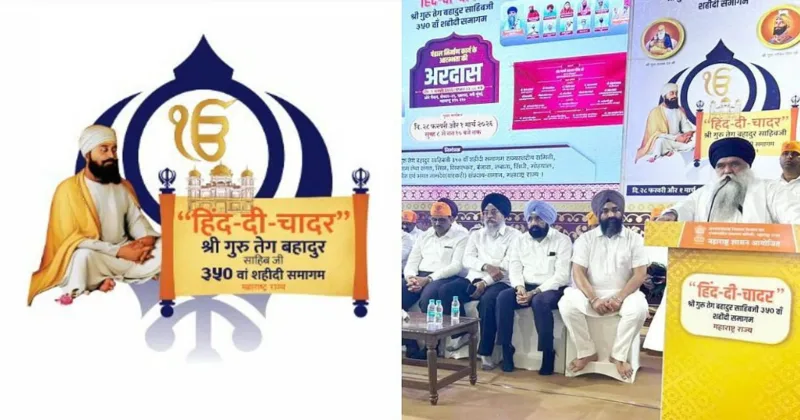
MUMBAI: On the occasion of the 350th Shaheedi Samagam of Guru Tegh Bahadur, revered as “Hind-Di-Chadar,” grand commemorative programmes have been organised across Maharashtra to honour his unparalleled sacrifice and enduring legacy.
As part of these observances, a major state-level programme will be held on February 28 and March 1 at Kharghar, Navi Mumbai. The event will be graced by the Prime Minister of India, Narendra Modi, Union Home Minister Amit Shah, and Maharashtra Chief Minister Devendra Fadnavis.
Earlier, grand programmes were successfully conducted in Nagpur and Nanded through the joint efforts of the Minority Development and Waqf Department, the 350th Shaheedi Samagam State Coordination Committee, and representatives of the Sikh, Sikligar, Banjara, Labana, Mohyal, Sindhi, Valmiki, Udaseen and Bhagat Namdev communities. An estimated 500,000 to 1 million devotees from across the state and the country attended these gatherings.
These commemorative events aim to carry forward the heroic legacy, spiritual teachings and message of sacrifice of Guru Tegh Bahadur to the younger generation. Inspired by the vision of Prime Minister Narendra Modi, the programme is being implemented across the country with the noble objective of preserving and promoting the reformist and spiritual heritage of India’s saints and Gurus.
Under the leadership and initiative of Chief Minister Devendra Fadnavis, the state-level programme is emerging as a symbol of unity, bringing together devotees from diverse sects and communities under one platform.
The events are being organized under the thematic concept of the “Ninth Guru, Nine Jewels, and Nine Communities,” highlighting the deep spiritual and historical connection of various communities with Guru Tegh Bahadur Sahib Ji.
In Nagpur and Nanded, the administration, Gurdwara Boards and social organizations worked in close coordination to ensure comprehensive arrangements for darshan, sanitation, drinking water, security and transportation. Devotees were introduced to the teachings and heroic history of the Sikh Gurus through Gurbani recitations, exhibitions, audio-visual presentations and thematic songs. Extensive arrangements for langar (community meals) serving lakhs of devotees, along with accommodation facilities, were also made.
Guru Tegh Bahadur’s supreme sacrifice stands as a timeless symbol of resistance against oppressive imperial policies and as a defense of freedom of conscience. Through his travels across the country, he undertook constructive efforts for spiritual awakening and social upliftment. He actively worked against superstition and social evils, and promoted public welfare through initiatives such as digging wells, constructing dharamshalas, encouraging charity, and serving humanity and animals. His life and martyrdom continue to inspire the youth to uphold national unity, harmony and integrity.
At a time when society was fragmented by divisions of caste and inequality, Guru Nanak united people through the philosophy of “Ek Onkar,” fostering equality and collective identity. Inspired by his teachings, diverse sections of society came together as followers of the Nanak Panth. The Shaheedi Samagam seeks to reinforce this enduring message of unity and social harmony by symbolically weaving all communities into a single thread.
Shri Guru Tegh Bahadur Sahib Ji – “Hind Di Chadar”: According to Sikh history, Guru Tegh Bahadur Sahib Ji was martyred in Delhi near the Red Fort, at the site where Gurdwara Sis Ganj Sahib stands today. As recorded in Sikh History published by the Shiromani Gurdwara Parbandhak Committee, he was presented with the choice to convert, perform miracles, or face death. Upholding the eternal principle of “One Thought, One Onkar, One Truth,” he chose to sacrifice his life in defence of faith and freedom of conscience. For this unparalleled martyrdom, he was bestowed the revered title “Hind-Di-Chadar” — the Shield of India.