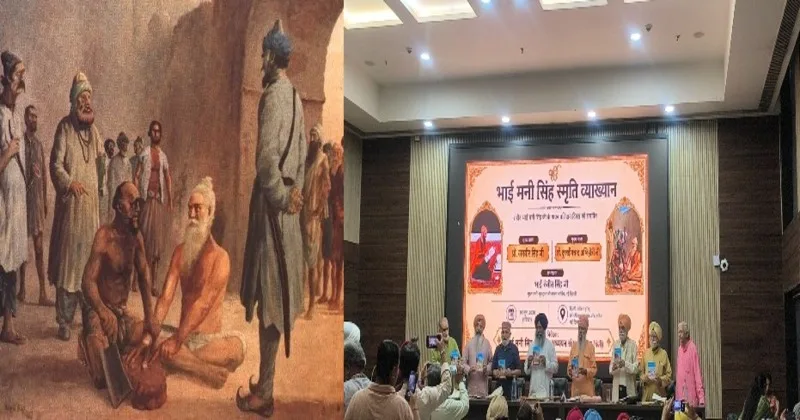
Every day, in Gurdwaras across the world, Sikh congregations rise and recite the Ardas, the formal prayer that has defined the community’s collective identity since the early eighteenth century:
“Jinaa Singhaa Singhneeaa dharam hayt sees ditay, Bandh Bandh Katai, Khopreeaa Lahaeeaa…dharam nahi haria.” (Those Sikh men and women who gave their heads for their faith, who were cut joint by joint, who had their scalps removed — but who never abandoned their Dharam).
The phrase Band Band Katai, cut joint by joint is not metaphor. It is a historical record. It refers with precision to the execution of Bhai Mani Singh Ji, martyred at Nakhas Chowk, Lahore, on June 14, 1738. That his death should be preserved in daily Ardas recited by millions across nearly three centuries, tells us something deeper that the state’s attempt to extinguish religious traditions through barbarities was confronted with dignity, serenity and fearlessness.
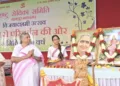
In memory of Bhai Mani Singh, on June 14, 2026, a lecture was organised by the Bhai Mani Singh Gurmatt Shodh and Addhayan Sansathan Trust at the Deputy Speaker Hall, Constitution Club of India, New Delhi, under the chairmanship of Bhai Ranjit Singh, Head Granthi of Gurdwara Sri Bangla Sahib. Prof. Jagbir Singh, Chancellor of Central University Bathinda, and note scholar and Former Vice-Chancellor, Central University of Himachal Pradesh, Dr. Kuldipchand Agnihotri were among the principal speakers. Prof. Jagbir Singh spoke of the urgent need to awaken society to such sacrifices. Bhai Ranjit Singh observed that programmes of this kind should be organised more frequently, so that all might understand the debt owed to those who died protecting the religious freedom that later generations breathe as though it were simply air. Dr. Agnihotri called for such martyrs to be restored to the national mainstream, they have, he said, been pushed to the margins of historical memory.
Following the book release, the session for the key speakers commenced. First, Shri Gurcharan Singh Gill Ji introduced the core theme of the event. Addressing the gathering next, the main speaker Prof. Jagbir Singh Ji focused on the monumental role of Bhai Sahab in compiling and editing the ‘Dasam Granth’. He stated that Bhai Mani Singh Ji was the patriarch of medieval Sikh scriptural scholarship who immortalized the Sikh intellectual tradition by meticulously preserving and consolidating the scattered text under extremely hostile political and social conditions. The second key speaker, Dr. Kuldipchand Agnihotri Ji, shedding light on the glorious history of the Vanjara (Banjara) community, remarked that Bhai Sahab’s lineage carried the chivalrous and self-sacrificing legacy of King Bhoj, wherein a total of 36 martyrs from this single family sacrificed their lives for the ideological sovereignty of the nation and faith.
Summing up the discourse in his presidential address, Bhai Ranjit Singh Ji beautifully expressed that Bhai Mani Singh Ji’s life is a sublime paradigm of the synthesis of ‘Shastra and Shaastra’ (the weapon and the scripture). He emphasized that his sacrifice teaches us that a worldly regime can cut a person’s body into pieces, but it can never conquer his conscience, resolve, and religious integrity. He added that today, when millions of Sikhs across the world remember the heroes who underwent ‘Band-Band Kataye’ (dismemberment joint-by-joint) in their daily Ardas, Bhai Mani Singh Ji’s scriptural purity and martyrdom emerge as the greatest guiding light for our cultural roots.
S. Gurlad Singh ji pressed upon the need of taking the life and message of Bhai Mani Singh ji to the masses. Following the lectures, at the conclusion of the ceremony, the Secretary of the Institute, Shri Rakesh Rikhi Ji, extended a heartfelt Vote of Thanks to all the honored guests on the stage, the revered saints, and the enlightened audience who gathered from all parts of the country. On this pious occasion, all the honorable and respected guests sitting on the dias were specially felicitated and honored by the Trust with beautiful replicas of ‘Sri Harimander Sahib’ and ceremonial shawls as a token of reverence and gratitude for their invaluable time and guidance.
Life and history of Bhai Mani Singh
The seventeenth and early eighteenth centuries in the Punjab were a period of acute religious and political crisis, a time when the Mughal Empire’s earlier policy of selective accommodation toward its non-Muslim subjects had hardened, under Emperor Aurangzeb (1658–1707), into systematic coercion. Temples were demolished, jizya, the tax on non-Muslims, was reimposed, and conversion to Islam(Sunni Orthodoxy) became for many the price of physical survival.
The Sikh community was a particular target. The Gurus, since the time of Guru Nanak Dev Ji in the early sixteenth century, articulated a vision of the divine present in every human being regardless of caste, religion, or social standing and their sangat had drawn worshippers from across the hierarchies of both Hindu and Muslim society. This was a challenge to the structures of religiously sanctioned inequality of Mughal rule. The execution of Guru Arjan Dev Ji in 1606 and of Guru Tegh Bahadur Ji in 1675 were not random acts of cruelty they were political calculations, attempts by the state to decapitate a movement that had grown too large to be tolerated.
Bhai Mani Singh was born in the village of Kailbowal, near Sunam in the Punjab. He was named Mani Ram at birth, called Mania by his family. His father was Bhai Mai Dass-a devout Sikh. When Mani Ram was approximately five years old, his parents brought him to Anandpur Sahib to pay homage to Guru Tegh Bahadur Ji, the ninth Guru. There the child encountered Gobind Rai-the Guru’s own son, who would later become Guru Gobind Singh Ji, the tenth Guru. The two boys were of similar age and became immediate companions. When Mani Ram’s parents prepared to return home the child refused. He wished to remain at Anandpur. His wish was granted.
Let me introduce the family of Bhai Mani Singh here. His elder brother, Bhai Dayala Ji, was one of the five devoted companions who accompanied Guru Tegh Bahadur Ji to Delhi in 1675. Bhai Dayala Ji was placed alive in a cauldron of boiling water and roasted until, in the words of the chronicles, he became like charcoal. Three days later Guru Tegh Bahadur Ji himself was beheaded at Chandni Chowk Delhi.
Sacrifice was the family tradition they grew up breathing. Bhai Mani Singh’s 11 brothers, 7 sons, 14 grandsons, 13 nephews and 9 uncles attained martyrdom. Bhai Bachittar Singh became a legend when on 1st September 1700 the Pahadi Rajas alliance sent a drunken armoured elephant to batter down the fort’s gate. Armed with his signature ‘Nagni Barchha’, a gift from the Guru, Bhai Bachittar Singh rode on horseback and charged the war elephant, thrusting his spear that it pierced the iron plate of the elephant’s forehead, the wounded elephant turned and ran back in retreat.
On the historic Baisakhi of 1699, when Guru Gobind Singh Ji created the Khalsa Panth, Mani Ram was among the first to step forward. He was initiated into the Khalsa and, following the tradition of all male initiates taking the name Singh, Mani Ram became Bhai Mani Singh. He was not merely a scholar he was also a warrior. Bhai Mani Singh fought bravely in the Battles of Bhangani and Nandawn alongside Guru Gobind Singh Ji. He accompanied the Guru on his tours and was at his side during the final journey south to Nanded, where Guru Gobind Singh passed from this world in 1708.
Among Bhai Mani Singh’s most sacred and lasting contributions is his role as the scribe of the Damdami Bir the final version of Sri Guru Granth Sahib Ji. This was the second and final edition of Adi Granth incorporating the sacred Bani of Guru Tegh Bahadur Ji that had been missing from the first compilation.
Bhai Mani Singh works include, Damdami Bir, Dasam Granth, Gyan Ratnavali, Bhagat Ratnavali, Ardas, he also holds special place among 52 poets of Sri Guru Gobind Singh ji.
In 1721 CE, Mata Sundri Ji appointed Bhai Mani Singh as the Head Granthi (Chief Custodian) of Sri Harmandir Sahib, Amritsar. By then, the Sikh community was fragmented into factions, which caused disputes. He restored peace among the Khalsa, put the administration of Sri Harmandar Sahib in order, initiated the daily routine of Kirtan, established Kirtan Jathas (hymn-singing squads), and began regular Gurbani discourses.
He also maintained Harmandir Sahib through persistent Mughal hostility. The Mughal authorities had banned Sikh gatherings and at one point Zakaria Khan even ordered the Holy Sarovar at Amritsar to be filled with soil, a desecration Bhai Mani Singh resisted. By then, Bhai Mani Singh, conceived a plan to use the festival of Bandi Chhor Divas as an opportunity to reunite the scattered Khalsa at Harmandir Sahib.
He applied to Governor Zakaria Khan for formal permission to hold the Diwali festival, understanding that without such permission, any gathering would be a pretext for massacre.
The Governor granted permission on the conditions that Bhai Mani Singh would pay a poll tax of Rs. 5,000 to the government after the gathering to be drawn from offerings made by visiting Sikhs. Bhai Mani Singh accepted, and sent invitations to Sikhs in every corner of Punjab, calling them to gather at Amritsar on Diwali. But Zakaria Khan had no intention to allow a Sikh gathering, he dispatched his military commander Diwan Lakhpat Rai with 30000 soldiers to massacre every Sikh who comes to Sri Harmandar Sahib.
Bhai Mani Singh got to know the plan of Zakaria Khan and he sent Hukamnama(Order) to all not to travel to Sri Harmandar Sahib, which saved the devout Sikhs from a massacre.
Zakaria Khan arrested Bhai Mani Singh for not paying the tax of Rs.5000. The Qazi tried to persuade him to embrace Islam. Bhai Mani Singh declared that his faith was his life that he would never surrender. The famous exchange between Bhai Mani Singh and Zakaria Khan was recorded. Zakaria Khan said that Bhai Mani Singh was no longer in the parikrama of Harmandar Sahib, where he could recite Baani that he was in Lahore where the air rang with ‘Allah Hu Akbar’, Bhai Mani Singh replied calmly that Waheguru was present everywhere, in Lahore as in Amritsar.
After this, Qazis declared that for refusing to accept Islam, Bhai Mani Singh’s entire body be cut into pieces, joint by joint. On June 14, 1738 at Nakhas Chowk Chowk, Lahore, which was the horse market near the Lahore Fort, Bhai Mani Singh. When the executioner was about to begin cutting his wrists, Bhai Mani Singh told him, ‘Follow your orders and start with my finger joints first’. The executioner began at his fingertips joint by joint, dismembering fingers, hands, wrists, elbows, and shoulders. Bhai Mani Singh ji uttered no cry of pain. The site of Bhai Mani Singh’s martyrdom Nakhas Chowk was renamed ‘Shaheed Ganj’, which is today located inside the Masti Gate of Lahore under Waqf Board.
Martyrology will recognize the importance of this moment as the most extreme physical form of barbarity possible. Dismembering joint by joint that this ninety-year-old scholar-saint-warrior chose this death over conversion.
We did not earn this freedom, he paid for it, joint by joint. To remember Bhai Mani Singh ji honestly, is the least we owe him.
Those present respectfully remembered the martyrdom of Bhai Mani Singh ji and called for such historic programmes to continue to be organised. The programme was attended by Shri Vishal ji, Pracharak Delhi Prant, Dr Anil Aggarwal ji, Prant Sanghchalak, Dr Gurcharan Singh Gill, Swami Rameshwar ji, Shri Avinash Jaiswal ji, Shri Vagish Issar ji, Dr CS Nanda President Ca Association, HPS Sran Retd IAS, MS Manchanda, former Chairman ITDC, Capt SS Panesar, former Director Flight Safety, and many distinguished audience across communities.