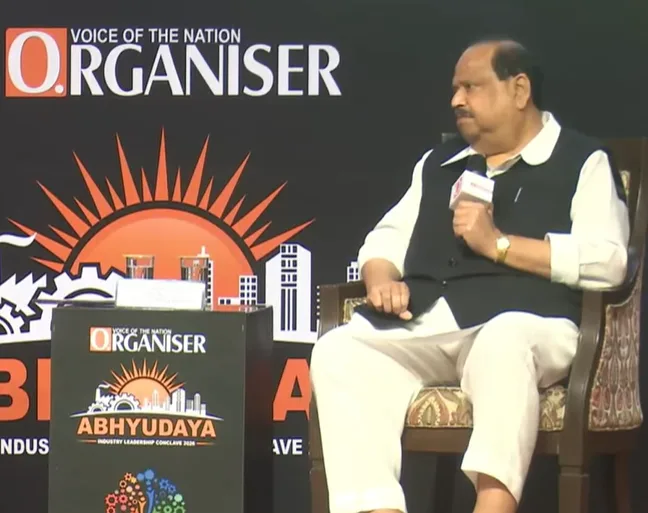
In a wide-ranging interaction on “Industrial Opportunities in Madhya Pradesh”, MSME Minister Chetanya Kumar Kashyap of the Government of Madhya Pradesh outlined the state’s evolving industrial strategy, emphasising MSME-led growth, regional inclusivity, women entrepreneurship, technology adoption, and efforts to translate investment commitments into projects on the ground.
At the Abhyudaya Leadership Conclave held in Bhopal on 16 February 2026, curated by Organiser Weekly, the interaction was conducted by Nishant Kumar Azad, Senior Correspondent of Organiser Weekly, bringing together policymakers, industry representatives, entrepreneurs, and stakeholders for an in-depth discussion on the state’s industrial trajectory and opportunities.
The discussion opened with reflections on how Madhya Pradesh has moved from being viewed as a “sick state” to emerging among the top performers on multiple growth parameters. Over the past two to two-and-a-half decades, earlier governments focused on agriculture, environment, and social sectors, but the current government led by Madhya Pradesh Chief Minister Mohan Yadav has placed renewed emphasis on strengthening the MSME and industrial ecosystem.
Shift towards industry and MSMEs
Responding to a question on why the government has shifted focus towards industry, the Minister Kashyap said that while the previous two decades saw major investments in irrigation, expanding irrigated area from a 6-7 lakh hectares to over 45 lakh hectares, the next phase requires accelerating industrial growth to balance the economy. He noted that agriculture contributes around 40 per cent while industry contributes roughly 19–20 per cent, and increasing the industrial share is essential for sustained development.
He highlighted the state’s decision to treat 2025 as the “year of industry and employment”, aligning with Prime Minister Narendra Modi’s emphasis on MSMEs as the backbone of India’s growth. Regional industrial summits and conclaves have been organised to bring together large investors, local entrepreneurs, youth, and global partners to identify opportunities across sectors.
Women entrepreneurship and inclusive growth
On women’s participation in the MSME sector, the minister said empowerment schemes and policy incentives are being strengthened to bring women into mainstream economic activity. Self-help groups are being linked with industrialisation, and efforts are underway to onboard women entrepreneurs onto platforms such as ONDC, Amazon, and Flipkart to improve market access.
Under the new MSME incentive policy, women entrepreneurs receive enhanced capital subsidies, up to 48 per cent compared to the standard 40 per cent and dedicated industrial spaces are being planned, including facilities in Bhopal’s Govindpura area. The government is also setting up support centres and training programmes to build capacity and ensure sustained participation.
Expanding industrialisation beyond big cities
Addressing concerns that industrial growth often concentrates in large cities, Kashyap said the government has decided to develop at least one industrial area in every Assembly Constituency, including tribal and remote districts such as Mandla, Dindori, and Betul. Smaller plots and tailored infrastructure will be provided to encourage local enterprises, with special provisions for women-led units.
Traditional clusters such as toy-making and local crafts are being supported through sheds, common facilities, and cluster development so that rural and small-town economies can participate in the growth journey.
Promoting regional products globally
On taking regional products to national and global markets, the minister cited efforts similar to the One District One Product approach. Products such as Morena gajak, Ratlam sev, Chanderi textiles, and furniture clusters in Bundelkhand are being supported through GI tagging, branding, workshops, and digital marketing initiatives. Training programmes are being conducted to help producers adopt e-commerce and improve product positioning.
Addressing industry concerns and data on closures
Responding to industry feedback that the single-window system is not always effective, Kashyap said official portal data indicates that actual closures are less than one per cent, with many cases reflecting status changes, restructuring, or re-registration rather than shutdowns. Flexible policies allow enterprises to modify partnerships or leases, and exit and revival frameworks are in place to help struggling units restart operations.
MSMEs and the vision of Viksit Bharat
On India’s goal of becoming a developed nation by 2047, the minister said MSMEs will play a crucial role by generating employment, enhancing financial inclusion, and strengthening supply chains. He pointed to initiatives such as credit guarantee expansion and trade platforms that enable bill discounting, helping small firms access working capital.
Technology, AI and future readiness
Kashyap emphasised the importance of adopting modern technologies, including artificial intelligence, to improve productivity and quality. The state’s MSME policy now includes subsidies up to ₹15 lakh, for technology upgrades, programming, and AI adoption. He also highlighted Madhya Pradesh’s potential as a hub for data centres and server infrastructure due to its landlocked geography and stable conditions.
Investment momentum and startup ecosystem
The minister said investment commitments worth several lakh crore have translated into ground-level activity, with projects worth around ₹8 lakh crore seeing foundation ceremonies, inaugurations, or progress in the past two years. About 1,200 plots across 13 industrial areas have been offered, with around 100 entrepreneurs already acquiring land.
Madhya Pradesh now has more than 4,300 registered startups, with efforts underway to expand entrepreneurial activity across districts and tap local talent.
Tribal development, waste management and skill initiatives
During the interactive session, participants raised questions on waste-to-wealth initiatives, testing facilities for exports, tribal entrepreneurship, and marketing support for self-help groups. The minister said recycling has been recognised as an industry, composting technologies are being upgraded, testing labs are being modernised, and incubation and common facility centres are being set up in tribal regions to support local enterprises.
Paper-to-product and education linkages
Responding to suggestions on linking research with manufacturing, Kashyap noted that the National Education Policy and state initiatives aim to encourage innovation, incubation, and entrepreneurship through colleges, ITIs, and district-level centres, helping translate ideas into marketable products.