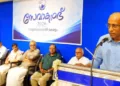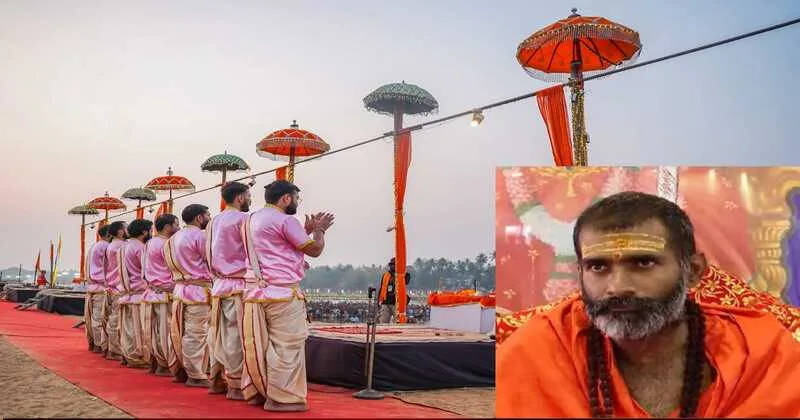
Kochi: The Mahamagham organised in Thirunavaya, Malappuram district, marked a major milestone as the first such event held in Kerala and concluded with what organisers described as overwhelming public participation and economic impact, according to chief organiser Mahamandaleswar of Juna Akhara, Swami Anandavanam Bharathi Maharaj.
Speaking in an interview with the media, Swami Anandavanam Bharathi said the event witnessed strong inter-community cooperation and significant commercial activity across the region. He noted that a survey conducted by IIT students estimated trade worth over Rs 100 crore during the festival period. “There has been a good income from trade. If we look at Kerala as a whole, business activity has nearly doubled, helping to energise the economy,” he said.
The Swami added that public transport services also saw unprecedented demand, with Kerala State Road Transport Corporation (KSRTC) operating close to 200 special services. “Local residents became direct beneficiaries. Everyone cooperated, irrespective of caste or religion,” he said.
They laughed..
Called Kerala’s Kumbha Mela a “BJP event.”
Predicted empty grounds and embarrassed silence.“Who will come?” they mocked.
Now look.
Every day, more footsteps.
More folded hands.
More faith.Sanatana Dharma doesn’t need approval. It only needs awakening.
And… pic.twitter.com/UHKNLQqyKC— Pratheesh Viswanath (@pratheesh_Hind) January 31, 2026
Interfaith cooperation and local economic gains
Highlighting examples of communal harmony, Swami Anandavanam Bharathi said volunteers from Seva Bharathi who were engaged in cleaning activities received lemon water and buttermilk from Muslim residents. “They congratulated our workers. This spirit of cooperation shows that people came together beyond religious boundaries,” he observed. He stressed that Dharma Jagaran opposes all forms of separatism and argued there was nothing wrong in encouraging the Hindu community to awaken and work for national well-being. “How can this be called communalism? Let other communities also think in similar ways. Can we say that Hindus should not support Hindu programmes?” he asked.
According to him, the Mahamagham demonstrated how large religious gatherings can also function as platforms for economic revival. Small traders, transport operators, food vendors and local businesses reportedly benefited from the influx of pilgrims, reinforcing the idea that cultural events can generate tangible livelihoods.
Dharma, power and political ideology
Drawing philosophical contrasts, Swami Anandavanam Bharathi said Hinduism teaches achievement through preservation, while communism, in his view, advocates destruction as a means to progress. “Hinduism says you grow by maintaining; communism says you grow by destroying. There is a fundamental difference,” he remarked. He further stated that no political party can protect Hinduism. “Hinduism does not expand because a party expands. In Hindu society, Dharma maintains and protects the state. In ancient times, kings upheld moral systems. When rulers became immoral, Dharma replaced them with moral leaders. Dharma protects power; power does not protect Dharma,” he said. According to him, whichever government comes to power is secondary to the moral framework guiding society. “Communists are not moral because the problem lies in their ideology,” he asserted, adding that even international communist leaders had remarked that Indian communism differs significantly from classical communist thought.
Witnessed faith, devotion, and tradition come alive at Kumbh Mela in Kerala.
Feeling blessed 😇🙌🏻 pic.twitter.com/kwKOXp7hF8
— FalconUpdatesHQ (@FalconUpdatesHQ) January 29, 2026
Swami Anandavanam Bharathi described Hinduism as broad, inclusive and free in nature, saying it allows space for internal correction and transformation. In contrast, he argued that Semitic religions, in their organised forms, tend to operate as political systems. “They express themselves through political structures, leaving little room for others. Their foundation is power,” he claimed. He pointed out that Hinduism historically coexisted peacefully with the Parsi community, noting that Parsis today hold substantial economic influence in India. “There has never been conflict with them,” he said, attributing tensions elsewhere to attempts by organised religious systems to consolidate power. “When power becomes concentrated, there is always an effort to suppress the weak. In Hinduism, Dharma acharyas point out mistakes and initiate reform from within.
Weaknesses exist only temporarily because Dharma resolves them,” he explained. Concluding his remarks, Swami Anandavanam Bharathi said Hinduism’s strength lies in its capacity for self-correction. “Dharma is central to Hindu society. Other systems often sideline weaknesses in pursuit of power, but Hinduism works to correct them and move forward. That is its enduring quality.”