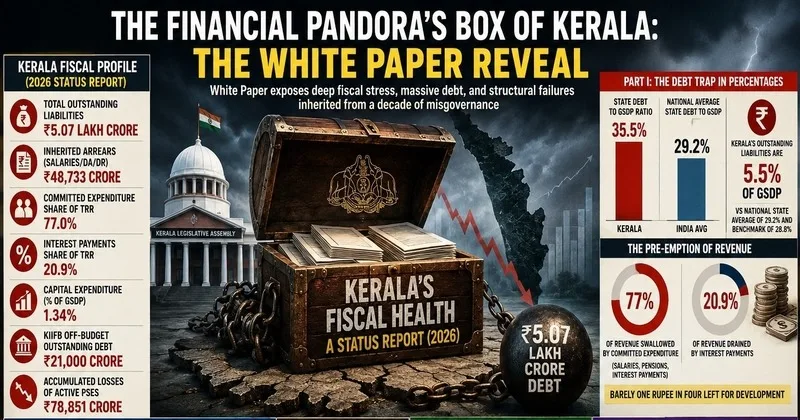
Keralam CM tabled the White Paper on the Financial Health of the state. A massive political and economic storm erupted in the State Assembly on Thursday following the tabling of a comprehensive financial health status report titled “Keralam’s Fiscal Health: A Status Report”. Presented by Chief Minister V D Satheesan, who also oversees the state’s Finance Portfolio, the extensive “White Paper” exposed deep structural fractures in the state’s economy inherited from the decade-long administration of the Left Democratic Front (LDF).
The startling data and systemic failures highlighted in the report have triggered intense debates on the future of the state’s economic model. It highlights the limitations of traditional state-led welfare systems when decoupled from productive economic growth, aligning with broader national pushes toward private investment, such as those advocated by Union Finance Minister Nirmala Sitharaman.
Part I: The Anatomy of a Fiscal Crisis
The expert committee, chaired by former Cabinet Secretary K.M. Chandrasekhar, has laid bare an economy heavily reliant on debt to cover regular operational costs rather than the creation of productive assets.
Part 1- The Debt Trap in Percentages
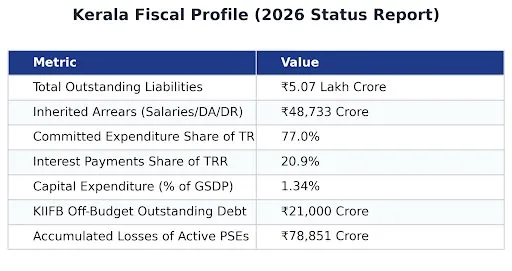
The White Paper reveals that Keralam’s outstanding liabilities have scaled an unprecedented Rs 5.07 lakh crore, translating to 5.5 per cent of the Gross State Domestic Product (GSDP).
The Pre-emption of Revenue:
A staggering 77 per cent of the state’s Total Revenue Receipts (TRR) is swallowed by committed expenditures—predominantly government salaries, pensions, and interest payments. Interest payments alone drain 20.9 per cent of incoming revenues. This leaves, in the words of the report, “barely one rupee in four” to fund critical social infrastructure like schools, hospitals, and long-term public works.
Stagnant Capital Growth:
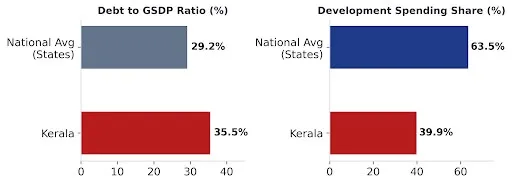
With funds heavily restricted by recurring operational commitments, Keralam’s capital expenditure has dropped to a critical 1.34 per cent of GSDP. This places the state among the lowest spenders on asset creation in India, trailing far behind the national state average of roughly 3.2 per cent. Development expenditure accounts for just 39.9 per cent of the budget, compared to a robust 63.5 per cent national benchmark.
Part II: KIIFB and the Illusion of Off-Budget Solvency
A key focus of the report is the Keralam Infrastructure Investment Fund Board (KIIFB). Originally designed to raise market resources through innovative financing structures outside the standard budget limits, KIIFB has come under scrutiny for its fiscal transparency.
State Debt vs Development Expenditure:
Kerala Debt to GSDP Ratio: 35.5 per cent
National Average State Debt:
Kerala Development Spending Share: 39.9 per cent
National Avg Development Share: 63.5 per cent
Higher Borrowing Costs: The status report notes that KIIFB’s financing operations carry borrowing costs consistently higher than standard government bonds, adding significant long-term obligations to the state treasury.
Political Prioritisation: The report states that project selections under KIIFB frequently prioritised political considerations over strategic economic outcomes. Notably, 20 per cent of KIIFB’s total project expenditure was directed exclusively to Kannur, a major political base for the former LDF administration.
Impending Obligations: The state now faces a combined obligation of approximately Rs 56,000 crore spanning active project funding commitments and immediate loan repayments. Furthermore, the state’s Public Sector Enterprises (PSEs) have shown worsening financial trends. Accumulated losses across 132 active units surged from Rs 31,571 crore in 2021-22 to Rs 78,851 crore by 2025. The trio of KSRTC (Transport), KWA (Water), and KSEBL (Electricity) accounted for 72 per cent of these losses, with the state power utility notably retaining electricity duty instead of channelling it directly into the state’s Consolidated Fund.
Part III: Two Sides of a Coin — The Political Gridlock
The ongoing debate highlights a deeper structural deadlock within the state’s traditional political spectrum. The former LDF government, through former Finance Minister K.N. Balagopal, heavily criticised the presentation of the document, asserting that bypassing internal finance department protocols to consult outside experts compromised administrative norms. The opposition further argued that the state’s economic strain is heavily exacerbated by tightening federal fiscal policies and reduced revenue deficit grants from the Union Finance Commission.
Concurrently, the newly positioned Congress-led United Democratic Front (UDF) administration has pointed to an “empty treasury”. Senior leaders have signalled that the state may need to brace for a period of fiscal tightening, cautioning the public against expecting a continuous stream of populist spending measures.
This dynamic leaves the public observing two major political blocs pointing fingers in opposite directions, while both operate within a shared fiscal framework that relies heavily on state borrowing to maintain immediate public spending commitments.
Part IV: Charting a Way Forward: The Shift from Welfare to Production
As Keralam faces these fiscal constraints, economic commentators are increasingly looking toward modern macroeconomic approaches to revitalise the state’s domestic economy. This aligns directly with points raised by Union Finance Minister Nirmala Sitharaman in her recent national policy interviews, such as the feature in The Mint referenced.
The Union Finance Minister emphasises that long-term fiscal stability requires clear alignment between economic reality and state-level policy. Economics and politics may not be completely detached from one another. If the economy is good, it is going to play in the minds of the people during the election.
Key Policy Structural Reforms:
To transition away from stagnant growth models toward a modern economic framework, the status report and national financial guidelines highlight several key adjustments:
Attracting Private Capital into Core Sectors: Overcoming long-standing regulatory hesitations to welcome private and Central public sector partnerships, particularly within capital-intensive areas like the energy and utility sectors.
Strategic Focus on Sunrise Sectors: Pivoting state infrastructure to support modern industries such as renewable energy, advanced technology hubs, and specialised manufacturing, which generate sustainable, high-value local employment.
Rationalising Subsidies: Shifting from broad production-based operational subsidies toward targeted consumption-based support to minimise structural wastage across public sector undertakings.
Addressing the Youth Employment Gap: While Kerala continues to maintain high human development indices, the state records an unemployment rate among educated young females of 20.7 per cent —nearly five times the national average. Expanding the domestic production economy is critical to retaining local talent, ensuring that external remittances complement rather than substitute for a thriving local job market.
The findings of the 2026 status report suggest that relying on continuous market borrowing to balance short-term budgets is becoming increasingly unsustainable. For Keralam to maintain its long-term social welfare achievements, policy frameworks must adapt to support structural revenue generation, active wealth creation, and open participation in India’s expanding industrial landscape.