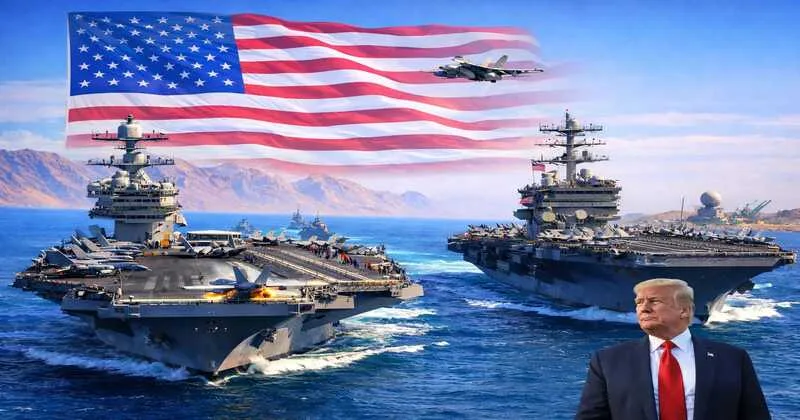
Washington: US President Donald Trump has escalated both diplomatic and military pressure on Iran, issuing a tough ultimatum over its nuclear programme and ordering a major naval deployment to the Middle East. Trump has given Tehran one month to reach a final agreement on a revised nuclear deal, warning that failure to strike a pact will be met with serious consequences. As part of this pressure campaign, he has ordered the deployment of the USS Gerald R. Ford, the world’s largest aircraft carrier, to the region. This move will position the Ford alongside the USS Abraham Lincoln, currently operating in the area, placing Iran’s coastline under comprehensive surveillance by US carrier strike groups.
Speaking publicly, Trump framed the decision as both a diplomatic lever and a military precaution. “I am interested in a diplomatic deal,” he said, “but if we don’t reach an agreement, we will need the warships. If we do, we can recall them.” His remarks underline a strategy that blends negotiation with a clear demonstration of force. The Gerald R. Ford is not new to high-profile missions. Earlier, it was instrumental in the daring operation that led to the capture of Venezuelan President Nicolas Maduro and his wife, a raid that drew global attention. The carrier is capable of carrying up to 75 aircraft, including about 60 fighter jets, giving the US Navy unparalleled reach and capability in the region.
The military escalation comes shortly after Israeli Prime Minister Benjamin Netanyahu’s visit to the White House, where he discussed the Iran issue extensively with Trump. Following that meeting, Trump emphasised the need for a firm stance against Tehran if talks faltered. Israeli officials have been vocal in urging Washington to press Iran on its ballistic missile programme and regional activities as part of any agreement.
Diplomatically, efforts to revive talks have so far fallen short. US special envoy Steve Witkoff and Trump’s senior adviser Jared Kushner held indirect discussions with Iranian Foreign Minister Abbas Araghchi in Oman, but these meetings did not produce a breakthrough. Officials from both sides reportedly plan to meet again in Geneva next Tuesday, but negotiators acknowledge that progress remains limited.
Trump, emboldened by strong economic indicators at home, including a drop in inflation to around 2.4 per cent and a rebound in the job market, appears confident in confronting Iran while maintaining domestic support. However, the increased US presence has already had global market effects, with oil prices rising amid concerns about potential disruptions to traffic through the Strait of Hormuz, a key choke point for global energy supplies. The situation in the Middle East, already strained by recent conflicts, is expected to become more volatile in the coming weeks. Trump’s warning of a painful response if Tehran fails to comply with his demands, combined with continued military build-up, underscores the fragile balance between diplomacy and the risk of confrontation.