
William’s evidence challenges the “Brahminical Monopoly” myth
July 7, 2026
  • Read Ecopy
  • Circulation
  • Advertise
  • Careers
  • About Us
  • Contact Us
Android AppiPhone AppArattai
Organiser
  • ‌
  • Bharat
    • Assam
    • Bihar
    • Chhattisgarh
    • Jharkhand
    • Maharashtra
    • View All States
  • World
    • Asia
    • Europe
    • North America
    • South America
    • Africa
    • Australia
  • Editorial
  • International
  • Opinion
  • RSS @ 100
  • More
    • Op Sindoor
    • Analysis
    • Sports
    • Defence
    • Politics
    • Business
    • Economy
    • Culture
    • Special Report
    • Sci & Tech
    • Entertainment
    • G20
    • Azadi Ka Amrit Mahotsav
    • Vocal4Local
    • Web Stories
    • Education
    • Employment
    • Books
    • Interviews
    • Travel
    • Law
    • Health
    • Obituary
  • Subscribe
    • Subscribe Print Edition
    • Subscribe Ecopy
    • Read Ecopy
  • ‌
  • Bharat
    • Assam
    • Bihar
    • Chhattisgarh
    • Jharkhand
    • Maharashtra
    • View All States
  • World
    • Asia
    • Europe
    • North America
    • South America
    • Africa
    • Australia
  • Editorial
  • International
  • Opinion
  • RSS @ 100
  • More
    • Op Sindoor
    • Analysis
    • Sports
    • Defence
    • Politics
    • Business
    • Economy
    • Culture
    • Special Report
    • Sci & Tech
    • Entertainment
    • G20
    • Azadi Ka Amrit Mahotsav
    • Vocal4Local
    • Web Stories
    • Education
    • Employment
    • Books
    • Interviews
    • Travel
    • Law
    • Health
    • Obituary
  • Subscribe
    • Subscribe Print Edition
    • Subscribe Ecopy
    • Read Ecopy
Organiser
  • Home
  • Bharat
  • World
  • Operation Sindoor
  • Editorial
  • Analysis
  • Opinion
  • Culture
  • Defence
  • International Edition
  • RSS @ 100
  • Magazine
  • Read Ecopy
Home Bharat

Debunking the Myth of Brahminical Monopoly: William Adam’s 1830s surveys show inclusive education in Bengal and Bihar

William Adam’s 1830s surveys of indigenous schools in Bengal and Bihar offer a detailed glimpse into caste participation in early Indian education. His data continues to fuel debates over whether traditional Hindu schooling was socially restrictive or more diverse than colonial narratives suggested

Nandini NairNandini Nair
Feb 14, 2026, 05:30 pm IST
in Bharat, Bihar, Education, West Bengal
Follow on Google News
FacebookTwitterWhatsAppTelegramEmail

The history of education and caste in pre-colonial and early colonial India remains one of the most contested subjects in modern historiography. A recurring claim in public discourse is that “Brahminical Hindus” maintained a rigid monopoly over knowledge, systematically excluding lower castes from learning until colonial intervention. However, the education surveys conducted by Scottish missionary William Adam in Bengal and Bihar during the 1830s are frequently cited to challenge this narrative. His reports provide valuable data on indigenous “native schools” and reveal a more complex educational landscape than commonly assumed.

https://twitter.com/MumukshuSavitri/status/2021823431952695751

William Adam’s Surveys: Background

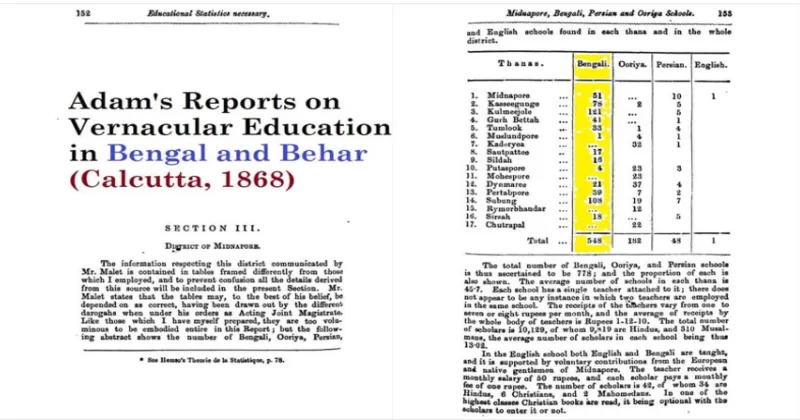
William Adam, a Scottish Baptist missionary, was commissioned by Governor-General Lord William Bentinck in the mid-1830s to examine the condition of education in Bengal and Bihar. Between 1835 and 1838, Adam submitted three detailed reports documenting indigenous village schools. These institutions were locally managed, funded by communities or parents, and conducted in regional languages such as Bengali and Hindi. Importantly, they operated outside direct British administrative control and were separate from missionary schools.

Adam’s work is often considered one of the earliest systematic attempts to map traditional education in eastern India. His findings have since become a focal point in debates over caste participation in pre-modern education.

Also Read: Adani Enterprises Defamation Case: Timeline of tweets and investigations that led to Ravi Nair’s conviction

Student Demographics: Evidence from the surveys

In districts such as Burdwan, Adam recorded a diverse student body. Of the over 12,000 Hindu students documented, Brahmins accounted for roughly 27.6%, while other upper castes made up the remaining portion of the population. Shudra students represented nearly half of the total, and students from communities categorised as “Avarna” were also present.

Similarly, in South Bihar, Adam’s data indicated that Brahmins and other upper castes together accounted for less than one-fifth of students in indigenous schools. A large majority came from occupational and agrarian communities typically classified as Shudra, with smaller but notable representation from groups identified as lower castes.

Supporters of the argument that caste barriers to education were less rigid than commonly portrayed point to these numbers as evidence that village schools admitted students from varied social backgrounds. Adam himself remarked that members of “all castes, both high and low” participated in education.

Adam also compared indigenous Hindu schools with missionary schools operating at the time. In some districts, a larger proportion of students from the lowest caste groups appeared to be enrolled in local native schools rather than missionary institutions. Proponents of a revisionist view argue that this undermines the colonial narrative portraying missionary education as the primary pathway to learning for marginalised communities.

Teacher Diversity and Social Mobility

Another notable aspect of Adam’s reports concerns teachers. While Brahmins and Kayasthas made up a significant share of instructors, Adam documented teachers from various occupational and lower-caste backgrounds as well. He even observed cases where families from higher social strata sent children to schools run by teachers of different castes or religious backgrounds. Advocates of a pluralistic interpretation argue that this reflects a degree of social flexibility within educational practices at the local level.

Colonial Narratives and Historical Interpretation

Some modern commentators argue that British colonial authorities exaggerated caste exclusion in order to justify educational intervention and missionary expansion under a “civilising mission.” They see Adam’s statistics as evidence that indigenous systems already offered a degree of inclusivity.

However, many historians caution against sweeping conclusions. While Adam’s data provides insight into certain regions and types of schooling, it does not necessarily reflect the entire Indian subcontinent or all forms of education. Elite Sanskritic or religious learning, for instance, often remained more restricted. Additionally, enrollment in elementary village schools did not automatically translate into equal access to advanced education or social mobility.

William Adam’s education surveys remain a crucial primary source for understanding early nineteenth-century indigenous schooling in eastern India. They highlight the presence of students and teachers from a wide range of castes and suggest that village education was more socially diverse than some simplified narratives imply.

 

Topics: Bengal HistoryBihar historyWilliam Adam SurveysColonial India EducationIndigenous SchoolsBritish Colonial NarrativesIndian Social History
Nandini Nair
Nandini Nair
Nandini Nair is a Subeditor-cum-Content Manager at Organiser Digital with more than 3.5 years of experience covering international, national, cultural and current affairs. Also tracks and develops impactful stories emerging from social media discourse, delivering engaging digital reporting [Read more]
ShareTweetSendShareSend
✮ Subscribe Organiser YouTube Channel. ✮
✮ Join Organiser's WhatsApp channel for Nationalist views beyond the news. ✮
Previous News

Maharashtra: Tipu Sultan portrait in Deputy Mayor’s office sparks controversy, BJP alleges disrespect to national icons

Next News

Daughters of Bharat: How Nari Shakti are strengthening India’s maritime frontiers

Related News

Maharani Kamsundari Devi

Remembering Maharani Kamsundari Devi, who gave gold to India during 1962 Indo-China war, yet forgotten by Congress

Motifs of Bhagwan Ganesha and a dancing female figure at Adina mosque, Malda

Adinath Mandir: The forgotten Mandir beneath Bengal’s grand mosque

Load More

Latest News

Shri Ram Janmabhoomi Teerth Kshetra Trust accepts resignation on moral grounds; SIT submits interim report

Ayodhya Ram Mandir Donation Row: Trust accepts resignations, promises greater transparency; SIT submits interim report

Nida Khan one of the accused in Nashik TCS Corporate Jihad Case gets bail

Nashik TCS Corporate Jihad Case: Court grants bail to Nida Khan in conversion and sexual harassment case

Karnataka State BJP files complaint with Election Commission over irregularities in voter verification

Karnataka SIR Row: NDA submits documentary evidence to Election Commission, alleges irregularities in voter revision

Hindenburg report was a conspiracy to tarnish the image of India’s industrial sector using the Adani Group as a pretext

Battlefield to Top of the World: Indian Paralympian Hokato Hotozhe Sema becomes No.1 in shot put F57 category

Editor of Organiser Weekly Prafulla Ketkar and West Bengal Governor R N Ravi at the Narad Jayanti Udjapan & Narad Samman 2026

Whether my reporting is in the interest of nation or not is a litmus test for journalist: West Bengal Governor R N Ravi

POJK Protests: A reality check on atrocities committed by Pakistan

117 pseudo-intellectuals write to PM Modi to extend diplomacy with Pakistan at the cost of national security

80 years of Organiser: Enduring voice

PM Modi and Australian PM Anthony Albanese

Powering India’s Nuclear Future: PM Modi’s Australia visit brings the landmark Uranium deal into focus

Load More
  • Privacy
  • Terms
  • Cookie Policy
  • Refund and Cancellation
  • Delivery and Shipping

© Bharat Prakashan (Delhi) Limited.
Tech-enabled by Ananthapuri Technologies

  • Home
  • Search Organiser
  • Bharat
    • Assam
    • Bihar
    • Chhattisgarh
    • Jharkhand
    • Maharashtra
    • View All States
  • World
    • Asia
    • Africa
    • North America
    • South America
    • Europe
    • Australia
  • Editorial
  • Operation Sindoor
  • Opinion
  • Analysis
  • Defence
  • Culture
  • Sports
  • Business
  • RSS @ 100
  • Entertainment
  • More ..
    • Sci & Tech
    • Vocal4Local
    • Special Report
    • Education
    • Employment
    • Books
    • Interviews
    • Travel
    • Health
    • Politics
    • Law
    • Economy
    • Obituary
  • Subscribe Magazine
  • Read Ecopy
  • Advertise
  • Circulation
  • Careers
  • About Us
  • Contact Us
  • Policies & Terms
    • Privacy Policy
    • Cookie Policy
    • Refund and Cancellation
    • Terms of Use

© Bharat Prakashan (Delhi) Limited.
Tech-enabled by Ananthapuri Technologies