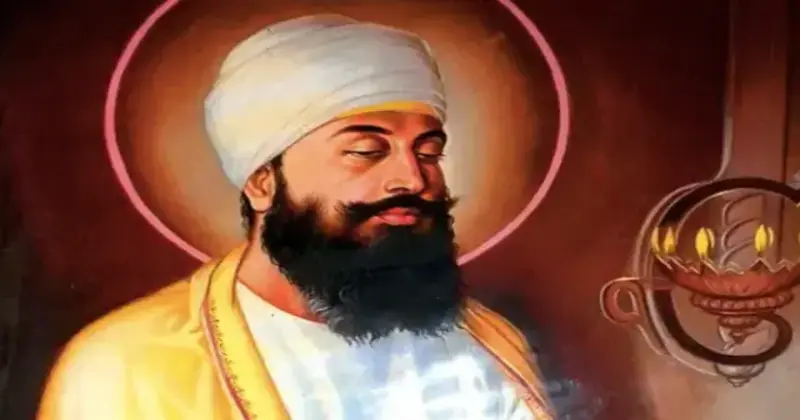
Guru Tegh Bahadur, the ninth Guru of the Sikh community, is a symbol of sacrifice, courage and religious freedom—not confined to any one religion or community, but dedicated to the entire humanity. When a spiritual master chose to offer his head rather than bow before injustice, oppression and religious persecution—without compromising his principles—he set an eternal example. On the occasion of the 350th Shaheedi Samagam (martyrdom anniversary), it is only natural that we remember that historic moment. To carry forward the saga of his unparalleled valor to next generations, after Nagpur & Nanded, a grand Shaheedi Samagam has now been organized in Navi Mumbai on February 28 & March 1.
The life of Guru Tegh Bahadur Sahib Ji represents the highest ideals of courage, sacrifice, compassion and religious liberty. He was born on April 1, 1621, in Amritsar. He was the youngest son of the sixth Sikh Guru, Guru Hargobind Sahib. While other children were engaged in play during childhood, Guru Tegh Bahadur found joy in solitude, meditation and devotion to the Almighty. This early inclination shaped his life into an example of inner strength and moral firmness rather than outward grandeur.
In his early years, Guru Tegh Bahadur received training in both Shaastra (scriptures) and Shastra (arms). He mastered warfare, horse riding and swordsmanship; yet, he never inclined towards violence or the lust for power. In his youth, he embraced a prolonged life of meditation and austerity. In 1664, Guru Tegh Bahadur became the ninth Guru of the Sikhs. At that time, the social and religious atmosphere in India was highly tense. Policies of the then ruler had led to growing religious intolerance and strict restrictions were being imposed on religious practices in many places. Accepting the Guruship in such circumstances was not merely a spiritual responsibility but a significant historical challenge.
During this period, he travelled extensively from Punjab to Bengal, Bihar, Assam and several parts of Eastern India. Through these journeys, he preached that God is One and all human beings are equal. He emphasized that the true path of devotion lies in truth, compassion and love. Guru Tegh Bahadur firmly declared that every individual has the right to live according to his or her faith and no authority has the power to snatch away that right. When this stance reached the court of the then ruler, he was summoned to Delhi. He was offered life, honor and privileges if he accepted the ruler’s religion. Alternatively, he was asked to perform miracles. Guru rejected both proposals. He believed that conversion under pressure was a betrayal of the soul and performing miracles would be an insult to the Divine. Even at the cost of his life, he resolved to uphold truth and conscience.
In 1675, Guru Tegh Bahadur was publicly executed at Chandni Chowk in Delhi. In his presence, his three devoted disciples—Bhai Mati Das, Bhai Sati Das and Bhai Dayal Das—were subjected to inhuman torture. Yet, Guru Ji remained steadfast. He accepted death but did not compromise his principles. This stands as a unique and unparalleled sacrifice in Indian history for the cause of religious freedom. The martyrdom of Sri Guru Tegh Bahadur Sahib had far-reaching consequences. It reaffirmed that the soul of India resides in tolerance, diversity and freedom of faith. Inspired by this supreme sacrifice, his son Guru Gobind Singh later established the Khalsa Panth, opening the path of organized resistance against injustice, oppression and falsehood. Thus, Guru Tegh Bahadur’s sacrifice became an eternal source of courage and self-respect for generations to come.
In today’s world, where religious intolerance, violence and hatred are rising in many regions, the message of Sri Guru Tegh Bahadur Sahib remains profoundly relevant. His life teaches that true courage lies in standing for truth. The protection of culture is achieved not by the sword, but by courage, compassion and integrity. Therefore, the name of Sri Guru Tegh Bahadur Sahib shall forever shine like an eternal flame across the Indian subcontinent.