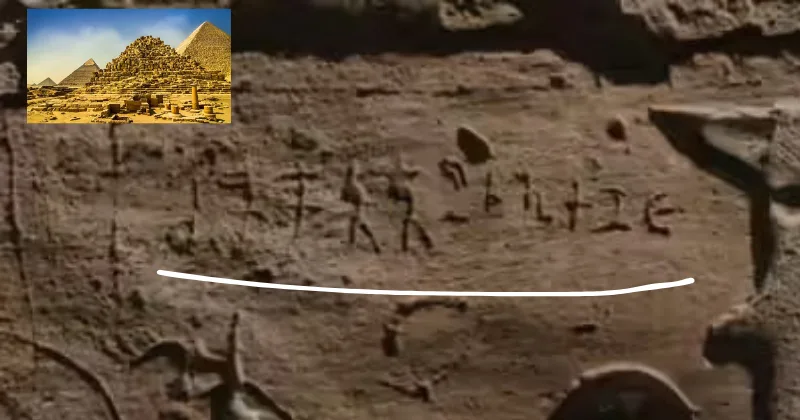
It is good news for history lovers. A rare finding that could rewrite the maritime history of ancient India, researchers have identified 2,000-year-old Tamil-Brahmi and Sanskrit inscriptions inside the high-security royal tombs of the Valley of the Kings in Egypt, a UNESCO World Heritage Site famed for its Pharaonic burials. The findings offer striking new evidence of maritime trade links between India and Egypt dating back around 2,000 years.
Commenting on the finding, TS Krishnan, author and historian, says in a post on X: “Tamil-Brahmi inscribed names discovered in Egypt are not entirely unexpected. Given the well-established maritime trade links between ancient Tamilakam and the Mediterranean world — particularly Egypt — during the Sangam age, such finds fall within a known historical framework.”
He says, “In fact, earlier discoveries include a broken pottery shard bearing Tamil-Brahmi inscriptions found in Egypt. The inscription has been read as ‘Paanai Uri’, which may be interpreted as ‘a pot hung by rope’ or ‘suspended vessel’. The artefact is generally dated to around the 1st century CE, corresponding to the height of Indo-Roman trade.
Tamil-Brahmi inscribed names discovered in Egypt are not entirely unexpected. Given the well-established maritime trade links between ancient Tamilakam and the Mediterranean world—particularly Egypt—during the Sangam age, such finds fall within a known historical framework.
In… pic.twitter.com/8PKzUK2pS4
— 𑀓𑀺𑀭𑀼𑀱𑁆𑀡𑀷𑁆 🇮🇳 (@tskrishnan) February 12, 2026
A netizen, Badri Seshadri, who is following this news, observed and criticised a local publication, saying, “The headline from The Hindu is a sad TN-specific clickbait. Inside the news we find that the inscriptions are in Tamil, Prakrit and Sanskrit. From Berenike to Gulf countries, Indian inscriptions have been found. True, Tamil language in Brahmi script is there, but equally and more detailed Prakrit and Sanskrit are there too. I would like a nicer and honest headline: ‘Brahmi inscriptions found in Valley of Kings in Egypt’, including the tomb of Ramesses VI. The most significant discovery is the name ‘Cikai Korran’, which appears in eight different locations. Korran, pronounced ‘Kotran’, means King.”
The headline from The Hindu is a sad TN specific clickbait. Inside the news we find that the inscriptions are in Tamil, Prakrit and Sanskrit.
From Berenike to Gulf countries, Indian inscriptions have been found. True, Tamil language in Brahmi script are there but equally and… https://t.co/luTMqRktmU
— Badri Seshadri (@bseshadri) February 12, 2026
This discovery in Egypt reconfirm the trade links between ancient Tamil Nadu, others, and the Roman Empire. Two researchers have concluded that 30 inscriptions in Tamil Brahmi, Prakrit and Sanskrit are present at tombs in the Valley of the Kings in Egypt, located within ancient Thebes. The Valley of the Kings, known primarily for housing royal tombs including that of Tutankhamun, appears to have also witnessed the presence of Indian merchants. They are said to belong to the period between the 1st and 3rd centuries CE.
According to reports, the inscriptions were identified during a study in 2024 and 2025 by Professor Charlotte Schmid at the French School of Asian Studies (EFEO) in Paris and Professor Ingo Strauch of the University of Lausanne in Switzerland.
The team documented them across six tombs in the Theban Necropolis. The team continued the footprints of French scholar Jule Baillet, who surveyed the Valley of the Kings in 1926 and published more than 2,000 Greek graffiti marks.
On the inaugural day of the four-day International Conference on Tamil Epigraphy on February 11, the duo presented their findings in a paper titled “From the Valley of the Kings to India: Indian Inscriptions in Egypt” at the ongoing international conference on Tamil Epigraphy in Chennai. They said, “Individuals who made these inscriptions came from the north-western and southern regions of the Indian subcontinent, with those from the latter forming the majority.”
The researchers noted that one inscription specifically reads ‘Cikai Korran vara kanta’, which translates to ‘Cikai Korran came and saw’, reflecting the style of Greek tourist graffiti found in the same complex. They said Indian visitors seem to have followed the existing practice of leaving their names inside the tombs. The term Cikai Korran appeared repeatedly and was inscribed eight times across five tombs. The name was found near entrances and high on interior walls among other graffiti marks.
Strauch said, “The name of Cikai Korran is revealing, as its first element may be connected to Sanskrit sikha (tuft or crown). The second element, Korran, is more distinctly Tamil. The root of Korran is echoed in the Chera warrior goddess, Kotravai, and the term Korravan or Kotravan, meaning King.”
He said the name Korran also finds mention in other finds in Egypt. The professor said, “It appears as Korrapuman written on a shard discovered at Berenike, a Red Sea port city, in 1995. The name also occurs in the Sangam corpus, where the Chera king Pittankorran, praised in the Purananooru, is sometimes directly addressed as Korran. These parallel attestations are seen in inscriptions from Pugalur, the ancient Chera capital, dated back to the 2nd or 3rd century BCE.”
They said, “Two other individuals also left their names in Tamil Brahmi in these tombs. One inscription reads ‘Kopan Varata Kantan’ (Kopan came and saw). The name Kopan has also been found at Ammankovilpatti, Tamil Nadu. The other Tamil names identified include Catan and Kiran.”
Strauch said, “When I first identified these inscriptions, I could not believe it, because so many people have visited these tombs over the years and nobody had identified anything Indian. I asked Charlotte whether I was mistaken.”
These inscriptions reconfirm the ancient Indian sea voyages from Indian seaports to today’s Middle East and up to Egypt, along well-established trading routes. They also show that their movement was not only limited to seaports, but extended deep into the territory, where they marked their presence and contribution to those societies. Indian archaeologists have time and again reiterated that the trade routes were active for thousands of years.