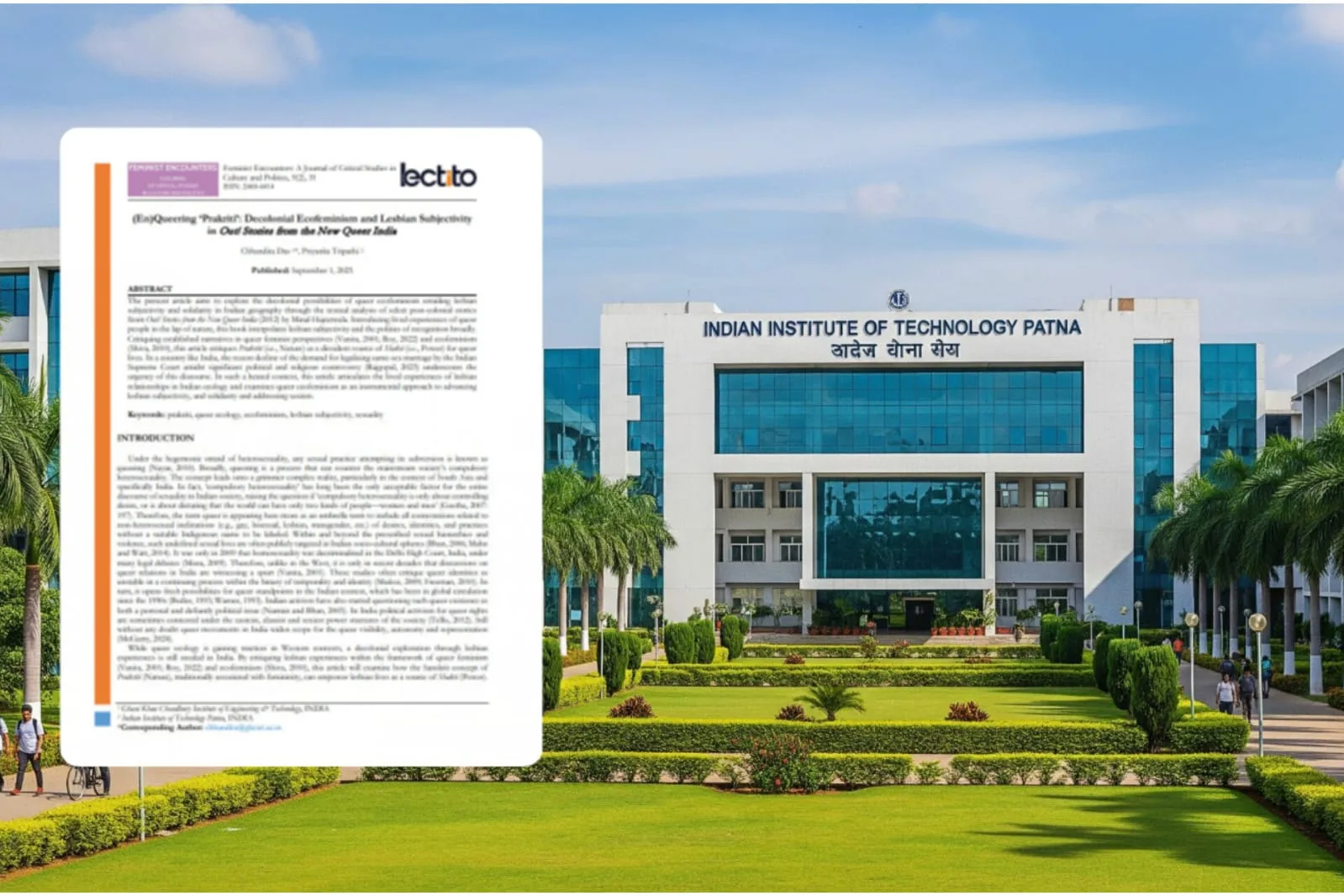
An academic paper from IIT Patna’s Humanities Department has ignited a nationwide debate after interpreting the Hindu concept of Shakti through the lens of lesbian subjectivity and queer ecofeminist theory
A recently published academic paper has placed IIT Patna at the centre of a heated national debate. The article, titled “(En)Queering ‘Prakriti’: Decolonial Ecofeminism and Lesbian Subjectivity in Out! Stories from the New Queer India,” argues that Prakriti (Nature) can be understood as a “dissident source of Shakti” for queer, specifically lesbian, subjectivity.
What has particularly angered people on social media is the paper’s claim that lesbian experience can be framed as a “heightened Shakti,” and that this reading moves “beyond the heteronormative Prakriti and Purusha dualism.” The authors further assert that “nature is queer” and go so far as to declare that “fully and properly, ecology is queer theory and queer theory is ecology.”
For many who reacted to this paper, this is not merely reinterpretation; it is a fundamental recoding of classical philosophical categories into contemporary ideological frameworks.
Metaphysics or modern activism?
In classical Sankhya philosophy, Prakriti and Purusha are ontological principles: primordial materiality and pure consciousness. They are not biological sexes, nor are they sociological categories. They describe the structure of reality itself.
By labelling this dualism “heteronormative,” they argue, the paper collapses metaphysical concepts into modern sexual politics. The philosophical architecture of Sankhya becomes reframed as a coded endorsement of heterosexuality, a move that many scholars say is intellectually untenable.
Similarly, Shakti within Shakta and broader Hindu traditions refers to divine cosmic energy, the dynamic power of the Absolute. To reinterpret it primarily through the lens of lesbian subjectivity, critics argue, risks shrinking a vast theological category into a metaphor for identity politics.
The line that sparked fury
Among the most controversial excerpts circulating online is a passage interpreting a fictional narrative in which two women die together. The paper states: “For these young women, death is liberation, not just annihilation.”
The authors frame this as symbolic resistance to compulsory heterosexuality and as an expression of “the highest Shakti of lesbianism.”
On X (formerly Twitter), this line triggered immediate backlash.
User Harshil wrote: “Read the entire paper. One word summary: Outrageous.”
He continued: “Prakriti and Purusha are ontological principles and not gender binaries. But still they are reduced to this.”
Reacting to the death-as-liberation passage, he added: “Authors romanticising death as ideological victory is dangerous moral theatre. This framing replaces dharmic struggle with fatalistic symbolism.”
He also sharply criticised the ecological claims: “How conveniently ecology is reduced to this sexuality theory?”
Another widely shared post by the account “Gems of Indian Academia” described the work as: “Distortion of Hindu Scriptures by IIT Patna’s Humanities Department… Why this is happening on tax money.”
These posts have been widely shared, with many questioning whether such theoretical experiments are appropriate in publicly funded technical institutions.
Humanities in IITs: A growing flashpoint
The controversy has once again drawn attention to the expanding role of humanities departments within IITs. Over the years, India’s premier technical institutes have broadened their academic footprint to include philosophy, cultural studies, sociology and critical theory.
Supporters argue that engineers and technologists benefit from exposure to critical thinking and interdisciplinary scholarship. But many say some strands of contemporary theory appear disconnected from India’s intellectual traditions and from the core technical mission of these institutes.
For detractors, the IIT Patna paper represents a deeper problem: the application of Western theoretical frameworks, queer theory, ecofeminism, post-structuralism, onto Indic metaphysical systems in ways they believe distort foundational meanings.
IIT Delhi Dalits and Palestinian row
In January this year, IIT Delhi’s Department of Humanities and Social Sciences hosted the “Critical Philosophy of Caste and Race (CPCR3)” conference, an academic event that quickly drew national attention for its ideological framing. The conference sought to situate caste within global theoretical paradigms of race, structural power, and human rights. However, it was a particular session titled “What’s common between Dalits and Palestinians?” that became the focal point of controversy. Many argued that drawing a parallel between Dalit experiences in India and the Israel-Palestine conflict risked importing a highly polarised geopolitical issue into domestic social discourse, potentially oversimplifying complex and historically distinct realities.
Keynote speakers such as Paul Divakar and Gajendran Ayyathurai framed caste within international advocacy and comparative race frameworks, reinforcing the conference’s globalised lens. Many contended that the repeated emphasis on race analogies and transnational activism, particularly the Dalit-Palestinian comparison reflected a narrow ideological spectrum, with insufficient representation of constitutional reform perspectives, indigenous intellectual traditions, or alternative sociological analyses rooted within India’s own historical context.
The January conference has since been viewed in the context of earlier campus controversies at institutions such as JNU, IIT Madras, and IIT Bombay, where academic programming triggered wider debates about ideological bias and academic freedom.
The ‘Nature is Queer’ claim
Perhaps the boldest claim in the paper is the assertion that “nature is queer” and that ecology and queer theory are essentially interchangeable.
This rhetorical leap has been widely mocked online. People argue that ecological science concerns biodiversity, systems, and environmental balance not identity theory. Equating the two, they say, substitutes slogan for scholarship.
Even among those open to interdisciplinary work, the sweeping nature of the claim has raised eyebrows. Does metaphor become ontology? Can poetic language stand in for philosophical argument?
A larger cultural question
The uproar is not merely about one paper. It reflects a broader cultural fault line: how should ancient philosophical traditions be engaged in modern academia? Where does reinterpretation end and reduction begin?
For people who are reacting to this, describing Prakriti-Purusha as “heteronormative” and framing lesbian identity as a new locus of Shakti represents not creative engagement but conceptual overreach. They see it as imposing contemporary ideological templates onto metaphysical systems that operate on entirely different planes.
As of now, IIT Patna has not issued a formal response to the online backlash. The paper remains part of peer-reviewed academic discourse.
But the reaction shows that debates once confined to journals now spill instantly into the public arena. And when sacred philosophical categories are involved, those debates quickly become emotionally charged.
What is clear is this: the IIT Patna paper has struck a nerve. Whether seen as bold theorising or as reckless reframing, it has forced a national conversation about the direction of humanities scholarship in India’s most prestigious institutions and about how far reinterpretation can go before it loses philosophical grounding altogether.
