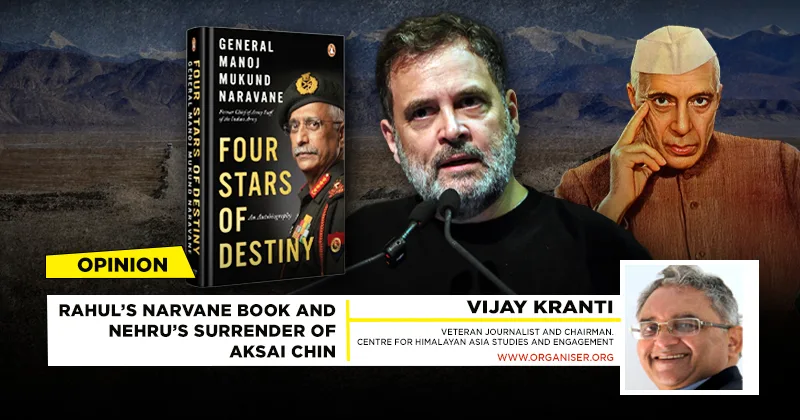
Ignorance is bliss in many cases. It looks more true in the case of Congress leader Rahul Gandhi. The enthusiasm and energy which he has demonstrated in waving what he claims to be a copy of retired Indian Army Chief General Manoj Narvane’s unpublished book ‘Four Stars of Destiny’ in the Parliament surely reflects his frustration against the Modi government. Clearly, the real thrust of his latest aggression is to establish that Modi acted as a weak Prime Minister and lacked the guts during the Galwan clash and the subsequent standoff with China. As a corollary, he wants to show the people of India that his Congress Party would have handled it more bravely.
But had Rahul Gandhi ever bothered to read the recent history of India, or even of his own Nehru-Gandhi family, his anger and arrogance over the Narvane book would have deflated before he even thought of raising this issue in public. It is interesting to note that almost every opposition political party and their leaders who have decided to stand behind Rahul in this episode have been far more critical of Rahul’s Congress Party, especially his great-grandfather, Pandit Jawahar Lal Nehru, in his dealings with China. It was Nehru’s spineless and thoughtless indifference that allowed China to walk away with India’s strategically sensitive 38,000 sq km of land in Aksai Chin, Ladakh. It is not a coincidence that because of China’s grabbing of Aksai Chin, and hence its permanent presence there, has rendered entire Ladakh, especially the areas of Pangong Tso, Galwan, Demchok, Siachin and Daulat Beg Oldi, vulnerable, which are today in the focus of Rahul’s protests.
The real story had started in 1951 when China occupied Tibet, and the millennia-old ‘India-Tibet’ border suddenly became the ‘India-China’ border overnight. But Nehru’s one-sided love affair with China was so overwhelming that until China invaded and gave India a humiliating and demoralising defeat in 1962, he maintained blind faith that China would do anything wrong to India. In 1952, 1953, 1955 and 1957, despite repeated warnings from India’s Trade Representative in Tibet, the Intelligence Bureau, Indian Military Intelligence, a friendly British mountaineer and even the Chinese government itself that China had entered Aksai Chin and was constructing a highway to connect Tibet with Xinjiang, Mr Nehru refused to accept it. In 1955, when a British mountaineer, Sidney Wignall, informed the Indian Army about the presence of Chinese soldiers in Aksai Chin, a senior general went to brief Defence Minister VK Krishna Menon on this subject. But instead of appreciating the General, the Defence Minister rebuked him in Nehru’s presence for “lapping up CIA propaganda” against China.
Later, when the Beijing government formally invited the Indian ambassador and his Military Attaché in Beijing in 1957 to join the inauguration of the Tibet-Xinjiang highway, the Nehru government raised no objection. It simply decided to keep away from the ‘celebration’ lest it be interpreted as India’s acknowledgement of China’s presence in the area. Finally, with this inauguration, China had not only formally annexed India’s 38,000 sq km area of Ladakh, but it had succeeded in linking China’s two recently occupied colonies, Tibet and East Turkistan (China’s new name ‘Xinjiang’ after occupation in 1949). This strategic road was 1179 km long, which traversed 179 km through Aksai Chin, and the remaining 1000 km ran along India’s border in Tibet and southern East Turkistan. It closely passed by India’s sensitive areas like Demchok, Galwan and Siachin. Unfortunately, Nehru and his Defence Minister had no time or desire to even find out what route this road had taken or what dangers it could pose to India’s security.
In March 1957 the Indian Army had, on its own initiative, deputed a team of Lt. Col RS Basera of 1-Kumaon Rifles and Havildar Diwan Singh from the Corps of Engineers to secretly travel to Aksai Chin area in the guise of Ladakhi yak herders to confirm the reports about the road construction. After an arduous two week journey from Leh to Pangong Lake and then via Karakoram Mountain Range and across the Syok River they could finally see the Chinese road with some military trucks plying on it. After their return the Director of Military Intelligence (DMI) took the two personally to the Prime Minister Nehru and Defence Minister Menon in New Delhi to brief them about the severity of situation. But to utter shock of DMI he was rebuked by Menon in presence of Nehru for spoiling relations with a ‘friendly neighbour’ and was ordered not to send any such patrols again to that area. However, soon New Delhi decided to ensure that the road was actually passing through Indian territory of Aksai Chin. According to “the History of the Conflict with China 1962”, the official account of the Ministry of Defence, Army Chief Gen. KS Thimayya deputed two reconnaissance and survey teams to Aksai Chin for this purpose. While the team lead by Lt. GKK Iyengar of Military Engineers was sent from North the other party under ITBP DSP Karam Singh was sent from South side. The ITBP team return with confirmation that the road was within the Indian territory but the other team was arrested by the Chinese PLA.
In early 1958, only five months after the ‘official’ opening of the highway Indian Foreign Secretary Subimal Dutt wrote to Nehru in which he pointed out that the newly constructed Tibet-Sinkiang highway ‘seemed’ to be passing through Indian territory of Aksai Chin. He even advised the Prime Minister to send a reconnoitering team ‘in the coming spring’ to check it had been really built on the Indian territory. Nehru agreed but feeling that it will not be very helpful, he instructed Dutt to instead send a strong letter to Beijing. But soon he asked him to send only ‘our maps’ of the area to the Chinese. However, the same day Nehru stopped the Foreign Secretary from sending the maps saying that he would himself raise the issue with the Chinese Premier informally. But no records show that Nehru ever raised the issue with the Chinese leadership later. It was only a year after the official opening of the highway that the Nehru government decided to lodge a formal complaint with Beijing about this ‘intrusion’.
But this formal complaint turned out to be far more disappointing than the casual and indifferent attitude of Pt Nehru, his Defence Minister and the MEA. The final action taken by Nehru’s government against China usurping such a vast and strategically important area of Ladakh in Aksai Chin and constructing a 179 km long section of its Tibet-Sinkiang highway through the Indian land turned out to be nothing more than an ‘informal’ note handed over by the Indian Foreign Secretary to the Chinese Ambassador in New Delhi on October 18, 1958. And that too more than a year after China had already inaugurated and celebrated its opening. Rather than asserting India’s sovereign right over Aksai Chin and protesting against construction of a military road through the Indian territory the Foreign Secretary’s note expressed ‘surprise’ and ‘regret’ that neither the “permission of Government of India was sought nor it was informed about constructing this road through the ‘indisputably Indian territory’”.
Apparently, to add more weight and seriousness to this protest letter the Indian note pointed out that “No applications for visas from Chinese personnel working on the road or from Chinese travellers traversing this road have ever been received by the Government of India.” Reflecting Pandit Nehru’s characteristic concern about ‘friendly’ relations between India and China the note concluded with the remark that, “As the Chinese Government are aware, the Government of India are anxious to settle these petty frontier disputes so that the friendly relations between the two countries may not suffer.” It is worth noting that the Nehru government is referring to the grabbing of 38,000 sq km of its land by China as a ‘petty’ frontier dispute. Still more interesting was the level of Nehru’s concern about the Indian Army team which was arrested and still under Chinese custody. Expressing a timid concern about the arrest of India’s patrol party of Lt Iyengar and his team of thirteen other officers, soldiers and pony owners by the Chinese, the note ended by asking the Chinese side if they had ‘seen’ this patrol party who has been reported ‘missing’ in that area?
The worst and most unfortunate facet of Nehru government’s indifference towards the fate of Aksai Chin came to fore in the Indian Parliament on April 22, 1959 when Nehru outright rejected query of an MP Braj Raj Singh who wanted to know about the truth of newspaper reports about China occupying over 30,000 sq km area of Aksai Chin in Ladakh. Nehru advised Singh and fellow MPs not to pay attention to such news items “emanating from Hong Kong or other odd places.”
It is worth noting the impact and consequences of China grabbing such a huge mass of strategically located land. It started with China using this part and the road network it has developed in this area to launch its first attack on India in 1962. Since then the PLA has used its presence in this area for gradually salami slicing of Indian lands in Ladakh. China’s Galwan action in 2020 and the resulting standoff involving over 50,000 troops each on both sides has proven how indifference and inaction at one moment of history can have such serious consequences. Last month’s news that construction of a new road in the Shaksgam area by the PLA has created new danger to the security of Siachin as well as the adjoining Indian defence posts in Galwan and Daulat Beg Oldi is yet another reminder of the costs of the indifference of Prime Minister Nehru.