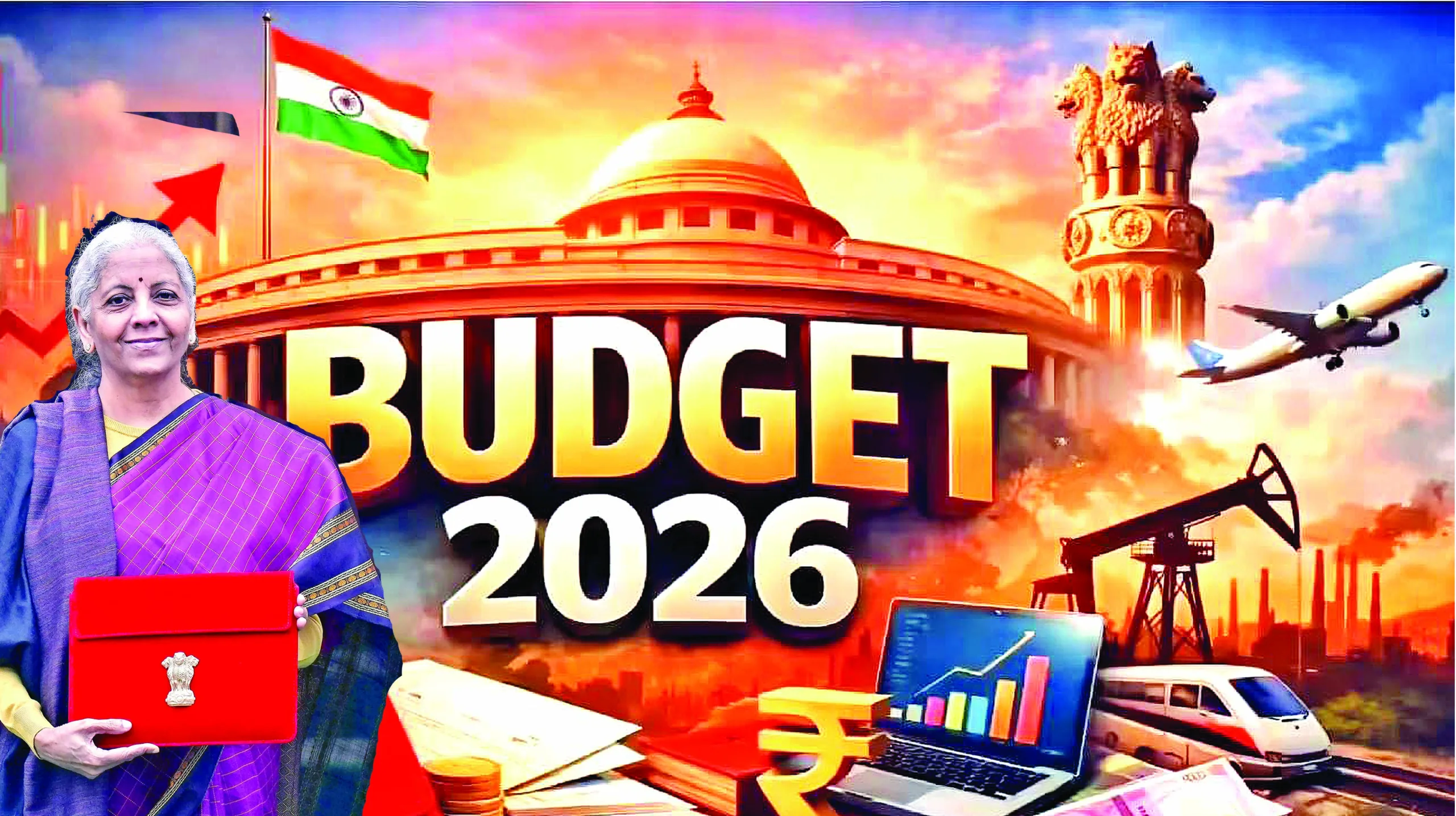
In the corridors of politics and economics, one usually hears the clamour of numbers. Yet the Union Budget 2026–27, presented in Parliament on Sunday, February 1, 2026, was not merely a document of figures. It emerged as a rare confluence of time, culture, and policy. The day itself bore testimony to Bharat’s civilisational pulse and the dialogue between the North and the South.
In Southern Bharat, it was the sacred festival of Thaipusam—a celebration of Lord Murugan’s victory, wisdom, and courage. In Northern Bharat, it was Magh Purnima—the culmination of Kalpavas, a day of charity and the serene compassion of the full moon. For Finance Minister Nirmala Sitharaman, whose roots are embedded in the cultural soil of Madurai, this was not a mere calendrical coincidence.
Just as Goddess Parvati bestowed upon Lord Murugan the Vel (spear) to destroy adharma and ignorance, this Budget appeared with the same symbolic force, as a policy Vel piercing structural barriers in the Bharatiya economy, and as an economic amrit nurturing growth.
In her speech, the Finance Minister stated clearly: “This Budget is not merely an account of income and expenditure. Just as the Vel pierces obstacles and Purnima signifies completeness, our objective is to eliminate regulatory complexity and nourish productivity.” For industry and taxpayers, the Budget’s Vel took concrete form as the Direct Tax Code 2026. The announcement to repeal the more than six-decade-old Income Tax Act, 1961 signals that growth will no longer be stifled by litigation and ambiguity.
In the words of a senior economist, “This Budget strikes directly at administrative inertia. Removing over 350 obsolete provisions to make taxation dispute-free is truly akin to wielding the Vel against bureaucracy.”
Alongside this, the government announced the ‘Nirvighna Mission’—a single-window digital clearance system aimed at reducing industrial approvals from months to minutes. This represents a modern manifestation of the spirit of Thaipusam, where devotees seek liberation from obstacles; here, entrepreneurs are freed from red tape.
The Offering of Magh Purnima
If the Vel was designed for the corporate and investment world, the gentle radiance of the full moon was reserved for farmers and the rural economy. Magh Purnima is traditionally associated with charity, balance, and nourishment. The Budget, too, moved beyond a subsidy-centric approach towards sustainable nourishment.
The most significant announcement in this direction was ‘Bharat-VISTAAR’—an AI-driven agricultural advisory platform that will provide 120 million farmers with precise, local-language information on weather, soil, and markets.
As the Finance Minister remarked: We are no longer merely “watering the plant”; we are “nourishing the soil.” True inclusive growth is achieved when even the smallest farmer has access to the same knowledge and technology as large agri-businesses.
Additionally, the ‘Annapurna Bio-Grid’ was proposed—a decentralised network of cold storage and food processing units to prevent crop losses before produce reaches the market. This is a policy translation of Magh Purnima’s ethos of abundance and food charity.
The Saptarishi Balance
This philosophy of nourishing growth was not confined to agriculture alone. Treating infrastructure as the protein of the economy, the government increased capital expenditure to Rs 12.5 lakh crore.
The key pillars of this strategy include:
- MSME ‘Udyog Shakti’ Fund: A Rs 15,000 crore dedicated fund to help micro enterprises scale into medium businesses.
- Biopharma Sovereignty Mission: An initiative to position Bharat as a global hub for biologics and APIs.
- Green Energy Corridor: A plan to connect Southern Bharat’s solar and wind potential with Northern Bharat’s industrial centres—symbolising not only economic but also cultural integration.
Political questions raised over the Sunday presentation of the Budget faded in comparison to the cultural significance of the date. By weaving together the symbols of Thaipusam (Tamil Nadu) and Magh Purnima (Northern Bharat), the Finance Minister constructed a civilisational bridge over the oft-cited North–South divide.
An opposition MP informally acknowledged in the Central Hall of Parliament:
“This was soft power politics, an attempt to simultaneously honour Tamil cultural symbols and the sanctity of Magh bathing.”
Budget 2026: Key Highlights (Prasad)
- Direct Tax Code 2026: Repeal of the Income Tax Act, 1961
- Bharat-VISTAAR: AI-based agricultural advisory platform
- Nirvighna Mission: Single-window industrial approvals
- Capital Expenditure: ₹12.5 lakh crore
- Udyog Shakti Fund: Special credit support for MSMEs
A Complete Thali
As the sun set over Raisina Hills and the Magh Purnima moon rose, it became evident that Budget 2026–27 is not a short-term “freebie” budget. It is a nourishing, balanced, and long-term vision document—rich in infrastructure protein, fortified with the vitamins of digital reform, and free from the excess fat of unnecessary regulation.
For a Bharat aspiring to double-digit growth, the daughter of Madurai has served a sattvic, complete, and thoughtful economic thali. The real test now lies in one question: Is our implementation machinery prepared to digest it?