“It is my proposal tonight to bring before you points where we are agreed, to find out, if we can, a ground of agreement; and if through the grace of the Lord such a state of things be possible, let us take it up, and from theory carry it out into practice. We are Hindus. I do not use the word Hindu in any bad sense at all, nor do I agree with those that think there is any bad meaning in it. In old times, it simply meant people who lived on the other side of the Indus; today a good many among those who hate us may have put a bad interpretation upon it, but names are nothing. Upon us depends whether the name Hindu will stand for everything that is glorious, everything that is spiritual, or whether it will remain a name of opprobrium, one designating the downtrodden, the worthless, the heathen. If at present the word Hindu means anything bad, never mind; by our action let us be ready to show that this is the highest word that any language can invent.”
–Swami Vivekananda, in his lecture at Lahore in November 1897 titled ‘The Common Bases of Hinduism’, The Complete Works of Swami Vivekananda, Volume 3, Lectures from Colombo to Almora
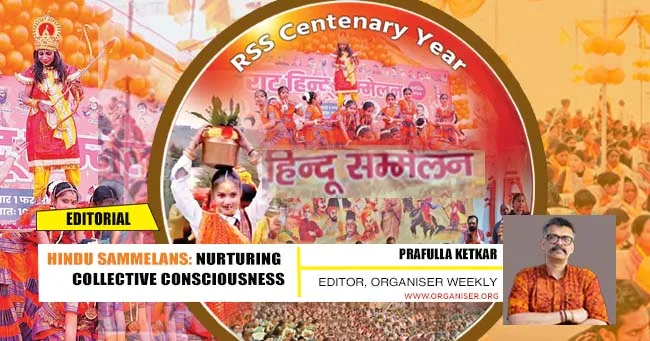
Marking the centenary year (Shatabdi Varsh) of the Rashtriya Swayamsevak Sangh (RSS), over 80,000 Hindu Sammelans (conventions) are being organised across Bharat. Like the idea behind an organisation called RSS, the holding of these events is also unique and exemplary. From the corners of Bharat, when we hear news of Hindu Sammelans, we need to decode their significance, future role, and possible impact.
A hundred years ago, the Sangh started with the objective of organising the entire Hindu society, which was relegated to self-oblivion and dejection during the colonial period. After achieving a critical mass of trained Swayamsevaks across Bharat, the Sangh is trying to reach the unreached through both personal and mass contacts. The current phase of Hindu Sammelans is part of the mass outreach. Coming together is the beginning. When attempts are being made to divide the society on caste, linguistic or regional lines, various social organisations representing different castes and sects are coming together as Hindus at more than 80,000 places, which itself is an exemplary way to showcase the path for transformation. The Sammelans feature participation from local community leaders, sants from various sects, intellectuals, and citizens, starting with – a procession and concluding with community meals and discussions on social issues. Such an exercise will foster collective confidence and strength in society, grounded in the values of equality and fraternity.
Mere coming together is not sufficient, but thinking together is also critical. Who are we? Despite outward differences, what are the common binding factors that make us one Rashtra? Hindu means seeing the oneness of existence. Diversity is just the manifestation of the same energy or divinity. The idea that different paths lead to the same destination is common to all Bharatiya sects. Hence, diversity should be celebrated while realising the inherent unity. This fundamental Darshan or philosophical experience makes us Hindu. The fundamental thought of diversity of unity was experienced and lived with in this sacred land of Bharat, which we revere as motherland. That provides us with a solid edifice for fraternity. And because we share a common worldview and a common motherland, we have a collective consciousness of our ancestry and worldview. Amidst the geopolitical, economic, and environmental turmoil, we face common challenges – both at the local and global levels. We have to mitigate them together. Thinking about them as Hindus is the second important objective of the Hindu Sammelans.
Working together is pertinent for success. After coming together and working together, we need to nurture common values and goals across our individual, familial, and societal spheres. The agenda of Panch-Parivartan – promoting social harmony, family values, an environment-friendly lifestyle, a sense of selfhood, and national duties – is the future action plan that would enable us to be the Rashtra that Swami Vivekananda had envisioned.
As the Rashtriya Swayamsevak Sangh (RSS) marks its centenary year, it is not celebrating the occasion as an organisational milestone, but nurturing a collective consciousness of the shared civilisational identity and responsibility through the Samaj Utsav of Hindu Sammelans.