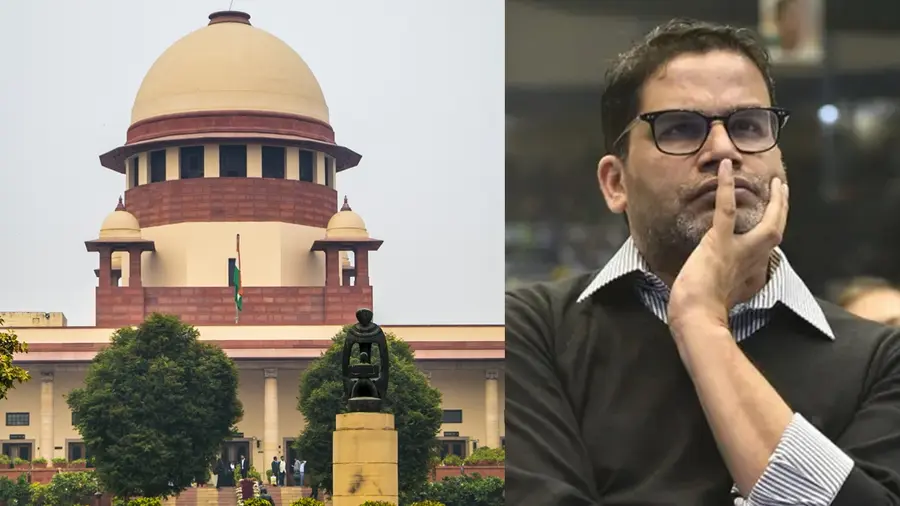
The Supreme Court on Friday (Feb 6) refused to entertain a petition filed by Jan Suraaj, the political party led by poll strategist-turned-politician Prashant Kishor, challenging the results of the Bihar Assembly elections held in November last year. The court made strong remarks on the party’s defeat, observing that the electorate had clearly rejected it.
A bench headed by Chief Justice Surya Kant dismissed the plea, remarking, “The people rejected you and now you are using this judicial platform to gain publicity?” The bench made it clear that election outcomes could not be challenged before the apex court in such a manner, particularly by a party that failed to secure public mandate.
Justice Joymalya Bagchi, who was also part of the bench, questioned the maintainability of the petition and asked Jan Suraaj’s counsel how such claims could be raised directly before the Supreme Court. The bench declined to hear the matter under Article 32 of the Constitution and directed the petitioner to approach the Bihar High Court, the appropriate forum for such disputes.
Jan Suraaj had sought to have the Bihar Assembly election results declared null and void, alleging large-scale violations of the Model Code of Conduct by the ruling Janata Dal (United)–Bharatiya Janata Party alliance. The party claimed that the state government’s decision to provide financial assistance of Rs 10,000 to one woman per family during the election period had compromised the fairness of the polls.
According to the petition, the benefit was extended to an estimated 25 to 35 lakh women while the Model Code of Conduct was in force, which Jan Suraaj termed as “corrupt practices” aimed at influencing voters. Prashant Kishor had earlier alleged that the JD(U) distributed crores of rupees per constituency and claimed that the ruling party should not have won more than 25 seats under normal circumstances.
However, the election results contradicted these claims, with Chief Minister Nitish Kumar’s JD(U) emerging as the single largest party by winning 85 seats, significantly improving its performance compared to previous elections.
The Supreme Court also noted that the larger issue of election freebies was already under its consideration in a separate matter. In earlier observations, the court had cautioned that competitive promises of financial benefits could push states towards fiscal distress and had referred the issue to a three-judge bench for detailed examination.
On Friday, the bench reiterated that while the court was serious about examining the issue of freebies, it would prefer petitions from “public-spirited” individuals rather than political parties that had suffered a complete electoral rout.
Jan Suraaj’s challenge comes after a disappointing electoral debut for the party, which contested 238 seats in the Bihar Assembly elections but failed to win a single constituency. The party secured a vote share of less than four per cent, marking a significant setback for Prashant Kishor, who had previously played a key role in crafting election strategies for parties such as the BJP and the JD(U).
Kishor had earlier acknowledged the high-risk nature of his political foray, stating that the outcome would either be a major breakthrough or a total failure. The Supreme Court’s dismissal of Jan Suraaj’s plea now brings a judicial closure to the party’s attempt to challenge the Bihar election verdict.