The uproar in the Lok Sabha over Rahul Gandhi’s reference to an unpublished memoir allegedly authored by former Army Chief General M. M. Naravane was neither accidental nor inevitable. It was the predictable outcome of a political style that has increasingly relied on provocation over preparation, insinuation over substantiation, and spectacle over statesmanship.
During the debate on the President’s Address, the Leader of Opposition chose to anchor his remarks on India-China border tensions by citing a magazine article that itself quoted from Four Stars of Destiny, an unpublished memoir. The problem was not merely procedural; it was profoundly political and constitutional.
By invoking material that had neither been published, authenticated, nor placed before Parliament, Rahul Gandhi walked straight into the heart of Rule 349 of the Rules of Procedure and Conduct of Business in the Lok Sabha, a rule designed precisely to prevent such reckless interventions.
What Rahul Gandhi said?
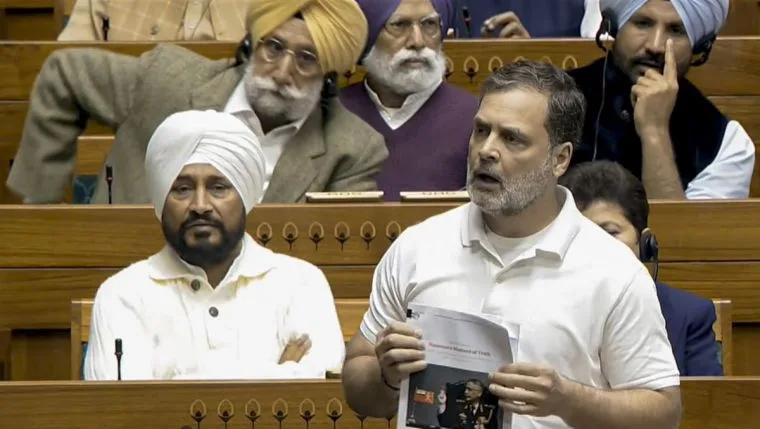
During the debate on the Motion of Thanks to the President’s Address in the Lok Sabha, Leader of Opposition Rahul Gandhi attempted to respond to BJP allegations questioning the Congress party’s patriotism by citing China-related content from an unpublished memoir of former Army Chief General M. M. Naravane (Retd).
Gandhi stated that he was quoting a magazine article which had published excerpts from the former Army Chief’s unpublished book, Four Stars of Destiny. In his speech, he used the phrase “Chinese tanks in Doklam”, claiming it appeared in the book, and displayed printed copies of the magazine article inside the House to substantiate his claim.
He clarified that he was not directly quoting the book but referencing a published media report based on it, which he maintained was authentic, and said he was doing so to respond to BJP MP Tejasvi Surya, who had questioned the Congress’s nationalism.
Despite objections, Gandhi challenged the Treasury benches, asking what the government was “scared” of, and continued to refer to both the memoir and the magazine article.
What MM Narvane said?
Former Army Chief General M. M. Naravane has put the matter beyond doubt. His position has been unequivocal: “Not an inch of land has been lost. We are exactly where we were before.”
Despite this categorical clarification, Rahul Gandhi has chosen to distort facts to suit his political narrative, dragging the name of a former Army Chief into partisan mudslinging. Shockingly, this was done by selectively invoking an unpublished book, a source that has neither been officially released nor authenticated.
As General Naravane himself stated, “We showed the world that it is possible to take on the bully China.”
𝐒𝐡𝐚𝐦𝐞𝐟𝐮𝐥 𝐩𝐨𝐥𝐢𝐭𝐢𝐜𝐬 𝐛𝐲 𝐑𝐚𝐡𝐮𝐥 𝐆𝐚𝐧𝐝𝐡𝐢! ❌
Former Army Chief General M. M. Naravane has stated clearly:
“𝐍𝐨𝐭 𝐚𝐧 𝐢𝐧𝐜𝐡 𝐨𝐟 𝐥𝐚𝐧𝐝 𝐡𝐚𝐬 𝐛𝐞𝐞𝐧 𝐥𝐨𝐬𝐭. 𝐖𝐞 𝐚𝐫𝐞 𝐞𝐱𝐚𝐜𝐭𝐥𝐲 𝐰𝐡𝐞𝐫𝐞 𝐰𝐞 𝐰𝐞𝐫𝐞 𝐛𝐞𝐟𝐨𝐫𝐞.”Yet, to push his… pic.twitter.com/s5aMZEvApB
— BJP (@BJP4India) February 2, 2026
India’s Armed Forces stood firm in Galwan, acted with restraint and resolve, and sent an unmistakable message to the world: India will not be coerced, intimidated, or pushed back. Leadership, strength, and national will prevailed on the ground.
Yet Rahul Gandhi continues to question the word of a former Army Chief, repeatedly suggesting loss of territory despite clear official statements to the contrary. Instead of standing with India’s soldiers, he has consistently undermined the country’s position, amplifying narratives drawn from foreign agencies and external commentators to score domestic political points and appease his overseas audience.
What Rule 349 actually protects
Rule 349 is not a technical hurdle meant to inconvenience Members of Parliament. It exists to safeguard the credibility, dignity and security of parliamentary proceedings.
Clause (i) of the rule explicitly states that a member “shall not read any book, newspaper or letter except in connection with the business of the House.” Over decades, parliamentary convention has refined this to allow references to published, verifiable material, provided the member is willing to take responsibility for its accuracy and provided it does not compromise national interest.
What Rule 349 emphatically does not permit is the selective introduction of unverified, unpublished, and potentially sensitive material, especially when it concerns military operations, border disputes, or national security.
Rahul Gandhi’s defenders have tried to portray the Speaker’s intervention as censorship. This is disingenuous. The Speaker did not silence debate on China; he stopped the House from being misused as a platform for hearsay wrapped in authority.
Unpublished memoirs and national security
There is a reason why memoirs of former military chiefs undergo rigorous vetting before publication. Such texts often deal with operational decisions, intelligence assessments, diplomatic negotiations, and classified experiences. Until they are officially cleared and released, they remain legally and ethically sensitive documents.
By attempting to quote from such a source, Rahul Gandhi crossed a line that responsible parliamentarians instinctively avoid. Even if the excerpt had been reported in a magazine, the underlying source remained unpublished and unauthorised for parliamentary citation.
Defence Minister Rajnath Singh and Home Minister Amit Shah were correct in objecting, not as political adversaries, but as constitutional custodians of national security. The Speaker’s ruling reaffirmed a foundational principle: Parliament is not a rumour mill, nor a courtroom for untested allegations.
A familiar pattern of provocation
This episode does not exist in isolation. Rahul Gandhi has a long and troubling record of making statements on India’s territorial integrity that are then celebrated by hostile foreign media and weaponised by adversarial states.
From “China has taken our land” remarks made outside Parliament to repeated insinuations that India’s military leadership is hiding the truth, the Congress leader has often chosen to echo narratives that weaken India’s diplomatic position, sometimes even contradicting official statements from the armed forces themselves.
Former Army Chief General Naravane had publicly stated that not an inch of Indian territory was lost during the Galwan clashes. Yet Rahul Gandhi continues to flirt with ambiguity, raising questions not to seek answers, but to cast doubt.
This is not accountability. This is political sabotage disguised as scrutiny.
When Leader of Opposition behaves like an activist
The office of the Leader of Opposition is not a megaphone for activism; it is a constitutional role demanding restraint, seriousness, and institutional respect.
Rahul Gandhi, however, often approaches Parliament as if it were a street protest, testing boundaries, pushing provocation, and then crying foul when rules are enforced.
His insistence during the proceedings questioning why he could not even paraphrase the content, betrayed either a lack of understanding of parliamentary decorum or a deliberate attempt to force a confrontation.
Parliamentary privilege is not a loophole to smuggle in half-baked claims. It is a responsibility to speak with greater care than anywhere else in public life.
Theatrics over substance
When prevented from quoting the memoir, Rahul Gandhi attempted to shift the narrative by portraying the objection as fear: “What are you afraid of?” he reportedly asked.
This is classic political theatre. The issue was never fear; it was fitness of material. Democracies function not on insinuation but on evidence, and evidence in Parliament must meet a higher standard than social media speculation.
A serious leader would have reframed the point using officially available data, government statements, or strategic assessments already in the public domain.
Instead, the Congress leader chose confrontation over credibility.
Speaker’s authority and the erosion of respect
One of the most damaging aspects of the episode was the implicit challenge to the Speaker’s authority. Parliamentary democracy depends on the Chair being respected as the neutral enforcer of rules.
By repeatedly questioning the ruling, seeking workarounds, and forcing adjournments, Rahul Gandhi contributed to the erosion of institutional discipline, something his party once claimed to uphold fiercely.
The same Congress that lectured the nation on constitutional values now appears increasingly comfortable undermining parliamentary authority when it suits political messaging.
Congress’ historical amnesia on national security
It is also worth recalling that the Congress party’s own record on national security, from the 1962 debacle to decades of strategic drift on China hardly qualifies it to lecture others with moral authority.
Yet Rahul Gandhi appears eager to weaponise border tensions for domestic politics, even if it means echoing talking points that adversaries find useful.
This raises an uncomfortable but necessary question: Is the Congress leadership willing to weaken India’s negotiating position just to land political blows at home?
The attempt to turn Rule 349 into a symbol of suppression is misleading. The rule functioned exactly as intended: to prevent Parliament from being misused for sensationalism and to protect national interest.
Rahul Gandhi’s clash with the Chair was not about freedom of speech; it was about freedom from responsibility.
Parliament allows robust debate, fierce criticism, and even uncomfortable questions. What it does not allow and should never allow is the injection of unverified, unpublished material into official proceedings, especially when the subject is India’s armed forces.
A moment of choice for the opposition
This episode should serve as a moment of introspection for the Congress party. Does it want to be a serious opposition offering policy alternatives and constructive scrutiny? Or does it want to continue down the path of disruption, drama and delegitimisation of institutions?
For Rahul Gandhi personally, the lesson is starker. Leadership is not measured by how loudly one speaks, but by how responsibly one uses the platform entrusted by the people.
In choosing provocation over procedure, and insinuation over evidence, Rahul Gandhi once again confirmed what many have long argued: that he mistakes disruption for dissent and controversy for courage.
(Author is a PhD in Political Communication, the views expressed are personal)