Finance Minister Nirmala Sitharaman on February 1 presented the Union Budget 2026-27 in the Lok Sabha, becoming the first finance minister in India’s history to deliver nine consecutive Budgets. The presentation comes at a time of slowing global trade, disrupted supply chains, and heightened expectations from salaried taxpayers for further rationalisation of income tax slabs.
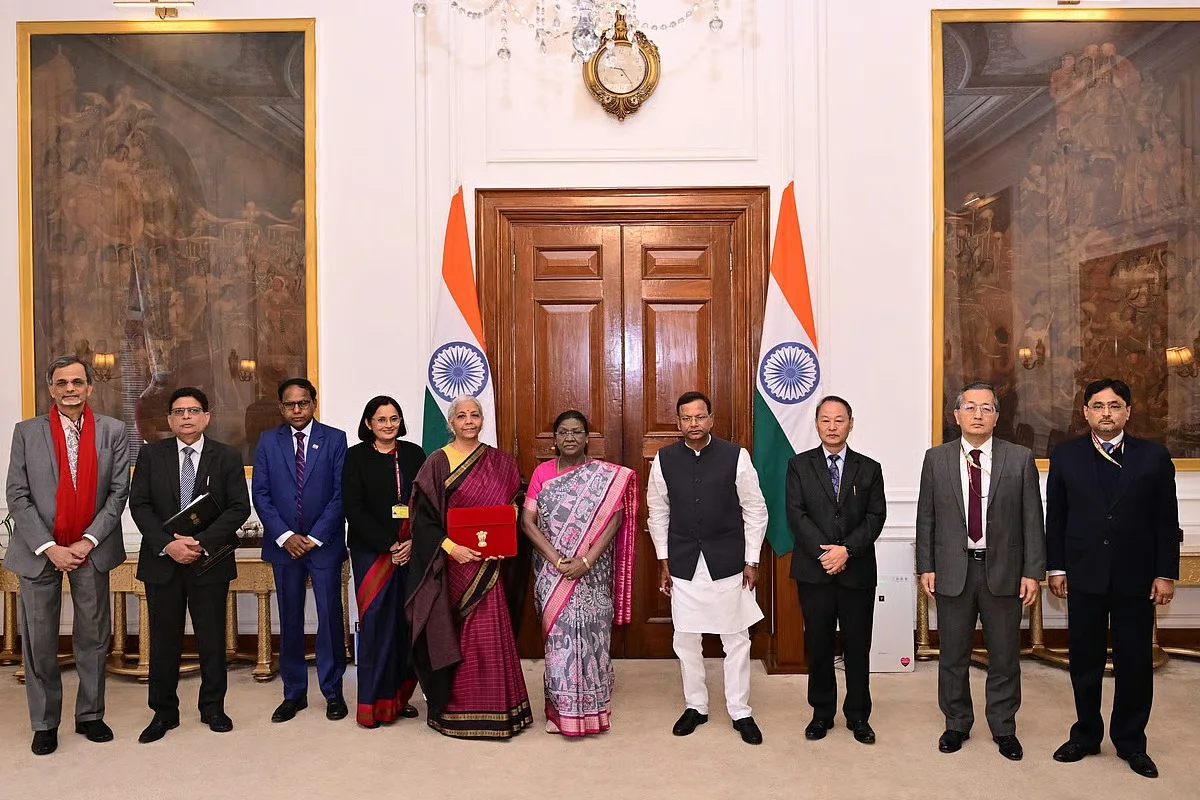
Ahead of the Budget speech, Sitharaman followed traditional protocol, calling on President Droupadi Murmu at Rashtrapati Bhavan and later proceeding to the Finance Ministry at Kartavya Bhavan. The Union Cabinet, chaired by Prime Minister Narendra Modi, approved the Budget shortly before its tabling in Parliament.
Focus on Reforms and ‘Vikasit Bharat’ Vision
In her opening remarks, Sitharaman asserted that India’s economic trajectory over the past decade has been marked by stability, fiscal discipline and moderate inflation despite global disruptions. Referring to the government’s long-term vision, she said India would continue taking “confident steps towards a Vikasit Bharat,” even as multilateralism weakens and access to critical resources becomes increasingly constrained.
Highlighting what she described as the government’s “Reform Express,” the finance minister underscored structural changes such as the Goods and Services Tax (GST), labour law reforms, and improvements in ease of doing business. She credited these reforms for enhancing productivity, competitiveness and economic resilience.
Three ‘Kartavya’ outlined by Government
Sitharaman laid out three core responsibilities, or Kartavya, guiding the government’s economic strategy. The first, she said, is to accelerate and sustain economic growth by boosting productivity and resilience amid volatile global conditions. The second focuses on fulfilling public aspirations by building capacity and enabling citizens to become partners in India’s growth journey. The third, aligned with the principle of Sabka Saath, Sabka Vikas, aims to ensure equitable access to resources across families, regions and sectors.
Income Tax Relief
While the Budget speech so far has emphasised reforms and macroeconomic stability, income tax announcements remain the most closely watched segment for salaried taxpayers and the middle class. Expectations have been shaped by last year’s significant changes, which made incomes up to Rs 12 lakh tax-free under the new tax regime, and up to Rs 12.75 lakh for salaried individuals after the standard deduction.
As of now, income tax slabs under the old and new regimes remain unchanged. Under the old regime, income up to Rs 2.5 lakh is exempt, with rates ranging from 5 per cent to 30 per cent thereafter. The new tax regime offers a more granular slab structure, with nil tax up to Rs 4 lakh and progressive rates rising to 30 per cent for income above Rs 24 lakh.
Surveys conducted ahead of the Budget indicate strong demand for increased standard deductions and clearer differentiation between the old and new tax regimes. Economists argue that meaningful relief for salaried taxpayers could help stimulate consumption at a time when global headwinds threaten growth momentum.
As the Budget speech continues, attention remains firmly fixed on whether the finance minister will translate reform rhetoric into tangible tax relief for the middle class or maintain the status quo while prioritising long-term fiscal stability.