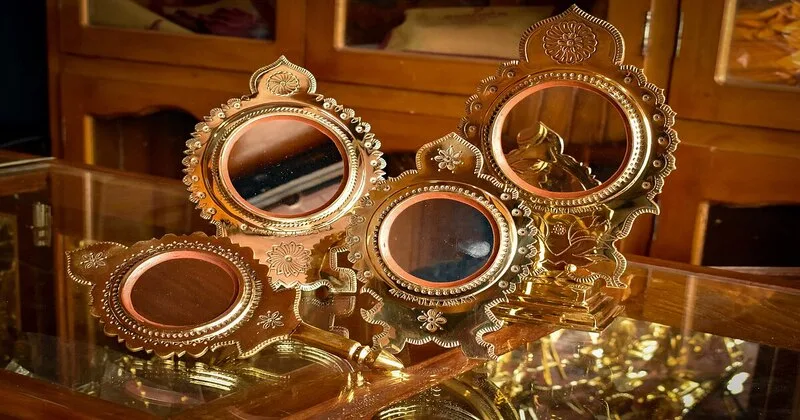
Among India’s many scientific and artisanal marvels, the Aranmula Kannadi (often spelled Kanadi) or the Aranmula metal mirror, occupies a unique and almost mystical position. Unlike conventional glass mirrors used worldwide, the Aranmula Kannadi is made entirely of metal, yet it produces a perfect, distortion free reflection. This rare mirror, crafted for centuries in the village of Aranmula in Kerala, represents a remarkable synthesis of metallurgy, optics, craftsmanship and cultural philosophy deeply rooted in Indian Knowledge Systems.
The origins of the Aranmula Kannadi are traditionally traced back over 500-700 years, during the reign of the Travancore kings. According to legend, the secret of the metal alloy was divinely revealed to a family of craftsmen associated with temple work. Since then, the knowledge has been passed down orally and experientially, within a small number of hereditary families.
Aranmula itself is a culturally significant village, known for the Parthasarathy Temple and the famous Aranmula boat race. The mirror is not merely a utilitarian object, it is regarded as auspicious, symbolizing truth, clarity, and prosperity. Traditionally, it is gifted during weddings, housewarmings and festivals such as Vishu, when it is placed alongside flowers, grains and lamps to signify abundance and self-reflection.
What makes the Aranmula Kannadi unique is its nature as a true front surface mirror. In conventional glass mirrors, light first passes through the glass and then reflects off a metallic coating at the back, a process that produces secondary reflections, slight image displacement and subtle optical distortions. The Aranmula Kannadi, however, reflects light directly from its meticulously polished metal surface. As a result, it produces an image with no parallax error, no ghost images and remarkable optical clarity.
This direct reflection mechanism ensures a level of precision and visual fidelity rarely achieved by ordinary mirrors. Remarkably, the same front surface mirror principle is now employed in advanced scientific instruments such as telescopes, laser systems and optical sensors highlighting that the craftsmen of Aranmula had mastered a sophisticated optical concept centuries before it became standard in modern science.
The metallurgical composition of the Aranmula Kannadi remains one of its greatest enigmas. Safeguarded under Geographical Indication (GI) status, the exact alloy formula is known only to a small lineage of traditional craftsmen. Scientific investigations indicate that the mirror is predominantly made from a copper – tin alloy, akin to bronze, but distinguished by highly precise elemental ratios and carefully controlled thermal treatment.
The resulting material exhibits several remarkable properties, including high reflectivity after polishing, notable hardness, structural brittleness that prevents postcasting reshaping, and strong resistance to corrosion and oxidation. Most strikingly, when finished entirely by hand using age old polishing methods, this metal surface attains a level of smoothness and reflective quality comparable to that of contemporary optical grade mirrors used in advanced scientific applications.
The crafting of the Aranmula Kannadi exemplifies extraordinary precision achieved without the aid of modern machinery. The creation of a single mirror is a painstaking and time intensive process, often spanning several weeks. It begins with the careful preparation of the alloy in traditional crucibles, followed by the casting of the molten metal into specially designed molds. The cast piece is then allowed to cool in a controlled manner to avoid the development of internal stresses.
This is followed by prolonged manual grinding and polishing, sometimes lasting many days, culminating in a final optical finish achieved using natural abrasives. Notably, no power driven polishing tools are employed at any stage. The mirror’s exceptional reflective quality emerges entirely from the artisan’s skill, tactile sensitivity and trained visual judgment, revealing a deep, experiential understanding of material properties and surface behaviour.
The scientific principles underlying the Aranmula Kannadi reveal a sophisticated convergence of optics, materials science and surface physics. From an optical perspective, the mirror exhibits near perfect specular reflection, free from double images and secondary reflections, with minimal light scattering due to its exceptionally smooth surface. In terms of materials science, the carefully controlled grain structure of the alloy, its precisely optimized composition and its thermo-mechanical stability collectively ensure durability and consistent reflective performance.
At the level of surface physics, the mirror achieves nanometer scale smoothness entirely through manual polishing, while its high reflectance arises from the collective behaviour of free electrons in the metallic surface. Together, these features demonstrate that Indian artisans were effectively practicing advanced applied physics and materials engineering, even though their knowledge was transmitted through experiential mastery rather than articulated in modern mathematical or theoretical frameworks.
The Aranmula Kannadi offers a profound illustration of the principles of Indian tradition, where material craftsmanship is inseparable from philosophical insight. The mirror embodies the classical Indian idea “यथा दृष्टं तथा सत्यम्”, reality is exactly as it is perceived, without distortion. Unlike conventional mirrors that subtly modify or duplicate images, the Aranmula Kannadi represents truth in its undiluted form, free from illusion.
This symbolism resonates deeply with Indian epistemology, in which valid knowledge must be untainted by error or misperception. The mirror’s creation reflects the IKS worldview, where scientific understanding, spiritual meaning and skilled craftsmanship converge. Knowledge in this tradition is experiential rather than abstract, rooted in context, directed toward meaningful purpose and guided by ethical responsibility, making the Aranmula Kannadi both a technological achievement and a philosophical statement.
In recent years, the Aranmula Kannadi has received growing international recognition from scientists, historians of technology and museum curators. It is showcased in prestigious institutions and frequently examined as a remarkable example of ancient Indian achievements in metallurgy and optical science. At the same time, this exceptional craft faces serious challenges, including a dwindling number of skilled artisans, high production costs due to labour intensive methods, competition from low quality imitations and limited participation from younger generations. Despite these difficulties, sustained efforts by the Kerala government, cultural organizations and the legal protection have played a crucial role in safeguarding and preserving this rare and invaluable tradition.
The underlying principles of the Aranmula Kannadi continue to hold significant relevance in contemporary science and technology. Its front surface reflection concept and ultrasmooth metallic finish align closely with the requirements of modern optical instrumentation, laser systems, astronomical mirrors and precision metrology. These applications demand distortion free reflection, minimal scattering and high surface accuracy, qualities inherently present in the traditional metal mirror. The Aranmula Kannadi thus serves as a powerful reminder that sophisticated technological insight did not emerge solely from industrial modernity, but also from long traditions of careful observation, hands-on experimentation and cumulative refinement carried out across generations of skilled practitioners.
The Aranmula Kannadi is far more than a mirror. It is a reflection of India’s scientific heritage, where knowledge was transmitted through craft, culture and consciousness rather than textbooks alone. It challenges the modern assumption that high science requires high machinery, demonstrating instead that precision, patience and insight can achieve extraordinary results. In an age dominated by mass production and digital illusions, the Aranmula Kannadi quietly asks us to pause and see clearly.