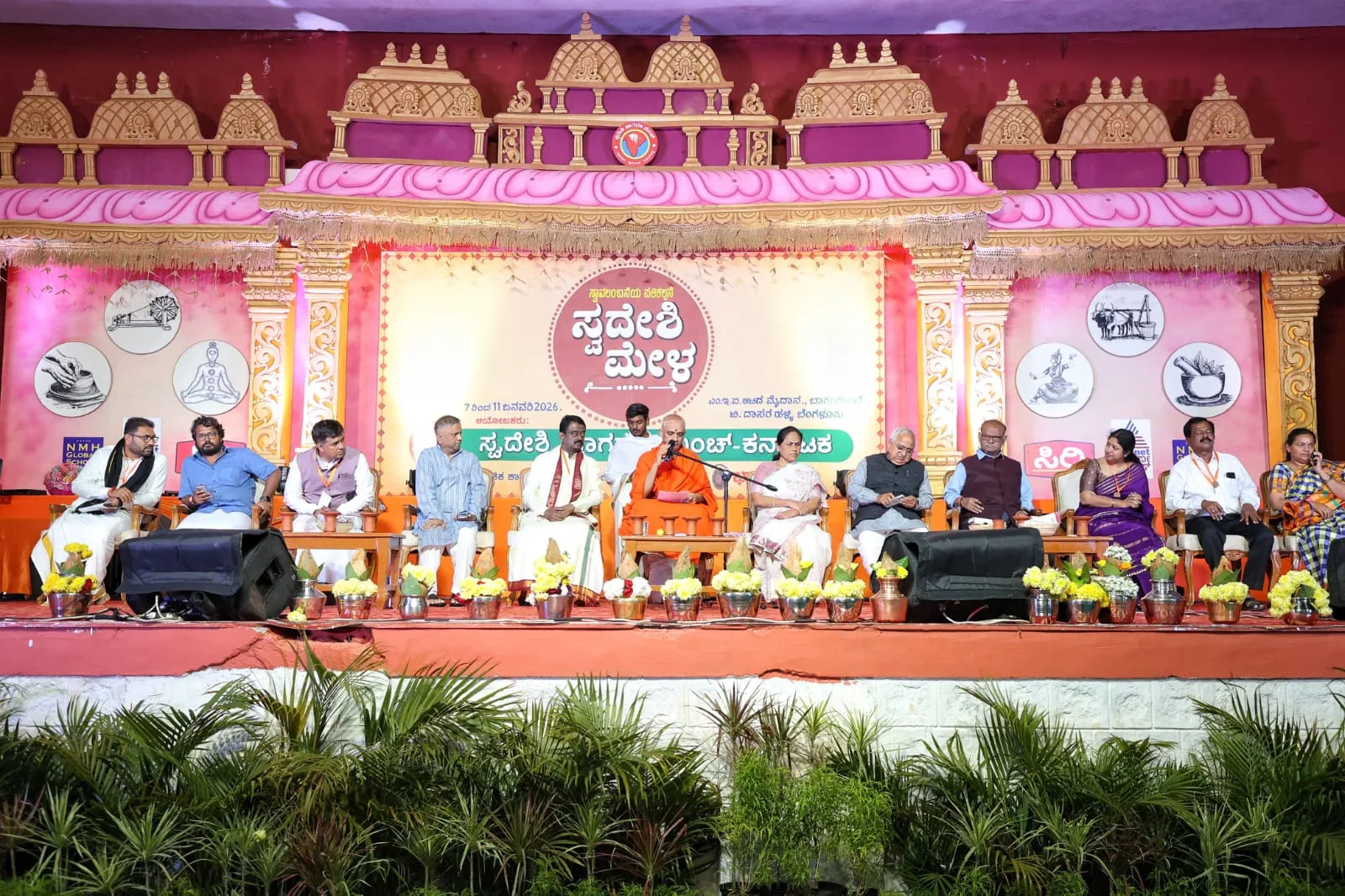
The concept of Swadeshi is often misinterpreted as a call to romanticise the past. In fact, the contemporary Swadeshi is more relevant to strengthening local supply chains, improving the economic productive capacity of the MSME and grassroots entrepreneurs, and building robust systems of domestic production. The Swadeshi Mela in Bengaluru, which the Swadeshi Jagran Manch, Karnataka Chapter, inaugurated on January 7, 2026, is a case in point to show how such economic platforms, as practical economic institutions, can connect production and demand, leading to a change in the patterns of consumption and reasonable development that is economically and culturally sustainable.
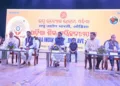
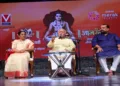
The mela was inaugurated with the blessings of Param Poojya Santosh Guruji, in the presence of former Chief Minister of Karnataka, Shri D. V. Sadananda Gowda, along with the MLA and the Mela Hon’ble President Shri S. Muniraju, with a commitment to run it as a “zero plastic” mela, with no plastic usage across the mela.
Not a Trade Fair, but a Production-Linked Market Platform
The Swadeshi mela was structured with a clear “Swadeshi filter”; it welcomed manufacturers and producers, not traders. In many trade fairs, the value addition is thin, and traders capture the margin. In contrast, Swadeshi mela strengthened the income share of the actual makers, exactly what India requires if it wants MSMEs and rural/urban startups to graduate into stable businesses.
This focus on production rather than mere commerce aligns naturally with the broader objective of “Atmanirbhar Bharat”. Self-reliance is not about shutting doors to the world, but rather is about ensuring that domestic demand, especially mass demand, to encompass jobs, transportation, packaging, raw materials, services and reinvestment.
The Demand Side Story: A Measurable Swadeshi Market
The mela’s scale is an economic indicator in itself. The footfall is estimated at around 4.5 lakh people over the mela days, with participation cutting across groups, though youth presence remained especially prominent.
In terms of supply-side participation, the mela saw 203 stalls, representing producers from multiple parts of Karnataka, including Vijayanagar, Davanagere, Mandya, Shivamogga, Ballari and more.
The mela reportedly generated around ₹7 crore in sales, representing direct market validation for local producers. It indicates that consumer demand for Swadeshi products is not limited to ideology; it has substantial purchasing power.
Beyond the mela campus, the local community experienced cultural and economic benefits. Local food vendors, parking attendants, auto drivers and nearby shops experienced increased customer traffic with temporary boosts to income during the mela. At the same time, cultural activities and traditional games fostered community spirit and made the Swadeshi Experience a reality for the neighbourhood.
MSMEs as the Primary Beneficiaries
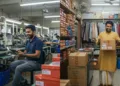
The largest beneficiaries were MSMEs. This is important because MSMEs in India suffer a wide range of problems, ranging from finance to market. Many policy designs over-focus on credit while under-focusing on demand aggregation and predictable markets. A mela, when executed with scale and discipline, becomes a demand aggregator. It reduces customer acquisition costs for small producers, offers a real-time consumer feedback loop, and creates repeat demand through reputation and networks.
In addition, participation by women entrepreneurs may be highlighted as one of the mela’s top takeaways. Economically, women entrepreneurship has high household welfare impacts, such as improved nutrition, better schooling continuity, and more stable household savings behaviour. A mela that expands women’s market access, therefore improves not just business outcomes, but also improves socio-economic resilience.
“Cultural Economy”: A Serious Economic Concept, Not a Soft Add-On
One of the most striking aspects of the mela report is its emphasis that the event did not restrict itself to economic activity, but promoted a “cultural economy.”
At first glance, this may sound abstract. But cultural economy is an essential driver of consumption patterns in India. Products anchored in local identity, such as handloom, Ayurvedic medicines, organic foods, indigenous crafts, and cow-based products, carry emotional and civilisational value. That value translates into willingness-to-pay, consumer loyalty and brand stickiness. In other words, cultural connect is a strong economic strategy.
The mela featured segments such as “Operation Sindoor” selfie point to hail the victory of the Indian Armed Forces, a gaushala showcasing different breeds of cows, a bull-driven traditional oil press machine, a live pottery making counter, and an EV engine conversion solution that could convert diesel/petrol vehicles into electric vehicles. Such offerings highlight that Swadeshi is not the opposite of innovation, but rather, can be a vehicle for frugal innovation that directly serves Indian affordability constraints.
There were 8 GI products featured in the mela, which is crucial from a competitiveness perspective. GI products are high-potential because they create differentiated markets and protect local producer communities from imitation-based competition.
Social Mobilisation: The Invisible Economics of Outreach
Markets do not grow automatically. They require mobilisation, trust, and information flow. Nearly 50,000 households were visited to invite people, supported by more than 300 volunteers from Swadeshi Jagran Manch and RSS actively involved in outreach.
This kind of mobilisation is often ignored by economists, yet it explains why some community markets succeed. The mela did not rely only on passive advertising but built a direct social network-based distribution system for information and invitations. Such networks reduce information asymmetry, particularly important for families who may otherwise not explore Swadeshi markets.
Children, Schools and the Long-Term Swadeshi Mindset
Economically, demand patterns are shaped early. The mela intelligently invested in shaping values through children. Activities like indigenous games were organised, cultural programmes were presented by school children and entertainment events such as folk performances, magic shows and Yakshagana attracted audiences consistently.
In total, 15 schools participated in several activities and competitions organised, and NSS volunteers contributed to cleaning activities post-mela. These are not small contributions but indicate community ownership and long-term sustainability.
When young students engage with Swadeshi not as a lecture but as a lived experience, like games, crafts and performances, it embeds a long-term consumer mindset that values local products, artisans and Indian innovation.
Is Swadeshi Anti-Globalisation? A Mature Economic Answer
A standard criticism is that Swadeshi implies isolation. But the mela itself demonstrates a more mature approach. Swadeshi here is not about rejecting the global economy, but ensuring that India’s growth is not structurally dependent on imported value chains for basic consumption.
Every nation that succeeded industrially, from South Korea to Japan to even the early stages of Western industrialisation, protected and promoted its domestic producers. India’s Swadeshi vision is thus not unusual, but rather aligned with the global history of economic development.
In this sense, Swadeshi becomes a pro-competition approach, and forces Indian producers to innovate and scale, while encouraging Indians to value domestic value addition. Globalisation becomes healthier when India participates as a producer, not merely as a market.
Conclusion: Beyond a Mela, Towards a Movement
Not just an event, the January 2026 Swadeshi Mela in Bengaluru was a step towards a movement. With a footfall of 4.5 lakh, 203 stalls and sales of ₹7 crore, it showed that Swadeshi economics can be successfully translated into practice.
Along with business, the mela also served as an educational and experiential platform. The cultural programmes and indigenous games made the Swadeshi philosophy a lived experience, strengthening cultural self-confidence and responsible consumption.
The emphasis on women entrepreneurship, GI products, skill camps and deep household outreach, along with a commitment to “Zero Plastic,” all represent an integrated model of economic growth, culture, ecology and community at the Mela.
As Swadeshi Jagran Manch prepares for next year’s mela with goals like 100% cloth banners and deeper rural manufacturer inclusion, the mela can evolve from a periodic fair into a permanent market-linkage institution, strengthening MSMEs not just by providing finance, but by creating stable market demand.
In that sense, the Swadeshi Mela becomes a blueprint of “Atmanirbhar Bharat” in practice, where self-reliance is not a slogan, but a measurable economic process rooted in local production, dignified livelihoods and conscious consumption.