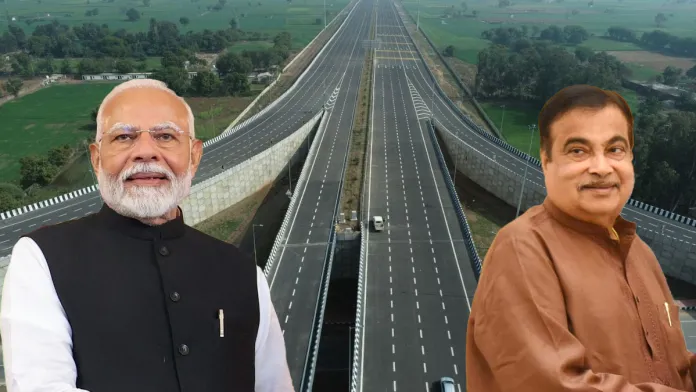
India’s road infrastructure has experienced one of the most significant transformations in its post-independence history. Over the past two decades, the country has dramatically expanded its national highway network while simultaneously upgrading its capacity and quality. The change has been driven by a combination of higher government spending, innovative financing models, technological advancements, and policy reforms aimed at improving efficiency.
What was once a largely two-lane highway network has gradually evolved into a system that increasingly features multi-lane highways and access-controlled expressways. The shift reflects a broader change in the government’s strategy, from merely expanding connectivity to building high-capacity transport corridors that can support economic growth, reduce logistics costs, and enable faster movement of goods and people across the country.
At the centre of this transformation lies a massive increase in public spending. The budgetary allocation for the Ministry of Road Transport and Highways (MoRTH) has risen nearly twentyfold since the late 2000s, creating the financial foundation for large-scale highway expansion.
The financial commitment to road infrastructure has grown exponentially in recent years. For the financial year 2026-27, the Ministry of Road Transport and Highways has been allocated Rs 3.09 lakh crore. This marks a dramatic increase compared to the Rs 15,450 crore allocated in 2009-10.
The current allocation is also about 2.5 times higher than the funding provided in 2021-22. A particularly sharp increase occurred between 2021-22 and 2022-23, when the budget rose by nearly 70 per cent, from Rs 1.23 lakh crore to Rs 2.08 lakh crore.
The ministry in its current independent form was created in 2009. Before that, road transport and highways were managed under different ministerial structures. Since its formation, the ministry has gradually expanded its financial capacity, enabling the government to simultaneously execute multiple highway projects across the country.
Greater availability of funds has helped avoid delays caused by payment bottlenecks and has allowed for more ambitious project planning. However, financial resources alone cannot explain the pace of transformation; structural reforms in project execution have also played a crucial role.
Expansion of the National Highway Network
The expansion of the national highway network over the past two decades has been remarkable. According to government data, the total length of national highways has doubled since 2008-09.
At the end of the financial year 2008-09, India had approximately 70,548 kilometres of national highways. By December 2025, that number had risen to about 1.46 lakh kilometres.
This means that more than 76,000 kilometres of national highways have been added to the network since 2008-09. Remarkably, the expansion achieved during this period exceeds the total addition made between 1951 and 2008-09.
For context, India had only 19,811 kilometres of national highways in 1951, soon after independence. Over the next several decades, the network expanded gradually, but the pace accelerated significantly in the last twenty years.
The growth becomes even more striking when compared to the network size in 2005-06. At that time, India had around 66,590 kilometres of national highways. Today, the total stands at approximately 1,46,572 kilometres—an increase of nearly 80,000 kilometres.
Beyond the sheer expansion in length, the quality and capacity of highways have also improved significantly.
In 2005-06, India’s highway network was dominated by two-lane or smaller roads. Out of the total 66,590 kilometres of highways at the time, only about 7,856 kilometres were four-lane or above.
Today, the length of four-lane and above highways has grown to 48,421 kilometres, representing a more than six-fold increase.
This means that nearly 40,000 kilometres of additional multi-lane highways have been built within less than two decades.
The share of four-lane and above highways in the national network has therefore increased from around 12 per cent in 2005-06 to approximately 33 per cent by December 2025.
In other words, nearly one-third of India’s national highway network now consists of four-lane or larger roads.
This represents a dramatic shift from the earlier situation where nearly nine out of every ten kilometres of highways were two-lane or smaller.
Despite the growth in multi-lane corridors, two-lane highways still form the largest portion of the national highway network.
The length of two-lane highways has more than doubled over the past two decades, from about 37,238 kilometres in 2005-06 to 84,774 kilometres by December 2025.
At the same time, the length of roads below two lanes has decreased significantly. Such roads have reduced from 21,496 kilometres in 2005-06 to around 13,000 kilometres today.
This shift reflects the government’s effort to gradually upgrade lower-capacity roads into wider highways capable of handling increasing traffic volumes.
From connectivity to capacity
India’s highway development strategy has also evolved over time. Earlier policies primarily focused on expanding connectivity by building new roads.
Today, the emphasis has shifted toward improving the carrying capacity of existing corridors.
Instead of simply adding kilometres of roads, planners are increasingly focusing on creating multi-lane highways and fully access-controlled expressways that can move traffic more efficiently.
The goal is to reduce travel time, lower transportation costs, and strengthen long-term logistics efficiency, factors that are critical for economic growth.
Along with expansion and upgrades, the pace of highway construction has also accelerated significantly.
Until around 2015-16, India was building approximately 5,000 to 6,000 kilometres of national highways each year.
However, the construction output doubled between 2014-15 and 2018-19, when the country crossed the 10,000-kilometre mark for the first time.
Since then, annual highway construction has largely remained above that level.
In terms of daily averages, the construction speed has also improved substantially. Before 2016-17, India typically built fewer than 15 kilometres of highways per day.
After 2016-17, the pace increased to more than 20 kilometres per day.
The fastest construction pace on record occurred in 2020-21, when India built highways at an average rate of 36.5 kilometres per day.
In the current financial year, the pace stood at around 18 kilometres per day until December. The pace is expected to improve in the final quarter of the financial year.
Hybrid annuity model revives private participation
A major policy reform that helped accelerate highway construction was the introduction of the Hybrid Annuity Model (HAM) in January 2016.
The model was designed to revive private sector participation in highway development at a time when many projects were stalled due to financial stress.
Under HAM, the government provides 40 per cent of the project cost as construction support. The remaining 60 per cent is paid to the developer as annuity payments over the operational period, along with interest.
This structure reduces the financial risk for private developers while ensuring that projects continue to move forward.
The introduction of HAM helped revive investor confidence and significantly accelerated both project awards and construction.
Digital Reforms: FASTag and revenue transparency
Another important reform was the gradual introduction of electronic toll collection through FASTag beginning in 2017.
FASTag uses radio-frequency identification technology to enable automatic toll payments without stopping at toll plazas.
The system has helped reduce congestion at toll booths and significantly improved revenue transparency by minimising leakages in toll collection.
Stable and predictable toll revenues have also helped strengthen project cash flows, making highway projects more attractive to private investors.
Changes in contracting practices have also contributed to faster project completion.
In 2012, the Cabinet Committee on Infrastructure approved the Engineering, Procurement and Construction (EPC) model for building two-lane national highways.
Under this model, contractors are responsible for investigation, design, and construction of the highway within a fixed timeline for a lump-sum price.
Earlier, projects were often executed through traditional item-rate contracts that were more prone to cost overruns and delays.
The EPC model introduced greater accountability and efficiency into the construction process.
A major milestone in India’s highway expansion strategy came with the launch of the Bharatmala programme in 2017.
Under this initiative, highway planning shifted from isolated road projects to a corridor-based approach.
Economic corridors were identified based on freight traffic patterns, allowing the government to focus investments on routes that carry the highest volumes of goods.
The programme also emphasised border roads, coastal connectivity, and improved access to ports.
Technological innovation has played a key role in accelerating road construction.
The sector has increasingly adopted mechanised construction methods that reduce reliance on manual labour while improving quality and efficiency.
One such technology is the use of slipform pavers—specialised machines that continuously place, compact, and shape concrete for roads without requiring fixed side forms.
Slipform paving enables faster and more consistent construction compared to manual methods.
Automated batching plants have also become widely used. These computerised systems precisely mix cement, aggregates, water, and additives in predetermined ratios.
In earlier years, this mixing was often done manually, leading to inconsistent quality and higher rejection rates.
Automated plants allow digital weighing of materials, real-time monitoring, and continuous feeding of pavers, which significantly increases productivity.
Modern highway projects also rely heavily on digital monitoring tools.
GPS-enabled construction equipment allows project managers to track machinery movements and optimise operations.
Sensor-based rollers help ensure proper compaction of road surfaces.
Drones are increasingly used for aerial monitoring of construction progress, enabling faster identification and resolution of issues.
These technologies have reduced administrative delays and improved project management efficiency.
Another important change in India’s highway construction approach has been the increased use of locally available and recycled materials.
Since November 2015, the government has made it mandatory for highway developers to use waste plastic in road construction along with bitumen.
Plastic-modified bituminous roads have been found to be more durable and resistant to water damage.
The use of recycled materials not only improves sustainability but also reduces construction costs and dependence on imported raw materials.
Despite the progress, highway construction in India continues to face challenges.
Land acquisition remains one of the biggest obstacles to timely project completion.
Obtaining forest and wildlife clearances, coordinating with railways and other agencies, and shifting utilities such as power lines and pipelines can also delay projects.
However, over the years the government has introduced several reforms aimed at simplifying land acquisition procedures to speed up highway development.
Taken together, higher capital allocations, innovative financing models, digital technologies, and mechanised construction have transformed India’s highway sector.
What was once a slow and fragmented system has evolved into a large-scale, programmatic infrastructure expansion strategy.
The transformation is not merely about building more roads; it reflects a deeper shift toward creating high-capacity transport corridors that support economic growth and logistics efficiency.
As India continues to expand its highway network and upgrade existing roads, the country’s transport infrastructure is increasingly becoming a key pillar of its development strategy in the decades ahead.