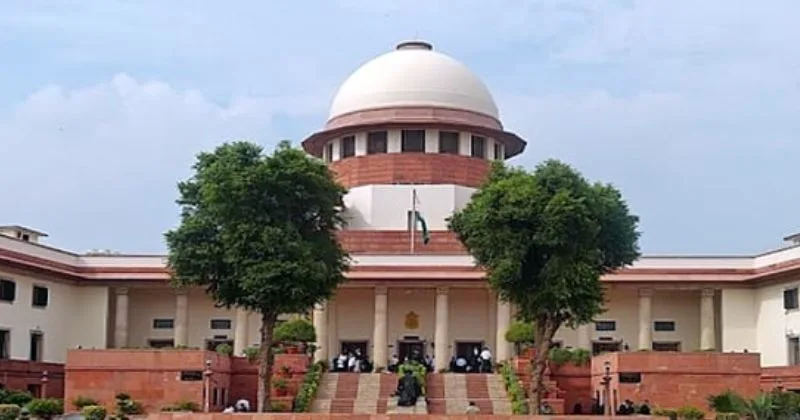
The Supreme Court on January 29, put on hold the University Grants Commission (Promotion of Equity in Higher Education Institutions) Regulations, 2026, observing that key provisions appear ambiguous and may lend themselves to misuse. The court also added that the unity of India must be reflected within educational institutions. The interim stay came while hearing a clutch of petitions challenging the regulations, which have triggered nationwide protests and a sharp political and social debate.
A Bench led by Chief Justice of India Surya Kant and Justice Joymalya Bagchi issued notice to the Union government and directed that the impugned 2026 regulations remain in abeyance until further orders, while explicitly ordering that the UGC Regulations of 2012 on equity and non-discrimination will continue to remain in force.
Who challenged the regulations?
The petitions were filed by Mritunjay Tiwari, Advocate Vineet Jindal, and Rahul Dewan, among others, who contended that the new framework institutionalises discrimination by design. They argued that the definition of “caste-based discrimination” under the 2026 rules proceeds on the presumption that discrimination can operate only in one direction and leaves students from non-reserved or general categories without any effective remedy, even if they face bias or harassment on campus.
Senior Advocate Indira Jaising appeared in the matter, while Solicitor General Tushar Mehta accepted notice on behalf of the Union of India and the UGC.
‘Vague’ provisions, risk of misuse
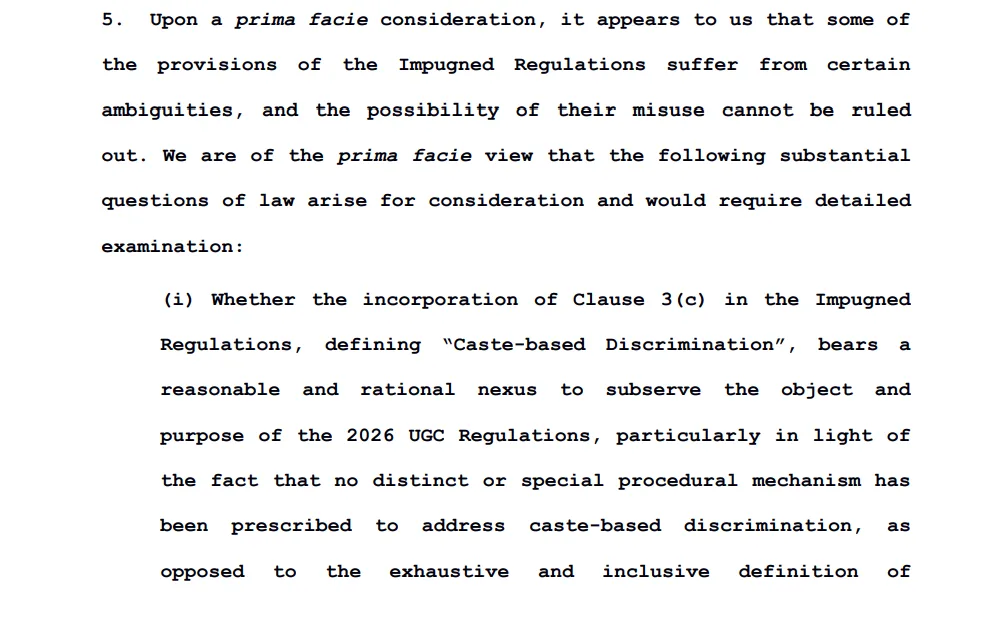
Recording its prima facie view, the court noted that some provisions of the 2026 regulations “suffer from certain ambiguities” and that “the possibility of their misuse cannot be ruled out”. The Bench identified multiple substantial questions of law that warrant detailed examination by a larger Bench.
Among the key issues flagged was Clause 3(c) of the regulations, which defines “caste-based discrimination”. The court questioned whether this restrictive definition has a reasonable nexus with the object of the regulations, particularly when no distinct procedural mechanism has been created to address such discrimination, unlike the broader and more inclusive definition of “discrimination” under Clause 3(e).
The Bench also expressed constitutional unease over Clause 7(d), which permits allocation of hostels, classrooms, mentorship groups or similar arrangements on specified criteria. The court asked whether the inclusion of the term “segregation”, even when claimed to be based on transparent and non-discriminatory criteria, could lead to a “separate yet equal” regime, undermining the guarantees of equality and fraternity under Articles 14 and 15 and the Preamble.
The court also noted the omission of “ragging” as a specific form of discrimination under the 2026 regulations. The Bench noted that ragging was explicitly recognised in the UGC Regulations, 2012, and asked whether its exclusion now amounts to a regressive legislative omission, potentially violating Articles 14 and 21 by creating an asymmetry in access to justice for victims.
Interim protection and next hearing
The Supreme Court directed that the 2012 UGC Regulations will continue to operate to ensure that marginalised groups are not left without remedies, even as it clarified that the grievances raised by the present petitioners also require protection.
The court has listed the matter for March 19, when it will also hear related petitions, including those filed by the mothers of Rohith Vemula and Payal Tadvi, and ordered that all connected issues be examined together by a three-judge Bench.
Political reactions
Reacting to the stay, BJP MP Nishikant Dubey welcomed the Supreme Court’s intervention and urged people to place faith in Prime Minister Narendra Modi’s government. He pointed out that the same government that introduced 10 per cent EWS reservation was being accused of insensitivity, despite its record of addressing concerns of the economically weaker sections.
What triggered the controversy?
The Union government had notified the UGC Equity Promotion Regulations, 2026, with the stated aim of curbing caste-based discrimination and ensuring a safe and inclusive academic environment. However, several organisations, particularly from upper-caste communities, alleged that the rules were one-sided, prone to false complaints, and could be weaponised against students and faculty. The opposition culminated in street protests and even a hunger strike announcement by Dasna Peeth head Yati Narasimhanand Giri.
With the Supreme Court now stepping in, the future of the regulations will hinge on whether the government can rework the framework to balance protection for the marginalised with constitutional guarantees of equality, fraternity and unity, without turning campuses into sites of legally sanctioned segregation.