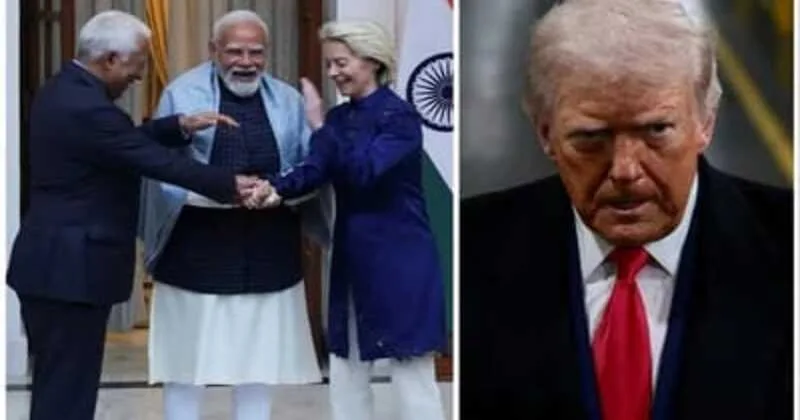
The United States and President Donald Trump are once again at odds following the announcement of a massive trade agreement between India and the European Union (EU), widely described as the “Mother of All Deals.” While Trump has so far refrained from issuing an official response to the India–EU agreement, his silence has only heightened global curiosity over how Washington will react.
However, strong criticism has already come from the US Treasury Secretary, Scott Bessent. Bessent’s remarks focused on reiterating Washington’s long-standing accusation that India is indirectly financing Russia’s war against Ukraine through its continued purchases of Russian crude oil. He argued that by entering into a comprehensive trade agreement with India, Europe is effectively “funding a war against itself.” According to Bessent, Europe’s economic engagement with India undermines its own strategic and security interests at a time when geopolitical tensions remain elevated.
Despite these sharp comments, India has maintained that its broader relationship with the United States remains on a positive footing. Union Petroleum Minister Hardeep Singh Puri stated that a trade agreement between India and the US is likely to materialise soon. He emphasised that bilateral discussions are progressing constructively and that a final decision on the proposed deal will be taken in due course. According to Puri, India is advocating a framework that ensures equal treatment and balanced benefits for all stakeholders, a principle that both India and the EU have highlighted while describing their landmark agreement.
In contrast, the US has already concluded trade deals with several of its partners that are widely seen as disproportionately favouring American interests. This approach has been a key factor behind the delay in finalising an India–US trade agreement. Washington, under Trump’s leadership, had demanded greater access for American dairy and agricultural products to the Indian market, along with significant reductions in tariffs on US exports. India has firmly resisted these demands, citing concerns over domestic farmers, food security, and rural livelihoods.
On the other hand, the India–EU trade deal has successfully balanced market access with strategic protection. While India excluded sensitive sectors such as agriculture and dairy from the agreement, the EU secured substantial concessions in other areas. One of the most significant gains for Europe is the sharp reduction in tariffs on its flagship automobile exports to India, a move that is expected to boost European carmakers operating in the Indian market.
The conclusion of such a far-reaching agreement has significantly strengthened the positions of both India and the EU in the global trade landscape. More importantly, it has provided them with greater leverage in ongoing negotiations with the United States. With this deal in place, India and the EU are now better positioned to resist pressure for unilateral concessions in talks with Washington, reinforcing the idea that mutually beneficial agreements need not come at the cost of strategic autonomy.
As a result, pressure has begun to mount on the United States. If Washington continues to adopt a rigid stance, it risks delaying the entry of American companies into India’s vast consumer market, particularly through tariff reductions. India, meanwhile, is actively expanding its trade diplomacy and is preparing to finalise agreements with several other countries, including Canada and Brazil, in addition to the EU. This diversified approach further reduces India’s dependence on any single trading partner.
Conclusion of the India-EU Free Trade Agreement today marks a significant milestone in our relations. I thank all the leaders of Europe over the years for their constructive spirit and commitment in making this possible. This agreement will deepen economic ties, create…
— Narendra Modi (@narendramodi) January 27, 2026
Against this backdrop, Trump’s eventual response to the India–EU deal assumes added significance. The timing of the agreement is particularly sensitive, as differences between the US and several European countries over the Greenland issue have recently intensified. The announcement of a major India–EU trade pact amid these tensions is expected to further unsettle Trump and complicate transatlantic trade dynamics.
The India–EU trade deal, combined with strong global market cues, is expected to provide a major boost to Indian equity markets. Early indicators this morning suggested a positive start, with the GIFT Nifty rising by more than one per cent at one point. This signals that benchmark indices such as the Sensex and the Nifty are likely to extend their winning momentum today. On Tuesday, the Sensex closed at 81,857, gaining 319.78 points, or 0.39 per cent, while the Nifty advanced 126.75 points, or 0.51 per cent, to end at 25,175.
IT, metal, and financial stocks led yesterday’s rally. European stock markets, buoyed by optimism surrounding the India–EU deal, closed higher, with the FTSE gaining 0.58 per cent. European automobile manufacturers recorded strong gains on expectations of improved access to the Indian market. Another sector expected to benefit significantly from the agreement is India’s garment and textile industry. The India–EU deal is projected to generate between 60 and 70 lakh new jobs in the textile sector. Union Minister Piyush Goyal has previously noted that textiles constitute the largest employment-generating sector in India after agriculture. Investor sentiment was further supported by gains in the rupee, which strengthened against the US dollar on expectations that the deal would attract substantial foreign investment. The rupee closed at 91.72 on Tuesday, up 0.2 per cent.