Decoding the Northeast: Undoing mental colonisation
June 6, 2026
  • Read Ecopy
  • Circulation
  • Advertise
  • Careers
  • About Us
  • Contact Us
Android AppiPhone AppArattai
Organiser
  • ‌
  • Bharat
    • Assam
    • Bihar
    • Chhattisgarh
    • Jharkhand
    • Maharashtra
    • View All States
  • World
    • Asia
    • Europe
    • North America
    • South America
    • Africa
    • Australia
  • Editorial
  • International
  • Opinion
  • RSS @ 100
  • More
    • Op Sindoor
    • Analysis
    • Sports
    • Defence
    • Politics
    • Business
    • Economy
    • Culture
    • Special Report
    • Sci & Tech
    • Entertainment
    • G20
    • Azadi Ka Amrit Mahotsav
    • Vocal4Local
    • Web Stories
    • Education
    • Employment
    • Books
    • Interviews
    • Travel
    • Law
    • Health
    • Obituary
  • Subscribe
    • Subscribe Print Edition
    • Subscribe Ecopy
    • Read Ecopy
  • ‌
  • Bharat
    • Assam
    • Bihar
    • Chhattisgarh
    • Jharkhand
    • Maharashtra
    • View All States
  • World
    • Asia
    • Europe
    • North America
    • South America
    • Africa
    • Australia
  • Editorial
  • International
  • Opinion
  • RSS @ 100
  • More
    • Op Sindoor
    • Analysis
    • Sports
    • Defence
    • Politics
    • Business
    • Economy
    • Culture
    • Special Report
    • Sci & Tech
    • Entertainment
    • G20
    • Azadi Ka Amrit Mahotsav
    • Vocal4Local
    • Web Stories
    • Education
    • Employment
    • Books
    • Interviews
    • Travel
    • Law
    • Health
    • Obituary
  • Subscribe
    • Subscribe Print Edition
    • Subscribe Ecopy
    • Read Ecopy
Organiser
  • Home
  • Bharat
  • World
  • Operation Sindoor
  • Editorial
  • Analysis
  • Opinion
  • Culture
  • Defence
  • International Edition
  • RSS @ 100
  • Magazine
  • Read Ecopy
Home Bharat

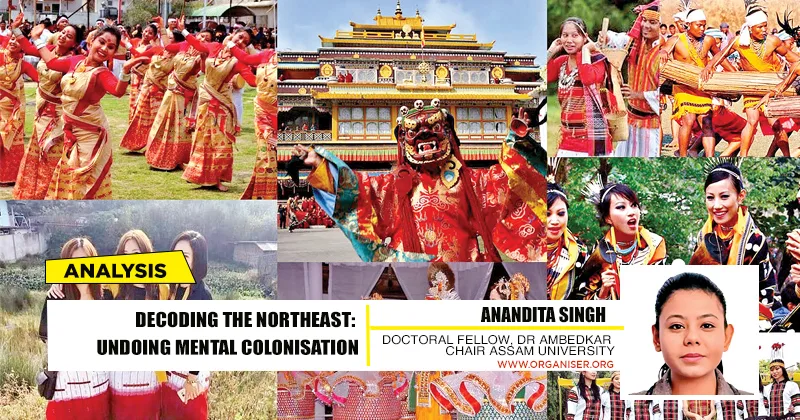
Decoding the Northeast: Undoing mental colonisation

Colonialism reshaped not only Bharat’s political boundaries but also its historical memory, leaving enduring distortions in how the North East is perceived. Recovering suppressed civilisational narratives is essential to understanding the region’s centrality, continuity, and unfinished journey of decolonisation

Anandita SinghAnandita Singh
Jan 27, 2026, 09:00 pm IST
in Bharat, Analysis
Follow on Google News
FacebookTwitterWhatsAppTelegramEmail

The world and tragically, many Bharatiyas were taught to believe that humanity was divided into binaries of “indigenous” or “aboriginals” on one side, and “migrants” or “invaders” on the other, a concept that conveniently justified colonial intervention. The British refined this further into the moral vocabulary of “civilised” and “savages,” using the latter to legitimise violence against undefeated communities. This allowed brutality to masquerade as governance; opening fire on gatherings, burning villages, starving tax offenders, and publicly beating them into submission.

Alongside physical violence ran systematic economic assault: bonded labour in plantations, forced migration, and merciless extraction of labour and dignity. From exploitative taxation to the plunder of an entire civilisation to fuel British industrialisation and imperial lifestyle, colonialism functioned at both micro and macro levels. Yet it was successfully portrayed as a “gift” that brought railways and postal services. In reality, British colonialism left no sphere of Bharatiya civilisation untouched. It restructured caste hierarchies, manufactured tribal identities, dismantled indigenous education, destroyed trade networks, altered religious relationships, transformed administrative languages, reinvented judicial systems, redrew boundaries, fragmented the landmass, and permanently destabilised Asian geopolitics. Colonialism did not merely loot wealth, it distorted reality itself.

The Struggle Continues

Every year on January 26, the birth of the Indian Republic is celebrated. Yet while colonialism withdrew physically in 1947, its intellectual and psychological afterlife persists. Decolonisation is therefore not merely a political milestone but an ongoing civilisational struggle.

Contemporary debates in the North East, such as demands for a Roman script for Kokborok or the celebration of Thomas Jones as the father of Khasi literacy while indigenous systems are forgotten, reveal how colonial memory continues to shape validation. Similarly, the preservation of David Scott’s memorial alongside the neglect of Khasi king Ram Singh’s memorial is not neutral remembrance but selective history.

Colonial residue is also evident in perceptions of Scheduled Tribe status, where communities are compelled to perform “primitiveness” to fit colonial categories. Even geographically, the North East is framed as “isolated,” a colonial idea that migrated into post-Independence consciousness. Historically, the region lay at the heart of Jambudweep, sustaining continuous civilisational flows long before colonial borders reordered our geographical imagination.

Erasure of History

The North East was never peripheral or “isolated”; it was central. The illusion of remoteness emerged only after the Partition of 1947; a colonial construct that severed organic land and water continuities and rebranded a once well-connected region as distant and underdeveloped. This rupture obscured dense water networks that historically bound the region to the subcontinent. The Brahmaputra, Barak-Surma, and Ganga systems converging near Dhaka made the region a vital node of inland and maritime connectivity. Historical records describe thriving trade routes, riverine commerce, and matrimonial alliances such as marriages between the Tripura kingdom and royal houses in present-day Madhya Pradesh testifying to sustained exchange of ideas, goods, and people. Colonial policy, followed by postcolonial academic repetition, erased this memory, replacing connectivity with a narrative of isolation that still shapes how the region is visualised.

Long before British intervention, the North East was not a cluster of “primitive” communities but a landscape of organised societies, sovereign political units, codified legal systems, technological traditions, and trans-regional connectivity. Among the Lushai hills, for example, villages functioned as self-governing units ruled by a Lal, supported by councils of elders (Upas), with public law (Khawtlang Dan) and individual law (Mimal Dan). Disputes relating to land, theft, marriage, and social conduct were resolved through established judicial processes with codified fines (Salam), demonstrating indigenous jurisprudence rather than social anarchy. These were legally structured polities independent of European models of governance.

The region also functioned as a civilisational and economic corridor. Trade networks connected Khamtis, Singphos, Mishmis, Nagas, Kachins, Shans, Tibetans, Burmese, Assamese, and Chinese through extensive land and river routes. Commodities such as ivory, silk, iron, salt, beads, amber, and textiles moved across Burma, Tibet, Assam, and China. Major trading centres such as Bhamo on the Irrawaddy attracted traders from the hill regions of Upper Assam, while river systems linked inland economies to maritime trade. Classical sources like the Arthashastra note global demand for Assam’s agarwood, while Hudud al-Alam records gold imports into Arabia in the tenth century, confirming participation in global trade circuits.

Politically, the North East was a landscape of kingdoms, dynasties, and state formations, not “stateless tribal zones”. Ancient and medieval polities such as Kamarupa, the Varman dynasty, Mleccha (Mech) rulers, Pal dynasties, Bhuyan chieftainships, the Chutiya kingdom, Kachari kingdoms, Koch kingdom, Ken kingdom, Tiwa, Karbi, Jaintia, Tripura, and Manipur formed a continuous tradition of statecraft. The Rajatarangini records matrimonial alliances between the Kamarupa kingdom and Kashmir, including the marriage of Princess Amritaprabha to King Meghavahana, demonstrating pan-Indian political connection. Prithu, who defeated Bakhtiyar Khilji, stand as evidence of organised military resistance and sovereign political authority. Archaeological remains: coins, inscriptions, copper plates, manuscripts, forts, palaces, temples, weapons, road systems, wells, and administrative complexes demonstrate bureaucratic governance, taxation systems, military organisation, and diplomatic relations.

Decolonising the North East, therefore, requires more than symbolic recognition. It demands rethinking history, identity, and knowledge systems, and moving beyond colonial binaries of civilised/uncivilised, mainstream/tribal, modern/backward. On this 77th Republic Day, political independence without intellectual liberation remains incomplete sovereignty. To decolonise the North East is not to invent a new past, but to recover a stolen one and reclaim the confidence to imagine a future free from colonial shadows.

Topics: North EastBharatiyasBrahmaputra77th Republic DayEuropean models of governance
ShareTweetSendShareSend
✮ Subscribe Organiser YouTube Channel. ✮
✮ Join Organiser's WhatsApp channel for Nationalist views beyond the news. ✮
Previous News

Renewable Energy: ‘Clean’ answer to complex question

Next News

Somnath Mandir: Testament to timeless resilience

Related News

Representative Image

Kamala Hydro Project: Powering progress in the remote frontiers of Arunachal Pradesh

VanDyke’s Arrest, Mysterious US Plot Around NE Bharat–Myanmar Border: What Is ‘Christian Nation’ Carving in South Asia?

VanDyke’s Arrest, Mysterious US Plot Around NE Bharat–Myanmar Border: What Is ‘Christian Nation’ Carving in South Asia?

Hindu Sammelan in Northeast: Our civilisation has evolved in forests; diversity is our strength

PM Narendra Modi welcomed guests with tradition a Pataka from North East on Republic Day 2026

Ashtalakshmi: Blesses the republic

Sri Lankan Member of Parliament Dayasiri Jayasekara

Vande Mataram echoes across Oceans: Sri Lankan MP Dayasiri Jayasekara sings India’s national song | Watch

Gujarat's 'Vande Mataram' tableau

Republic Day 2026: Gujarat’s ‘Vande Mataram’ tableau showcases timeless mantra of Swadeshi, self-reliance, and freedom

Load More

Latest News

The Porumamilla inscription and the ancient science behind a reservoir that survived 650 years

India’s 655-Year-Old Water Policy: The Porumamilla inscription that turned stone into a manual of hydrology

India’s Permanent Representative to the United Nations Ambassador Harish Parvathaneni

India slams Pakistan at UNSC for peddling false narratives on Jammu & Kashmir

Keralam: Pathanamthitta temple property occupied beyond lease period reclaimed by devotees

A series of high-level engagements signals New Delhi's growing focus on building interoperable security networks across the Indo-Pacific

India strengthens Indo-Pacific security architecture with new defence and maritime partnerships

Prime Minister Narendra Modi

“Makes every Indian proud”: PM Modi hails India’s 7.7 per cent GDP growth in FY 2025-26

Once known for maoist violence, Minpa now leads healthcare revolution with telemedicine services in Sukma

From Maoist Stronghold to Healthcare Hub: How Chhattisgarh’s Minpa is transforming through telemedicine & development

Dr Surendra Jain, Joint General secretary, VHP

VHP Demands Audit of Waqf Properties Amid Encroachment Claims: “Land should go to rightful owner,” says Surendra Jain

A Special NIA Court has framed charges against banned PFI and 20 office bearers, including E. Abubakar and O.M.A. Salam, under UAPA and IPC

PFI Terror Case: Special NIA court charges Abubakar, Salam & others for alleged conspiracy to wage war against India

Prime Minister Narendra Modi with women during an event (Old image used for representative purposes)

The Nari Shakti Decade: How 12 years of policy reforms under Modi govt transformed lives of women in Bharat

Ritabrata Banerjee, expelled by Mamata Banerjee from TMC, has been appointed as the Leader of the Opposition in Bengal assembly.

TMC House Divided: Mamata’s party battles Itself as LoP row exposes deepening cracks after BJP’s big blow

Load More
  • Privacy
  • Terms
  • Cookie Policy
  • Refund and Cancellation
  • Delivery and Shipping

© Bharat Prakashan (Delhi) Limited.
Tech-enabled by Ananthapuri Technologies

  • Home
  • Search Organiser
  • Bharat
    • Assam
    • Bihar
    • Chhattisgarh
    • Jharkhand
    • Maharashtra
    • View All States
  • World
    • Asia
    • Africa
    • North America
    • South America
    • Europe
    • Australia
  • Editorial
  • Operation Sindoor
  • Opinion
  • Analysis
  • Defence
  • Culture
  • Sports
  • Business
  • RSS @ 100
  • Entertainment
  • More ..
    • Sci & Tech
    • Vocal4Local
    • Special Report
    • Education
    • Employment
    • Books
    • Interviews
    • Travel
    • Health
    • Politics
    • Law
    • Economy
    • Obituary
  • Subscribe Magazine
  • Read Ecopy
  • Advertise
  • Circulation
  • Careers
  • About Us
  • Contact Us
  • Policies & Terms
    • Privacy Policy
    • Cookie Policy
    • Refund and Cancellation
    • Terms of Use

© Bharat Prakashan (Delhi) Limited.
Tech-enabled by Ananthapuri Technologies