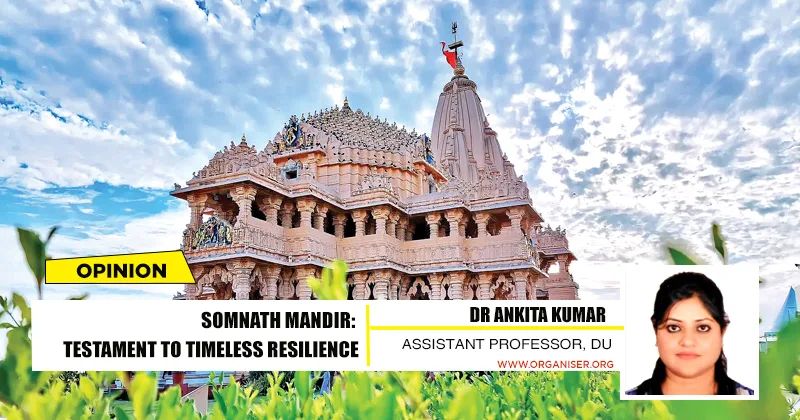
At Prabhas Patan, where the Western edge of Bharat meets the restless Arabian Sea, stands the mandir of Somnath. The waves strike the coast with a rhythm that seems almost deliberate, echoing a history that long predates dynasties, chroniclers, or even written records. Few sacred sites in Bharat have endured repeated violence, erasure, and renewal, and fewer still symbolise the resilience of a civilisation under assault. Somnath Mandir is not merely a temple; it is a palimpsest of Bharat’s history, layered with devotion, destruction, resilience and renewal.
For centuries, Somnath has occupied a unique place in the civilisational consciousness of Bharat. Though repeatedly attacked and desecrated, it has never vanished from the sacred geography of the land. Each reconstruction was an act of religious devotion and cultural assertion. In the post-Independence era, rebuilding Somnath Mandir became a defining moment in Bharat’s effort to reclaim its historical dignity after centuries of political subjugation. The antiquity of Somnath Mandir extends beyond recorded history into the realm of sacred tradition. Prabhasa appears in the Mahabharat as a tirtha of exceptional sanctity, associated with penance, purification, and cosmic renewal. Puranic literature recounts that Soma, the moon God, was freed from a wasting curse after worshipping Shiva at Prabhasa. In gratitude, Soma established the linga, and Shiva came to be worshipped here as Somnath, Bhagwan of the Moon.
Reverence for Bhagwan Shiva
The site’s sacredness was further enhanced by the confluence of Sarasvati, Kapila, and Hiranya rivers, making it a magnet for pilgrims across Bharat. Over time, Somnath Mandir became a foremost centre of Shaiva worship, revered for its mythological associations, ritual continuity, and institutional stability.
By the early medieval period, the mandir had acquired immense wealth and prestige through royal patronage. Dynasties such as the Maitrakas and the Chalukyas of Anhilwara endowed the shrine with land, villages, and revenue assignments. Somnath was not merely a place of worship; it was an economic institution supporting priests, scholars, artisans, musicians, and temple servants. Its proximity to major ports along the Gujarat coast also linked it to the wider Indian Ocean world, where merchants and pilgrims carried tales of its splendour far beyond Bharat’s shores. The first major attack was recorded to have occurred in 725 CE, during the Umayyad expansion under Al-Junayd, governor of Sindh. The assault marked the beginning of a pattern of devastation and revival: the Gurjara-Pratihara king Nagabhata II rebuilt the shrine in red sandstone around 815 CE. The most infamous attack occurred in January 1026 CE, during the reign of Bhimadeva I, when Mahmud of Ghazni led an expedition across the Thar Desert. Chroniclers such as Farrukh Sistani, Gardizi, and Al-Biruni recorded the campaign. Al-Biruni recounts that Mahmud ordered the linga broken, its fragments carried to Ghazni, with portions placed at the entrance of a mosque to be trampled. Persian chronicles celebrated the raid as triumphal iconoclasm, while later Bharatiya traditions remember it as profound cultural trauma. Yet to view the event purely as religious zealotry is to oversimplify medieval politics. Mahmud was an empire-builder, motivated as much by plunder and prestige as by ideology. Somnath, wealthy, famous, and symbolically central to Hindu sacred geography, offered both material gain and reputational glory. Striking such a renowned shrine projected his power deep into the subcontinent. Crucially, the 1026 destruction did not mark the end of Somnath. Within a few decades, Hindu rulers restored the shrine, reestablishing worship and pilgrimage, a pattern of destruction followed by reconstruction that would define Somnath’s history.
Between 1026 and 1030 CE, Bhimadeva I, with the support of King Bhoja and Trailokyanapala of Lata, rebuilt the temple in the Maru-Gurjara style. His grandson Jayasimha Siddharaja added a mahapitha to the stairway and invited the Shaiva scholar Bhava Brihaspati to oversee temple affairs.
In 1169 CE, the Somnathpattana Prasasti records that Kumarapala, influenced by Jain scholar Hemachandra, undertook major repairs and appointed Bhava Brihaspati as head priest. That year, Bhava Brihaspati constructed the Kailasa-Meru Prasada, the fifth Somnath temple described in inscriptions as resembling Mount Kailasa itself. Subsequent additions in the thirteenth century included the Meghanada Mandapa and subsidiary Shiva shrines. This recurring cycle of destruction and determined reconstruction became the defining rhythm of Somnath’s history. In 1298 CE, Alauddin Khalji’s forces, led by Ulugh Khan, attacked Somnath. Persian chroniclers claimed the idols were destroyed and the principal image taken to Delhi. The Kanhadade Prabandha, however, narrates fierce resistance by Kanhadade Chauhan of Jalor, with the Somnath linga recovered after battle. Five new lingas were carved and installed across western Bharat, ensuring ritual continuity despite political disruption.
Under the Gujarat Sultanate, the cycle of destruction continued. Zafar Khan (Muzaffar Shah I) struck in 1395, followed by Sultan Mahmud Begada in 1451. During these centuries, the temple was often converted into a mosque or left in ruins. Yet Hindu worship resumed repeatedly, aided by regional rulers such as the Chudasama king Mahipaladeva, demonstrating the temple’s enduring spiritual significance despite imperial antagonism. The 16th century marked the introduction of European maritime powers into the conflict. Portuguese forces along the Gujarat coast targeted the shrine, contributing to its decline during a period of religious and commercial competition. British colonial historiography shaped modern perceptions of Somnath. Colonial historians often portrayed the temple’s destruction as evidence of inherent Hindu weakness and perpetual inter-religious conflict, narratives that justified British rule as a civilising force. Mahmud of Ghazni’s raid was presented as marking the decline of Bharat’s civilisation. These interpretations ignored the resilience embedded in Somnath’s history. The temple had been rebuilt repeatedly, and its destruction never caused the collapse of Hindu religious life. Colonial policies discouraged large-scale reconstruction, citing concerns about public order. Somnath thus remained in a state of neglect, its ruins interpreted through a colonial lens.
By the late nineteenth and early twentieth centuries, nationalists reclaimed Somnath as a symbol of cultural endurance. Writers, historians, and political leaders revisited its history to challenge colonial narratives. Kanhaiyalal Maneklal Munshi emerged as the most influential interpreter. In Somnath: The Shrine Eternal, Munshi portrayed the temple as a living symbol of Bharat’s spirit, repeatedly assaulted yet never extinguished.
For Munshi and others, Somnath was not a call for vengeance but a reminder of continuity. Its survival demonstrated that political defeat did not equate to cultural annihilation, a perspective that shaped post-Independence reconstruction. British colonial historiography played a decisive role in shaping modern perceptions of Somnath.