The Republic Day Parade on January 26, 2026, will not only be a ceremonial celebration of India’s constitutional journey but also a powerful statement of military readiness, technological advancement and generational continuity within the armed forces. At the heart of this year’s parade are the officers commanding the contingents, many of whom represent families that have served the nation in uniform across decades.
Among them is Lieutenant Amit Choudhary of the Arunachal Scouts, for whom leading a mixed Scouts contingent at Kartavya Path is both a professional achievement and a deeply emotional moment. A second-generation Army officer, Lt Choudhary will march on the same historic avenue where his father once participated as part of the Brigade of the Guards contingent during the 1990 Republic Day Parade.
During the full-dress rehearsal held on Friday amid steady rainfall, Lt Choudhary and his contingent marched in specialised multi-layered combat uniforms, snow boots and polarised sunglasses, underscoring the Scouts’ role in high-altitude and extreme-weather operations. Speaking after the rehearsal, the young officer recalled childhood memories of watching the parade on television and reenacting the march at home, calling it “very special” to now command a contingent at the same venue where his father once stood.
Army’s Operational Doctrine Takes Centre Stage
Senior Army officials have indicated that the 2026 parade has been curated to reflect the force’s operational transformation and preparedness for future warfare. Major General Navraj Dhillon, Chief of Staff, Delhi Area, said the Army tableau this year will be themed around the Integrated Operation Centre. The tableau will commemorate Operation Sindoor and offer a glimpse into India’s strategic planning and joint operational coordination.
In addition to the mixed Scouts contingent in an operational role, five other Army marching contingents will take part in the parade. These include contingents from the Rajput Regiment, Assam Regiment, Jammu and Kashmir Light Infantry, Regiment of Artillery and the Bhairav Battalion, each representing different combat traditions and theatres of deployment.
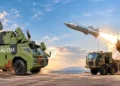
The parade will also feature an extensive display of India’s key defence assets. These include the BrahMos supersonic cruise missile, the Akash air defence system, Medium Range Surface-to-Air Missile (MRSAM), Advanced Towed Artillery Gun System (ATAGS), the indigenous Dhanush artillery gun, Shaktiban Regiment platforms, Divyastra Battery and the ‘Suryastra’ Universal Rocket Launcher System. Unmanned ground vehicles and a static display of drones mounted on multiple platforms will further highlight the Army’s push towards automation and reduced battlefield risk.
In a notable departure from tradition, the mounted 61 Cavalry will appear in full battle gear instead of ceremonial uniforms. Army platforms, many of them indigenously developed, will roll down Kartavya Path in a phased battle array formation, visually simulating operational deployment rather than pageantry alone.
Generations of Service on Parade
A striking theme running through this year’s contingent leadership is multi-generational military service. Captain Samira Z. Buttar, who will lead the Integrated Operation Centre tableau contingent, is a fourth-generation Army officer. She follows a distinguished lineage that includes her father, her grandfather Brigadier Sampuran Singh, and her great-grandfather.
Recalling her family’s service, Capt Buttar said her grandfather fought in the 1965 war and was awarded both the Maha Vir Chakra and the Vir Chakra. She hinted that the tableau would include a surprise element for spectators, adding to the anticipation surrounding the Army’s presentation.
Captain Ahaan Kumar, aged 26, will once again command the iconic 61 Cavalry contingent, mounted on his charger Ranveer. The grandson of a war veteran and son of Lieutenant General Bhavnish Kumar, the General Officer Commanding of Delhi Area and the Parade Commander, Capt Kumar noted that this year’s experience would be markedly different. While the cavalry marched in ceremonial dress with swords last year, the shift to battle gear this time has given the contingent a distinctly operational character.
Animals, Technology and the Army’s ‘Silent Warriors’
The 90-minute Republic Day Parade will feature 18 marching contingents and 13 military bands, offering a blend of tradition and modernity. An animal contingent comprising Zanskar ponies, Bactrian camels, trained raptors and Army dogs will also march, reflecting the continued relevance of animals in diverse terrains and missions.
Captain Harshita Raghav, who will lead the Remount Veterinary Corps contingent, described animals as the Army’s “silent warriors” and “true force multipliers.” A native of Bhopal and among the first batch of women officers in the RVC, she follows her father, who served in the Indian Air Force. She highlighted the critical role animals play in logistics, surveillance and operational support, particularly in challenging environments.
Technology-driven warfare will also be represented by a contingent showcasing unmanned ground vehicles, led by Captain Vikas Yadav of the 4th Battalion, 1 Gorkha Rifles. A third-generation Army officer, Capt Yadav explained that these systems are deployed for surveillance, logistics and combat support. Capable of self-navigation and carrying mission-specific payloads, the platforms are designed to reduce risks to both soldiers and animals in combat zones.
As India marks its 77th Republic Day, the 2026 parade promises to be more than a ceremonial march-past. With commanders embodying generations of service and platforms reflecting India’s growing military self-reliance, the spectacle on Kartavya Path will stand as a testament to continuity, capability and the evolving face of the Indian Army.