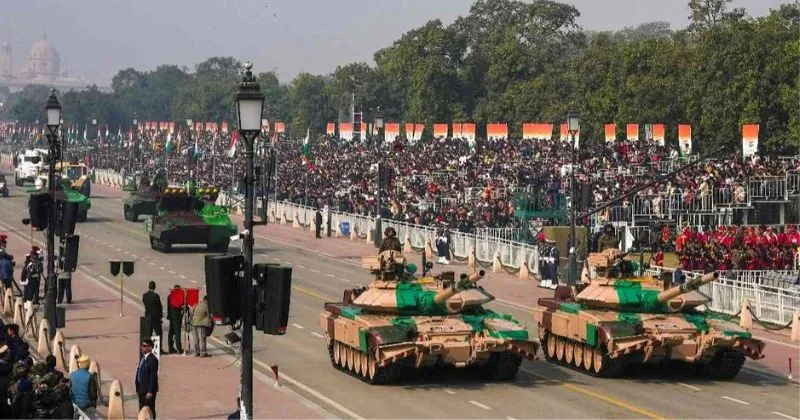
On the morning of January 26, the Indian Republic presents itself with confidence and composure. The parade advances in disciplined precision, the tableaux narrate unity through form and colour, and the Constitution is recalled with ceremonial solemnity. For a few hours, the Republic stands fully visible—orderly, assured, conscious of its democratic inheritance.
But the Republic was never intended to live only in ceremony.
Republic Day is not merely an occasion for remembrance; it is a constitutional reminder. It asks a quieter, more demanding question: whether the principles enshrined in the Constitution continue to guide governance and civic conduct once the rituals conclude and the routine of administration resumes.
The Constitution of India did more than transfer power from colonial rulers to indigenous hands. It undertook a civilisational task—the transformation of a people long governed as subjects into a nation of citizens. The framers were clear-eyed about the difficulty of this task. Democracy, they knew, could not be sustained by symbolism or sentiment alone. It would require discipline: of institutions, of authority, and of citizens themselves.
Dr B.R. Ambedkar’s insistence on constitutional morality emerged from this understanding. Democracies, he warned, are rarely destroyed in a single dramatic moment. More often, they weaken gradually, as constitutional restraint gives way to convenience and exceptions begin to feel routine.
The enduring question before India, therefore, is not whether the Constitution exists, but whether the Republic continues to govern itself in its spirit.
Public life today reveals a tendency to engage with constitutional values selectively. Liberty is asserted forcefully, equality is acknowledged conditionally, and fraternity—the most demanding of the Republic’s ideals—is frequently treated as optional. Yet the Preamble did not conceive these values as separable. Liberty without responsibility weakens authority; equality without cohesion fragments society; fraternity without discipline dissolves into abstraction.
Liberty, as the Constitution envisioned it, was never licence. It was freedom regulated by law, accountability, and respect for national unity. Dissent was protected not to weaken the State, but to strengthen it through correction. A confident Republic does not fear disagreement; it regulates it through constitutional means rather than moral suspicion. When liberty is exercised without regard for consequence—or when authority restrains it without due process—it ceases to serve the Republic and begins to corrode trust.
Equality, similarly, was framed not as abstract sameness but as corrective justice. The Constitution recognised that historical disadvantage required institutional remedies. That commitment remains relevant wherever sections of society continue to remain excluded from opportunity, dignity, or representation. Equality that is unevenly applied or indefinitely postponed weakens governance and erodes social cohesion.
Fraternity remains the Republic’s most fragile pillar. Ambedkar placed it deliberately alongside liberty and equality, aware that without a sense of shared belonging, constitutional democracy cannot endure. In an era of heightened political mobilisation and assertive identities, sustaining fraternity becomes more difficult—and more necessary. Without it, the Republic risks becoming a contest of claims rather than a collective national enterprise.
Republic Day, therefore, is not a declaration of completion. It is an audit of commitment.
This reality is especially visible in regions such as the Northeast, where the relationship with the Indian Republic has often been shaped through dialogue and accommodation rather than inherited certainty. Here, the Constitution has functioned as an instrument of integration—through federalism, cultural recognition, and consultative governance. Indian unity has never rested on uniformity. Its durability lies in the capacity to integrate difference without weakening national cohesion.
When constitutional processes are diluted—through excessive centralisation, delayed justice, or the erosion of consultation—it is often these regions that feel the strain first. The health of the Republic must therefore be measured not only by national narratives, but by how equitably constitutional protections are experienced across its diverse geography.
None of this is to deny the Republic’s achievements. India has sustained regular elections under conditions of extraordinary complexity. Democratic participation has widened, institutions have endured, and judicial review has frequently acted as a corrective force. These are not incidental successes; they reflect the resilience of the constitutional framework.
Yet constitutional democracy does not survive on legacy alone. It endures through daily adherence to norms—respect for institutions, tolerance of disagreement, and restraint in the exercise of power. The Republic is rarely weakened by dramatic rupture. It is tested instead by the gradual relaxation of discipline: when exceptions multiply, boundaries blur, and accountability thins.
One such test lies in the narrowing space for reasoned disagreement. The Constitution does not merely tolerate dissent; it protects it as a democratic necessity. A Republic that lacks the confidence to absorb criticism risks undermining its own foundations. Strength lies not in enforced unanimity, but in the ability to manage disagreement without coercion or delegitimisation.
Another risk lies in allowing symbolism to outpace outcomes. Rituals matter, but symbolism cannot substitute for governance that delivers. Republic Day ceremonies acquire meaning only when accompanied by tangible progress—in education, healthcare, employment, environmental stewardship, and access to justice. These remain the true measures of constitutional governance.
Citizens, too, carry responsibility for sustaining the Republic. The Constitution grants rights generously, but it also imposes duties—often overlooked and rarely discussed. Civic responsibility cannot be outsourced entirely to institutions. Democratic maturity requires citizens to demand accountability while practising restraint, to assert freedom while recognising the freedoms of others. This balance is not instinctive; it has to be learned.
Education is central to this task. Constitutional literacy is not the memorisation of articles or amendments. It is an understanding of the discipline that animates them. A Republic cannot endure if its citizens encounter the Constitution only during ceremonial observance, rather than as a guide to everyday conduct. As someone engaged with education, one sees daily how fragile this understanding can be—and how necessary it is to renew it.
As India asserts itself on the global stage—as a major economy, a strategic actor, and the world’s largest democracy—the internal health of its Republic assumes greater significance. Global influence ultimately rests on domestic legitimacy. A Republic that honours its Constitution in practice commands greater moral authority than one that celebrates it only in rhetoric.
Republic Day, therefore, must be reclaimed from routine observance and restored to reflection. It invites necessary questions: Are institutions being strengthened or personalised? Is power exercised with constitutional restraint? Are citizens treated as participants in governance or merely as spectators of authority?
The Republic does not collapse in a single moment. It weakens when constitutional vigilance gives way to complacency. Its survival depends not on uniform agreement, but on a shared commitment to democratic procedures—even when outcomes are inconvenient.
When the parade ends and the flags are lowered, the Republic’s real work begins—in courtrooms and classrooms, in legislatures and local councils, in newsrooms and neighbourhoods. The Constitution waits there, not as an ornament of statehood, but as a discipline of governance.
To honour the Republic is not merely to salute it once a year. It is to insist—quietly and persistently—that power remain accountable, liberty remain responsible, and fraternity remain possible.
That, ultimately, is what the Constitution demands—not as sentiment, but as a discipline of nationhood, long after the rituals are over.