India has achieved a major milestone in indigenous defence technology with the development of Bhargavastra, an advanced counter-drone system capable of launching 64 micro-missiles simultaneously to neutralise hostile drone swarms within seconds. With this capability, India joins an exclusive global bracket, becoming the only country to field a domestically developed platform with such high-volume salvo firepower against unmanned aerial threats.
Bhargavastra has been developed by Solar Defence and Aerospace Limited (SDAL), based in Nagpur, Maharashtra, using fully indigenous technology. The system is designed to respond to one of the most rapidly evolving threats in modern warfare, the use of low-cost drones and coordinated drone swarms for surveillance, disruption and targeted attacks. Defence experts say such threats have increasingly challenged conventional air defence systems, which are often expensive and not optimised to counter multiple small aerial targets simultaneously.
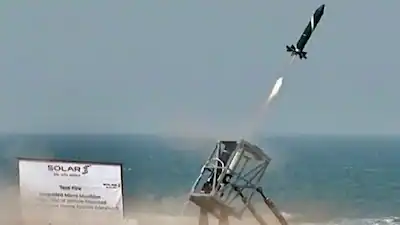
The successful trials of Bhargavastra were conducted at Gopalpur in Odisha in May 2025, where the system demonstrated its ability to detect, track and destroy multiple drones in quick succession. The platform’s performance has since drawn attention within strategic and defence circles for its combination of firepower, speed and cost efficiency.
Defence Minister Rajnath Singh, speaking on January 19, 2026, described Bhargavastra’s success as a significant boost to India’s self-reliance in defence manufacturing. He underlined that the system reflects the growing maturity of India’s private defence sector and aligns closely with the government’s Atmanirbhar Bharat vision, which seeks to reduce dependence on imports while building export-ready defence capabilities.
At the core of Bhargavastra’s effectiveness is its unprecedented salvo mode. The system can fire 64 unguided or guided micro-missiles within a span of around 10 seconds, allowing it to overwhelm and neutralise dense drone formations before they can reach critical assets. In comparison, similar counter-drone or short-range air defence systems deployed by other countries typically engage targets with no more than four missiles at a time, making Bhargavastra’s capacity a global standout.
The system operates on a layered defence concept. In the first tier, unguided rockets are used to counter drone swarms at close range, creating a defensive umbrella against mass attacks. The second tier consists of precision-guided micro-missiles designed for accurate interception of specific aerial targets. This dual approach allows flexibility, enabling commanders to respond proportionately depending on the scale and nature of the threat.
In terms of detection and engagement, Bhargavastra can identify hostile drones from a distance of approximately six to ten kilometres and destroy them effectively within a range of up to 2.5 kilometres. Officials associated with the project say this makes the system particularly suitable for protecting sensitive installations, forward military bases, ammunition depots and high-value missile defence assets.
Another key advantage highlighted by defence planners is cost efficiency. Traditional surface-to-air missile systems such as the S-400 are designed to counter high-end threats like fighter aircraft and ballistic missiles and are prohibitively expensive to use against small, low-cost drones. Bhargavastra fills this critical gap by offering a relatively inexpensive yet highly effective solution, ensuring that adversaries cannot exploit cost asymmetry through drone warfare.
The system has also been engineered for versatility and mobility. Mounted on an all-terrain mobile platform, Bhargavastra can be rapidly deployed across diverse operational environments, including deserts, plains and high-altitude, snow-bound regions above 5,000 metres. Its all-weather capability ensures uninterrupted performance in extreme climatic conditions, a crucial requirement given India’s varied geography.
Strategically, Bhargavastra is seen as a timely response to the increasing use of drones by both state and non-state actors in the region. Security assessments have repeatedly flagged the growing drone capabilities of neighbouring countries, particularly China and Pakistan, along with the use of drones for cross-border smuggling, surveillance and potential attack missions. By strengthening India’s layered air defence architecture, Bhargavastra adds a critical shield against these emerging threats.
Beyond its immediate operational value, Bhargavastra also signals India’s readiness to lead in next-generation warfare technologies. As drone warfare continues to redefine battlefields globally, systems like Bhargavastra position India not only as a capable defender but also as a potential exporter of advanced counter-drone solutions in the future.
With its successful development and trials, Bhargavastra stands as a symbol of India’s evolving defence ecosystem, where indigenous innovation, private sector participation and strategic necessity converge to address the realities of modern conflict.