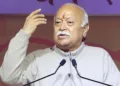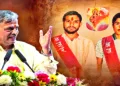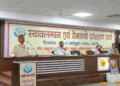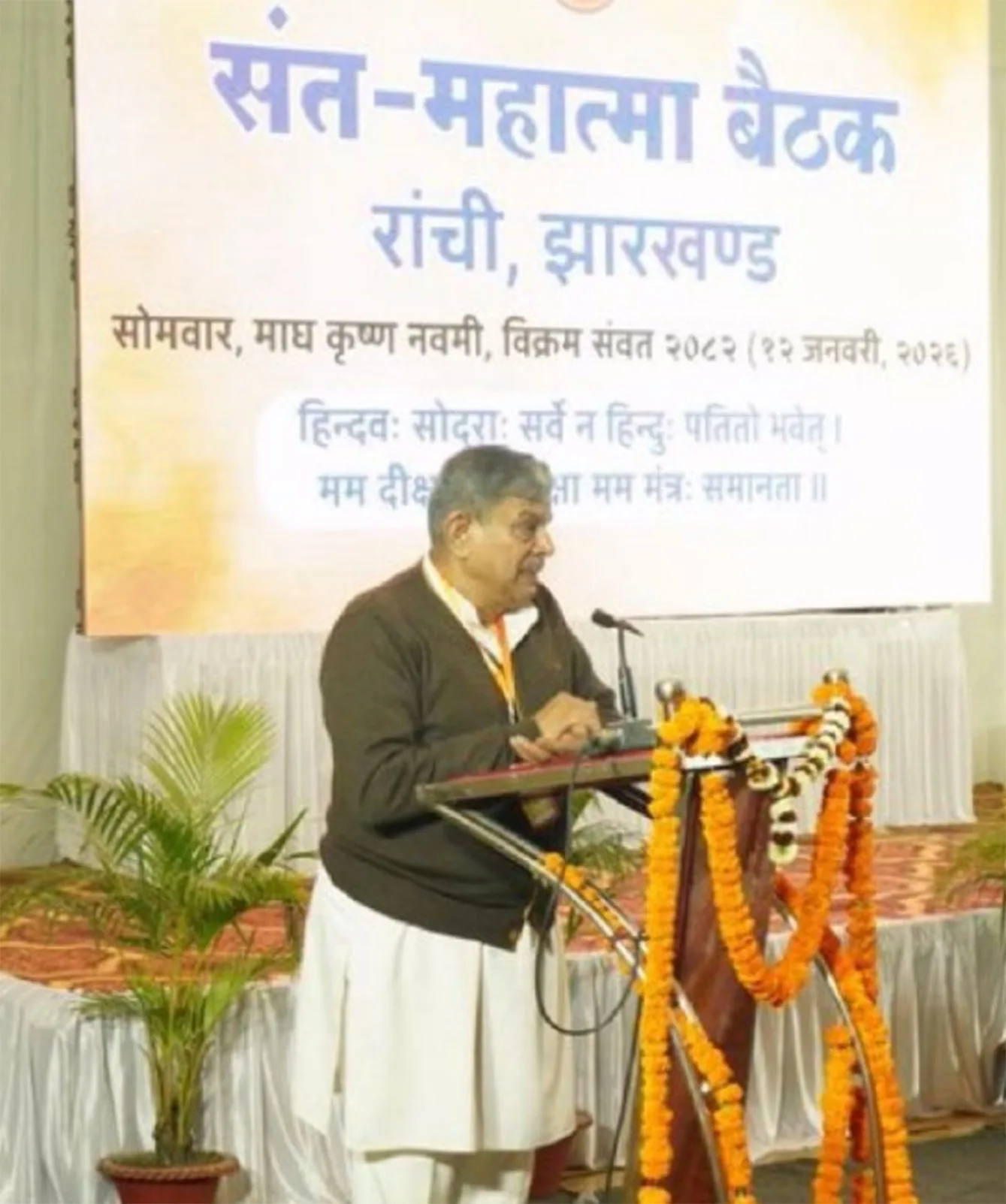
“We do not choose the family or caste we are born into; then, why practice casteism? No caste should be considered superior or inferior,” said Rashtriya Swayamsevak Sangh (RSS) Sarkaryavah, Dattatreya Hosabale while addressing a Samajik Sadbhav Baithak (Social Harmony Meeting) in Ranchi, Jharkhand on January 12, 2026.
More than 600 representatives from various social organisations, caste groups, fraternities, and communities participated in the meeting. The objective was to establish a dialogue on contemporary issues prevailing in society and to deliberate on collective efforts to strengthen social integration.
In the first session, representatives of different social groups shared information about the social, cultural, and service-related work being carried out in their respective areas. They also highlighted critical social challenges such as religious conversion, infiltration, drug addiction, illiteracy, superstition, lack of mutual cooperation, and ‘Love Jihad.’
While addressing the gathering on these strategic challenges, the Sarkaryavah identified three sensitive regions: Jharkhand’s Chhotanagpur, the Janajatiya belts of North-Eastern states, and Southern states like Kerala, Tamil Nadu, Andhra Pradesh, and Telangana. He noted that conspiracies involving church-affiliated groups have targeted these Janajatiya areas while obstructing Hindu spiritual leaders. He cited poverty, illiteracy, and superstition as primary drivers of conversion.
He specifically mentioned the “3-D problem” plaguing Janajatiya regions: Dharmantaran (Conversion), DJ Culture, and Daru (Liquor). To combat conversion, he urged society to foster mutual cooperation, eliminate untouchability and caste discrimination, and strengthen the demographic stability of Hindu society. On ‘Ghar-Wapsi’ (homecoming) efforts, he stated that Dharma Jagran (Dharmic awakening) is the responsibility of society and must be carried out by society itself.
He emphasised that gender equality is a necessity of the present time. When men and women are working side-by-side, there is no justification for inequality between them.
He further said that today social media is filled with both positive and negative content. To protect children from its negative impact, it is necessary to connect them with Bharatiya sanskriti. He stressed adopting a process of dialogue with children for this purpose.
Commemorating Swami Vivekananda’s birth anniversary, he urged the youth to adopt the mantra: “Think a little less, Act a little more.” He laid special emphasis on the following duties of Hindu society like expansion of service activities, ensuring that the benefits of government schemes reach the last person in society, and integrating those affected by poverty, illiteracy, and deprivation into the mainstream. He urged economically capable families to adopt divyang children and appealed to various social groups to support such children.
On the issue of Bangladeshi infiltration, he said that infiltration had long been used for political gains. The condition of Hindus in Bangladesh today is evident to all. Border fencing remains a major challenge, and at times even our own people provide shelter to infiltrators. The government is making efforts to address this issue through various mechanisms, including SIR. He appealed to representatives of various groups within Hindu society to enhance mutual cooperation along with the development of their respective communities. He called for participation in each other’s programmes, mutual respect, support for weaker sections, and constantly remembering the spirit of “We are all Hindus.”A discussion on spiritual and religious subjects was also held with more than 78 sants from Jharkhand who were present at the meeting. Deliberations included Article 342, under which the status of Janajatiya communities remains unchanged even after religious conversion, allowing them to continue availing benefits granted to Scheduled Tribes even after converting to Christianity or Islam. It was stated that if this provision is removed, conversions would be significantly reduced. Issues such as the establishment of Gurukuls were also discussed. Social and spiritual institutions of society have worked in the fields of service, literature, art, and religion. This tradition has continued for thousands of years with a great objective in mind. Governments have also contributed to many such efforts. However, many responsibilities lie with families as well, such as imparting values to children and teaching them to respect elders.
The unity of society is essential. Just as every link in a chain must be strong and connected to the next, society too must remain united and resilient. Concluding the sessions, he noted that while Bharat is progressing, issues like slums and environmental degradation reflect social deficiencies. He called for the protection of public property and building a society where the youth do not have to rely solely on government assistance.