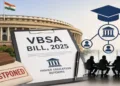
A midst the ongoing debate on how colonial imposition has shaped Bharat’s education sector, which eventually destroyed the traditional Bharatiya Knowledge System brick by brick, Viksit Bharat Shiksha Adhisthan Bill, 2025, is a welcome move towards revival of ancient legacy. It stood on the shoulders of internationally renowned institutions like Nalanda and Takshasila. The stripping down of the University Grants Commission (UGC), which adopted much of its structure after the British model, is a phenomenal shift in the Indian HEIs landscape, encouraging Swaavlamban (self-reliance), complemented by the adoption of global best practices.
Setting up a multidisciplinary institution in India today requires a host of approval forms from separate regulators, accompanied by their distinct timelines, adding to the delay and complication. Further, most of our HEIs today are dealing with a major crisis of quality education, with only a handful of them being featured in Global Rankings, and even fewer in the top 10. Perhaps VBSA is a one-stop solution to address these issues. It provides for establishment of an apex commission – Viksit Bharat Shiksha Adhisthan, an umbrella body constituted of three councils, the Regulatory Council, the Accreditation Council and the Standards Council. The three councils are proposed to function independently. The move will not only iron out these wrinkles but will also put the Indian Higher Educational Institutions (HEIs) at par with the global norms by creating the Professional Standards Setting Body (PSSB). The reformation is in line with the NEP, 2020, thereby revamping all aspects of the education structure, including its regulation and governance, to create a new system that is aligned with the aspirational goals of 21st-century education, including Sustainable Development Goal 4 (SDG4), while building upon the traditions and value systems of our nation.
VBSA: The Rationale
In a recent interview, Professor M. Jagadesh Kumar, former UGC Chairman, mentioned how UGC and AICTE manage over 80 per cent of Higher Education Institutions (HEIs) in India, from accreditation to assessment, suggesting the amount of strain on current mechanisms and institutions. The sheer quantum of more than one thousand universities, over 60,000 HIEs responsible for more than 4 crore students, contributes to a complicated web of checks and regulations. Further, the system that regulates HIEs has expanded manifoldly, leading to the establishment of various statutory regulatory bodies, requiring multiple approvals by higher educational institutions, inspections, etc., resulting in duplication of efforts and over-regulation of the sector. This demand paves the way for a reformed and simplified regulatory system for higher educational institutions in the country. An overarching PSSB is needed to standardise and raise academic and research acumen nationwide, creating a common benchmark for all institutions.
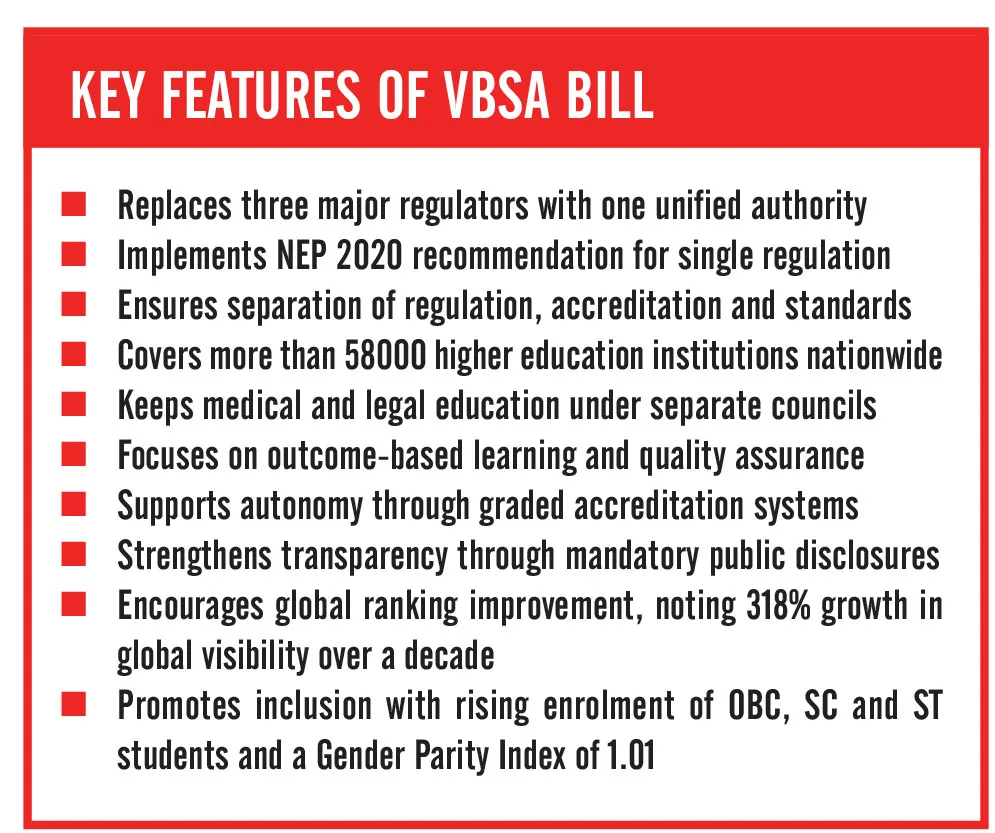
The Bill segregates the grant and fund disbursement powers from the HEIs ecosystem, which were previously held by the UGC. Despite being the primary source of funding for central universities, the Ministry of Education used to allocate funds through UGC. By removing the middle layer, the bill ensures transparency and avoids conflicts of interest, as regulatory bodies should not also disburse funds. While the power to regulate fees in higher education institutes has been kept out of the purview of the apex body, it has been empowered to impose a fine of 10 lakhs to 2 crores on institutions found in violation of operating standards.
The Structure
This seismic shift in India’s higher education system, Clause 55 of the VBSA, 2025, repeals archaic acts like the University Grants Commission Act, 1956; All India Council for Technical Education Act, 1987; and National Council for Teacher Education Act, 1993. The dissolution of UGC will lead to the culmination of the fragmented and redundant regulatory mechanisms. The Bill promises to preserve transitional continuity, while providing for the constitution of three councils under the apex Commission, namely – Viksit Bharat Viniyaman Parishad (Regulatory) for enforcing co-ordination and maintenance of standards in higher educational institutions compliance and autonomy, Viksit Bharat Shiksha Gunvatta Parishad (Accreditation) shall be the accrediting body to supervise and oversee an independent ecosystem of accreditation, and Viksit Bharat Shiksha Manak Parishad (Standards) ensuring synchronisation and determination of academic standards in higher educational institutions. The Commission will be helmed by a chairperson, with up to 12 members appointed by the President on the recommendation of the central government, including the three Council Presidents, the Union Higher Education Secretary, five top experts, and two State HEI academicians.
Impact on Education
The land that once hosted international scholars in its universities has degraded to the effect that only 50 per cent of fresh graduates are employable in the workforce. Today, only a handful of institutions offer learning outcomes and skill-based curricula, which is a major setback for the pool of 4 crore learners who happen to be the ultimate stakeholders in the process. This reinforces that UGC was a relic with its archaic mechanisms to regulate quality at HEIs, driving students towards private institutions, fostering the commercialisation of quality education.
The complete overhaul of our HEI operating ecosystem is a milestone in our journey to realise the dream of ViksitBharat@2047
Echoing the ideas of Pandit Deendayal Upadhyay, besides taking away the power to regulate funds, VBSA proposes to establish measures to avoid commercialisation, as such commercialisation is fatal, making education both inaccessible and devoid of values. The architecture of VBSA is such that it offers performance-linked credits, whereby the better the performance of HEI, the greater the allocated funding and autonomy it enjoys. Falling in line with the “light but tight” philosophy of NEP, 2020, where light means reduced regulations and bureaucratic hurdles, tight means clarity in standards and scope for public scrutiny. The Regulatory Council will maintain a digital window for higher educational institutions to report all matters pertaining to financial probity, governance, infrastructure, faculty and staff, courses and educational outcomes, in addition to a student grievance redressal mechanism.
The proposed changes in the regulatory framework of the HEI ecosystem open new avenues for Indian students seeking admission to foreign universities. The VBSA sets out standard operating procedures for foreign universities planning to establish campuses in India. While defining these standards, it also streamlines the arduous process of multiple prerequisites, ranging from Central Government approval to UGC nods, necessary for such operations.
The complete overhaul of our HEI operating ecosystem is a milestone in our journey to realise the dream of ViksitBharat@2047. Viksit Bharat Shiksha Adhishthan is not merely a structural change; it is the rediscovery of the spirit of Aatmanirbhartā in higher education. In the spirit of doing things the “India Way”, it will put India on the world map as a global hub of knowledge. It sets us on a path towards capitalising on our vibrant demography and nurturing the talent pool to be utilised for building the largest economy, on our way to “समृद्ध एवं महान भारत|”