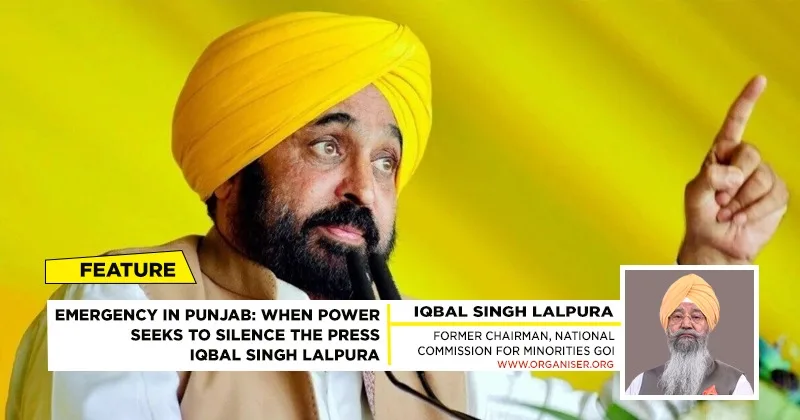
Democracy does not collapse overnight. More often, it erodes gradually—through silence, intimidation, selective enforcement of laws, and the slow suffocation of institutions meant to hold power accountable. Recent developments in Punjab compel every citizen who values constitutional governance to pause and reflect on whether the State is witnessing a silent, undeclared return of Emergency-like conditions, executed not through proclamation, but through administrative coercion.
At the heart of the present concern lies the treatment meted out to the Punjab Kesari Group, one of the most respected and widely circulated newspaper groups in North India. The issue is not merely about one media house or one family; it is about the fundamental right of the press to function independently, free from fear, pressure, or political reprisal.
The chain of events speaks for itself and cannot be ignored. On October 31, 2025, Punjab Kesari published a balanced and factual report relating to allegations raised by the opposition against a senior functionary associated with the ruling establishment in Punjab. The report, by all accounts, adhered to journalistic norms and did not cross the boundaries of responsible reporting. Yet, shortly thereafter—beginning 2 November 2025—all government advertisements to the Punjab Kesari Group were abruptly stopped.
Economic pressure has long been recognised as a subtle yet effective means of disciplining independent voices. While governments have discretion over advertising policy, the timing and selectivity of such withdrawals inevitably raise questions of intent, especially when they follow critical reporting.
What followed in January 2026 deepened these concerns manifold. Within a span of days, an extraordinary number of actions were initiated against entities linked to the Punjab Kesari Group. Multiple departments—FSSAI, GST, Excise, Pollution Control Board, Factories Department, and electricity authorities—conducted raids, inspections, issued notices, cancelled licences, disconnected power supply, and obstructed operations at hotels and printing presses in Jalandhar, Ludhiana, and Bathinda.
Each department, taken individually, may claim statutory authority. However, governance is not judged merely by legality in isolation, but by pattern, proportionality, and purpose. When several arms of the State move in rapid succession against a single media group, following an episode of critical journalism, it creates a reasonable and serious apprehension that regulatory power is being weaponised.
What followed in January 2026 deepened these concerns manifold. Within a span of days, an extraordinary number of actions were initiated against entities linked to the Punjab Kesari Group. Multiple departments—FSSAI, GST, Excise, Pollution Control Board, Factories Department, and electricity authorities—conducted raids, inspections, issued notices, cancelled licences, disconnected power supply, and obstructed operations at hotels and printing presses in Jalandhar, Ludhiana, and Bathinda.
Each department, taken individually, may claim statutory authority. However, governance is not judged merely by legality in isolation, but by pattern, proportionality, and purpose. When several arms of the State move in rapid succession against a single media group, following an episode of critical journalism, it creates a reasonable and serious apprehension that regulatory power is being weaponised.
More alarming was the reported deployment of police forces outside printing presses, creating an atmosphere of fear and intimidation. A printing press is not merely a commercial establishment; it is a critical infrastructure of democracy. Any action that obstructs its functioning directly impairs a citizen’s right to information.
These developments do not exist in a vacuum. Earlier, a prominent Jalandhar newspaper and its owner were subjected to sustained administrative pressure and harassment. That pressure reportedly eased only after the newspaper was compelled to arrive at an understanding with the ruling Aam Aadmi Party. The message such incidents convey to the media fraternity is unmistakable: independence invites reprisal, accommodation ensures survival.
This is a deeply dangerous trajectory.
The Constitution of India does not merely permit freedom of speech and expression; it enshrines it as a cornerstone of republican governance. The Supreme Court has repeatedly held that freedom of the press is implicit in Article 19(1)(a). A press that operates under fear is no press at all—it becomes an echo chamber of power.
What we are witnessing in Punjab resembles a de facto Emergency, where constitutional rights are not formally suspended, but are effectively curtailed through executive overreach. The Emergency of 1975 remains a dark chapter in India’s democratic history precisely because it demonstrated how easily institutions can be bent when dissent is treated as defiance.
Punjab, of all places, understands this danger intimately. The State has endured decades of turbulence, terrorism, and trauma. During the darkest years, when fear ruled the streets and bullets sought to silence truth, journalists stood firm. The Punjab Kesari Group, in particular, paid an enormous price. Its founder, Lala Jagat Narain, was assassinated. His son, Ramesh Chandra Chopra, was also killed. Over sixty members of the organisation—employees, agents, hawkers, reporters—lost their lives for refusing to abandon fearless journalism.
That legacy is not merely institutional; it is moral. To intimidate such a media house today through administrative might is not just an act of coercion—it is an insult to the sacrifices made in defence of democracy.
The issue extends beyond journalism. A free press is essential for free elections. With Punjab moving towards an electoral phase, any attempt to muzzle independent voices distorts the democratic playing field. Voters cannot make informed choices if information is filtered through fear or favour.
Supporters of such actions often argue that no one is above the law. That is correct. But it is equally true that no government is above the Constitution. The law must be applied uniformly, without vendetta, and without timing that betrays political motivation. Selective enforcement is the very definition of abuse of power.
This moment calls for introspection by all who believe in democratic values—regardless of political affiliation. Today it may be one newspaper group; tomorrow it could be another institution, another voice, another critic. History teaches us that authoritarian tendencies, once normalised, rarely confine themselves to their original targets.
Punjab’s proud tradition is one of courage, dissent, and resilience. From the Ghadar movement to the freedom struggle, from resisting colonial rule to standing against terrorism, Punjabis have never accepted intimidation as governance. To allow fear to replace freedom today would be a betrayal of that heritage.
It is therefore imperative that constitutional authorities take urgent cognisance of these developments. Regulatory institutions must be insulated from political direction. Media houses must be allowed to function without fear of reprisal. Accountability must flow both ways—those in power must also remain answerable to the people.
This is not about defending one newspaper or opposing one government. It is about defending the idea of India as a constitutional democracy, where disagreement is not punished, criticism is not criminalised, and power remains subject to scrutiny.
An attack on the press is an attack on the citizen. An attack on truth is an attack on democracy. Punjab must not be allowed to slide into a climate where silence is safer than speech.
The time to reflect—and to correct—is now. Let’s oppose this trend and stand for freedom of Press.