Archi“thefts” of modern Hyderabad
August 10, 2026
  • Read Ecopy
  • Circulation
  • Advertise
  • Careers
  • About Us
  • Contact Us
Android AppiPhone AppArattai
Organiser
  • ‌
  • Bharat
    • Assam
    • Bihar
    • Chhattisgarh
    • Jharkhand
    • Maharashtra
    • View All States
  • World
    • Asia
    • Europe
    • North America
    • South America
    • Africa
    • Australia
  • Editorial
  • International
  • Opinion
  • RSS @ 100
  • More
    • Op Sindoor
    • Analysis
    • Sports
    • Defence
    • Politics
    • Business
    • Economy
    • Culture
    • Special Report
    • Sci & Tech
    • Entertainment
    • G20
    • Azadi Ka Amrit Mahotsav
    • Vocal4Local
    • Web Stories
    • Education
    • Employment
    • Books
    • Interviews
    • Travel
    • Law
    • Health
    • Obituary
  • Subscribe
    • Subscribe Print Edition
    • Subscribe Ecopy
    • Read Ecopy
  • ‌
  • Bharat
    • Assam
    • Bihar
    • Chhattisgarh
    • Jharkhand
    • Maharashtra
    • View All States
  • World
    • Asia
    • Europe
    • North America
    • South America
    • Africa
    • Australia
  • Editorial
  • International
  • Opinion
  • RSS @ 100
  • More
    • Op Sindoor
    • Analysis
    • Sports
    • Defence
    • Politics
    • Business
    • Economy
    • Culture
    • Special Report
    • Sci & Tech
    • Entertainment
    • G20
    • Azadi Ka Amrit Mahotsav
    • Vocal4Local
    • Web Stories
    • Education
    • Employment
    • Books
    • Interviews
    • Travel
    • Law
    • Health
    • Obituary
  • Subscribe
    • Subscribe Print Edition
    • Subscribe Ecopy
    • Read Ecopy
Organiser
  • Home
  • Bharat
  • World
  • Operation Sindoor
  • Editorial
  • Analysis
  • Opinion
  • Culture
  • Defence
  • International Edition
  • RSS @ 100
  • Magazine
  • Read Ecopy
Home Politics

Archi“thefts” of modern Hyderabad: How vote bank delimitation is undermining the city’s governance

Hyderabad is already struggling with traffic paralysis, routine flooding, unreliable water supply, outdated drainage systems, sewage overflow, congestion and crumbling roads. Yet instead of addressing these structural failures, the government’s priority has been redrawing lines on a map. There has been no financial modelling for a 2,000-square-kilometre GHMC, no assessment of manpower requirements, no transport or environmental study. GHMC is being treated less as a civic institution and more as an instrument for political control and real estate expansion

Sumiran KomarrajuSumiran Komarraju
Jan 18, 2026, 09:30 pm IST
inPolitics, Bharat, Telangana
Follow on Google News
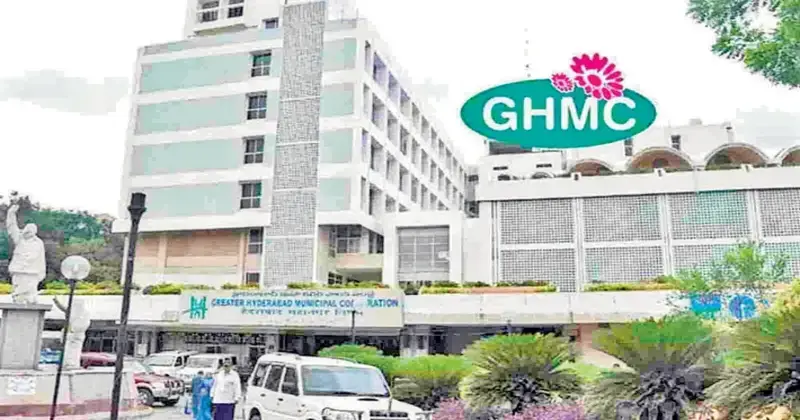
Greater Hyderabad Municipal Corporation(GHMC)

Greater Hyderabad Municipal Corporation(GHMC)

Facebook
Twitter
WhatsAppTelegramEmail

Hyderabad has established itself as a hub for top global companies, making it one of India’s most innovative centres for technology, pharmaceuticals and research. As the city expands in all directions and attracts global attention, a familiar Congress tactic has resurfaced—this time disguised as administrative reform. In theory, reform should mean better governance, improved service delivery, rational planning, and democratic consultation. What Hyderabad is witnessing today reflects none of these principles. It is political engineering through city delimitation, and it comes at the direct cost of the city’s future.

The Congress government has merged 27 urban municipalities into the Greater Hyderabad Municipal Corporation (GHMC), expanding the city’s jurisdiction from roughly 625 square kilometres to over 2,000 square kilometres. These municipalities span Medchal–Malkajgiri, Rangareddy and Sangareddy districts. The expansion was executed through notifications, without meaningful consultation with elected representatives, without publicly released population, fiscal or infrastructure modelling and without any phased administrative transition plan. This is not routine governance. It is a structural intervention with immediate and long-term political consequences.

Alongside this territorial expansion, the government has doubled the number of municipal wards from 150 to 300 and increased the number of mayors from one to three. This redrawing of the municipal map was rushed through within days of the merger, without a transparent population parity framework or a clear explanation of representational logic. Elected representatives from the 27 merged municipalities—covering nearly half of the expanded GHMC area—were entirely excluded from the process. The city’s democratic mandate is being reshaped not through deliberation, but through arithmetic.

The effects are visible in how ward boundaries are being structured. In the core GHMC area, particularly in the Old City, boundaries are being carefully protected and reshaped to preserve existing vote banks. In contrast, in the newly merged municipalities, neighbourhoods are split, clubbed or diluted to break political coherence. Opposition-supporting localities are chopped into multiple wards; demographically distinct areas are forcibly fused; natural boundaries, revenue limits and local identities are ignored. This is not neutral delimitation. It is vote engineering.

Such outcomes are not without precedent. From the imbalances triggered at independence to politically driven delimitation exercises in undivided Andhra Pradesh under the Congress rule, boundary-making for electoral ends has repeatedly produced instability rather than integration. Congress’s historical reliance on appeasement politics as an organising principle is well documented and the manner in which this exercise has been executed follows that familiar pattern.

Recent public remarks by the current Chief Minister—explicitly framing the party’s political identity in minority terms—reinforce this reading by anchoring political strategy in communal arithmetic rather than civic governance. The parallels with the approach adopted during Y. S. Rajasekhar Reddy’s tenure in undivided Andhra Pradesh, when Hyderabad’s boundaries and administrative decisions were similarly leveraged for electoral consolidation, are difficult to ignore.

By embedding demographic and communal imbalance into the ward structure, the present exercise distorts political representation and weakens accountability. Governance becomes contingent on bloc control rather than service delivery, fiscal prudence or long-term planning— conditions essential for Hyderabad to function as a genuinely global and well-governed city. When ward boundaries consistently concentrate power within a single communal bloc, institutional checks weaken and enforcement becomes selective rather than uniform. Decisionmaking follows numerical dominance, not civic necessity.

Also Read: 136 Startups a Day: How Bharat quietly built one of the world’s most stable startup ecosystems

The risks are not abstract. Hyderabad is already struggling with traffic paralysis, routine flooding, unreliable water supply, outdated drainage systems, sewage overflow, congestion and crumbling roads. Yet instead of addressing these structural failures, the government’s priority has been redrawing lines on a map. There has been no financial modelling for a 2,000-square-kilometre GHMC, no assessment of manpower requirements, no transport or environmental study. GHMC is being treated less as a civic institution and more as an instrument for political control and real estate expansion. Citizens inherit administrative chaos; insiders inherit profit.

Urban governance has been reduced to high-decibel events and headline management. Summits substitute for strategy, spectacle stands in for administration, and publicity is mistaken for progress. The Rising Telangana Summit offered optics without an urban roadmap. Celebrity visits became theatre for a city struggling with drains, buses and water. This is governance hollowed out and replaced with noise.

Hyderabad today is being split into two realities. One is a curated, camera-ready city marketed through select western corridors. The other is the lived city—merged municipalities, overcrowded core zones, neglected peripheries, and unplanned colonies—abandoned by serious governance. This duality is not accidental; it is the outcome of deliberate political design.

At a time when the world looks to BJP-led administration in India for examples of infrastructure led growth, regulatory predictability, and administrative capacity, the present Congress regime has moved Hyderabad in the opposite direction. Global cities such as London, Paris, Sydney and Brussels offer cautionary lessons on how sustained governance failure combined with demographic imbalance fuels social fragmentation, insecurity, and uneven civic outcomes.

And yet, Hyderabad is being cut, carved, and rigged.

This is not merely an administrative failure; it is a warning. Hyderabad is slowly sliding into the grip of modern Razakars and their political patrons who are bent on weakening democratic processes. Hyderabad is not Congress property. It is not AIMIM territory. It belongs to its people.


Topics: TelanganaHyderabadDevelopmentpoliticsGovernanceMismanagementGreater Hyderabad Municipal Corporation (GHMC)
Share
Tweet
SendShareSend
✮ Subscribe Organiser YouTube Channel. ✮
✮ Join Organiser's WhatsApp channel for Nationalist views beyond the news. ✮
Previous News

‘Punch Doctors’, Fake patients, paper faculty: ED lays bare alleged Rs 500 crore Al Falah Medical College scam

Next News

Exercise DOSTI: India, Maldives & Sri Lanka kick off joint drills to foster collective security in the Indian Ocean

Related News

Why are young people forced to protest? A question that demands reflection!

Representative Image

The grammar of democracy must triumph over the grammar of anarchy

Koukoor Dargah in Medchal district, Telangana

Telangana: Police arrest Nazar in Medak after wife alleges he posed as an orphan, used fake Hindu name to marry her

The Politics of Strategic Retreat: Why PM Narendra Modi wins big by losing small

Representative Image

Youth Power: Not anyone’s pawn, but the engine of a developed India

Ahilyabai Holkar

300 year-old Ahilya Kamadhenu manuscript found in Indore; Reveals Holkar Maharani’s vision for good governance

Load More

Latest News

ABVP Opposes function on Delhi riot accused Umar Khalid in JNU; Programme cancelled

ABVP JNU opposes programme linked to Umar Khalid at Jawaharlal Nehru University; Programme cancelled

Bollywood film maker Shakeel Noorani arrested in rape case

Bollywood film maker Shakeel Noorani arrested in rape case; Actress alleges drugging, sexual assault and video threat

Armed Security Personnel

Khyber Pakhtunkhwa Violence: Policemen killed in Lakki Marwat; two tribal elders shot dead in South Waziristan

India presents peacocks to UN Geneva

India’s Peacock Diplomacy: New Delhi presents 5 peacocks to UN Geneva; Resonates cultural heritage & soft power

UN raises concern over poll violence in PoJK

PoJK: UN flags concern over poll violence amid Pakistan’s crackdown on peaceful protesters in the occupied territory

The Long March of Ideas: Cultural Marxism, Protest Politics

India’s Civilisational Truth: What does India say about tribal pride and the indigenous discourses?

Talent has always existed; opportunity is now reaching every corner: Gagan Narang, Olympic bronze medallist

Representative Image

Leftist agenda targets emotional Gen Z; Logical thinking crucial for next generation for national well-being

JNU cancels auditorium booking for Umar Khalid's book discussion

JNU cancels Umar Khalid’s book discussion as organisers concealed real purpose; Permission was asked for ‘Advasi Diwas’

Load More
  • Privacy
  • Terms
  • Cookie Policy
  • Refund and Cancellation
  • Delivery and Shipping

© Bharat Prakashan (Delhi) Limited.
Tech-enabled by Ananthapuri Technologies

  • Home
  • Search Organiser
  • Bharat
    • Assam
    • Bihar
    • Chhattisgarh
    • Jharkhand
    • Maharashtra
    • View All States
  • World
    • Asia
    • Africa
    • North America
    • South America
    • Europe
    • Australia
  • Editorial
  • Operation Sindoor
  • Opinion
  • Analysis
  • Defence
  • Culture
  • Sports
  • Business
  • RSS @ 100
  • Entertainment
  • More ..
    • Sci & Tech
    • Vocal4Local
    • Special Report
    • Education
    • Employment
    • Books
    • Interviews
    • Travel
    • Health
    • Politics
    • Law
    • Economy
    • Obituary
  • Subscribe Magazine
  • Read Ecopy
  • Advertise
  • Circulation
  • Careers
  • About Us
  • Contact Us
  • Policies & Terms
    • Privacy Policy
    • Cookie Policy
    • Refund and Cancellation
    • Terms of Use

© Bharat Prakashan (Delhi) Limited.
Tech-enabled by Ananthapuri Technologies