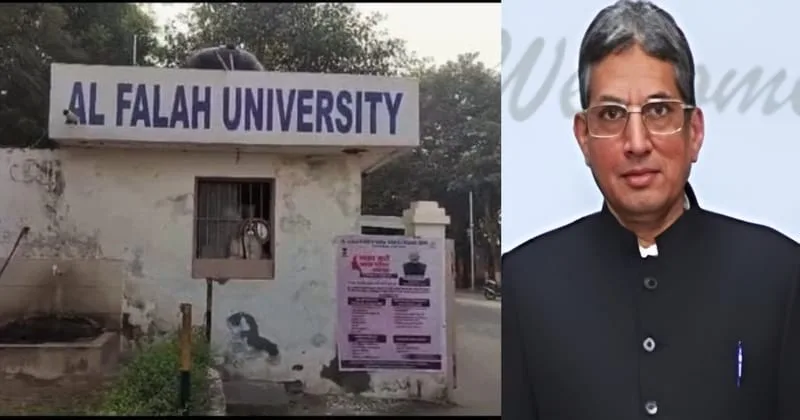
The Enforcement Directorate has filed a 200-page prosecution complaint under the Prevention of Money Laundering Act, 2002, against Al Falah Group chairperson Javed Ahmed Siddiqui and others, alleging large-scale financial irregularities and systemic fraud in the functioning of Al Falah Medical College and University. According to the agency, proceeds of crime amounting to at least Rs 500 crore were generated by deceiving students, parents and regulatory authorities.
A special court is expected to consider taking cognisance of the complaint on January 31.
Al Falah University has earlier been in the spotlight due to its alleged links to a so-called “white-collar terror module” that emerged during investigations into the Red Fort blast case in Delhi, adding to the gravity of the allegations now levelled by the central agency.
One of the most serious charges in the ED’s complaint pertains to the alleged appointment of “punch doctors” — medical professionals hired solely to mark attendance through the biometric system without performing any teaching or clinical duties.
Quoting the statement of Vice-Chancellor and Principal Dr Bhupinder Kaur Anand, the ED has alleged that doctors were engaged merely to satisfy the National Medical Commission’s (NMC) attendance requirements.
“Medical staff were solely engaged to record attendance through the AEBA biometric system to satisfy the NMC mandate. No class or medical duty by these punch doctors. Merely shown as regular employees for NMC records,” Dr Anand reportedly told investigators.
The complaint further claims that faculty members were shown as full-time employees on paper but rarely, if ever, attended the institution or discharged academic responsibilities. According to the ED, this was part of an “irregular arrangement” deliberately designed to project compliance with statutory norms.
The ED has alleged that Al Falah Medical College hurriedly filled multiple faculty and staff positions just days before a crucial NMC inspection on June 12, 2025. These recruitments, the agency claims, followed no transparent or standard procedure.
According to Dr Anand’s statement, the recruitment process involved walk-in interviews, with final approval resting solely with chairperson Javed Ahmed Siddiqui. No external recruitment agency was engaged, and due diligence was allegedly bypassed.
The agency further claimed that several doctors arrested in connection with the Red Fort blast case, including Dr Muzammil, Dr Shaheen and others, were recruited in a similar manner, allegedly after receiving Siddiqui’s approval.
In another explosive allegation, the ED has accused the institution of staging hospital occupancy by arranging fake patients during inspections.
Citing a statement dated December 24, 2025, by IT department head Fardeen Beg, the complaint alleges that individuals posing as patients were brought in to show full bed occupancy whenever inspections by the NMC were scheduled.
“Before a visit by the NMC, fake patients were arranged with the help of the PRO. Fake patients were coordinated through Asha workers to show full occupancy. The conspiracy was with the consent of chairman Javed Ahmed Siddiqui,” the ED alleged.
The agency claims this practice was a routine part of the institution’s strategy to mislead regulators into believing that the medical college and hospital were fully functional and compliant with prescribed norms.
The ED’s complaint paints Al Falah as a “one-man show”, alleging that Siddiqui exercised absolute control over all decisions related to the university and medical college.
According to investigators, other board members existed only on paper, and minutes of board meetings were allegedly fabricated without any actual deliberations taking place. Crucial decisions, including appointments, contracts and administrative approvals, were allegedly taken unilaterally by Siddiqui.
The agency has described Siddiqui as the “mastermind” behind the alleged scam, accusing him of orchestrating the fraudulent structure that enabled the institution to operate despite serious deficiencies.
The ED has also alleged that Siddiqui floated private companies, including Karkun Construction and Developers and Aamla Enterprises by incorporating his family members as stakeholders.
“All construction contracts at the new medical college and hostel were given to this company,” the complaint alleged, suggesting possible diversion and layering of funds to generate and conceal proceeds of crime.
According to the ED, such arrangements point to classic money laundering mechanisms, where institutional funds were allegedly siphoned off through related-party transactions.
Beyond regulatory violations, the ED has accused Al Falah Charitable Trust and its management of dishonestly inducing thousands of students and their families into paying hefty tuition and examination fees under false pretences.
By allegedly projecting a fully compliant medical college with adequate faculty, infrastructure and patient inflow, the institution is accused of misleading aspirants who trusted its claims and invested significant financial resources in their education.
With the prosecution complaint now filed, the legal focus shifts to whether the special court will take cognisance of the case later this month. If the court proceeds, Siddiqui and other accused could face a prolonged trial under stringent provisions of the PMLA, which carry severe penalties, including imprisonment and attachment of assets.