India’s startup ecosystem witnessed unprecedented expansion in 2025, with over 50,000 new startups registered in a single year, translating into an average of 136 startups every day. With this surge, the total number of registered startups has climbed to 2.09 lakh, underlining the fastest annual growth recorded in the past decade.
The momentum is striking when viewed in comparison with the previous year. On National Startup Day in January 2025, India had approximately 1.59 lakh registered startups. In just one year, the ecosystem expanded by nearly one-third, reflecting both policy continuity and growing entrepreneurial confidence.
This data, released by the Department for Promotion of Industry and Internal Trade (DPIIT), places India firmly among the world’s most dynamic startup ecosystems, not only in scale, but also in sustainability.
How smaller cities are driving growth
One of the most significant shifts highlighted by the DPIIT report is the geographical spread of entrepreneurship. Contrary to the long-held perception that startups are concentrated in metropolitan hubs, 52.6 percent of India’s startups now originate from Tier-2 and Tier-3 cities.
This decentralisation marks a structural transformation. Cities beyond Delhi, Mumbai, Bengaluru, and Hyderabad are increasingly emerging as innovation centres, supported by improved digital infrastructure, local incubators, and government-backed schemes.
From consumer goods and agri-tech to manufacturing and industrial machinery, startups in smaller cities are addressing hyper-local problems while scaling nationally. This trend also indicates a maturing ecosystem where innovation is no longer restricted to elite urban clusters.
Women at the Core
Another defining feature of India’s startup growth is the strong participation of women entrepreneurs. According to official data, nearly half of all startups have at least one woman director, spanning sectors as diverse as baby care products, healthcare, fintech, and heavy engineering.
India has also emerged as the world’s second-largest ecosystem for funding women-led startups, a milestone that reflects gradual but meaningful progress in gender inclusion. This shift has been enabled by targeted policy interventions, improved access to capital, and changing social attitudes toward women-led enterprises.
Prime Minister Narendra Modi has repeatedly highlighted this aspect as a cornerstone of the Startup India mission, positioning women not as beneficiaries but as drivers of innovation-led growth.
Startups as a national employment engine
Over the last decade, Indian startups have collectively generated approximately 2.1 million direct jobs, according to DPIIT estimates. On average, each startup employs around 10 people, making the sector a significant contributor to employment at a time when traditional industries are undergoing automation-driven changes.
Importantly, these jobs are not limited to high-end technology roles. Startups are creating employment across supply chains, logistics, manufacturing, customer support, marketing, and services, particularly in semi-urban and rural regions.
As India’s demographic dividend peaks, the role of startups in absorbing skilled and semi-skilled youth is becoming increasingly critical.
While startup registrations surged in 2025, only seven companies achieved unicorn status during the year, reflecting a more cautious investment climate globally. In contrast to earlier years of rapid valuation growth, investors are now prioritising profitability, governance, and long-term sustainability.
Regulatory changes have also played a role. The implementation of India’s online gaming law resulted in four major companies, Dream11, MPL, Gameskraft, and Games24Into7—losing their unicorn status. This episode underscored how policy clarity and sector-specific regulation can significantly impact valuations, especially in emerging digital industries.
Despite this, India continues to retain one of the world’s largest pools of high-growth startups poised for scale.
Lowest closure rate globally
One of the most remarkable indicators of India’s startup health is its exceptionally low closure rate. According to DPIIT Joint Secretary Sanjeev, only 6,385 startups have shut down over the past ten years, amounting to just 3% of total registered startups.
This is among the lowest closure rates worldwide, challenging the narrative that startups are inherently unstable or short-lived. This resilience is a combination of policy support, domestic market depth, adaptive business models, and phased funding mechanisms.
Rather than a boom-and-bust cycle, India’s startup ecosystem appears to be evolving with greater maturity and risk awareness.
State-wise snapshot
At the state level, Maharashtra continues to lead India’s startup landscape, with 34,444 registered startups, though it has also recorded 1,200 closures, the highest in absolute terms due to scale.
Karnataka follows with 20,330 startups, while Delhi and Uttar Pradesh are tied at 19,273 each. Gujarat, Tamil Nadu, and Telangana also feature prominently, reflecting a competitive inter-state innovation environment.
Interestingly, Madhya Pradesh recorded the lowest number of closures—180—out of 6,493 startups, suggesting relatively stable growth. This variation highlights how local policy frameworks, ease of doing business, and ecosystem support can significantly influence startup outcomes.
From Startup India to entrepreneurial India
As the Startup India initiative completes a decade, policymakers and industry leaders are increasingly framing the next phase as a transition from “Startup India” to “Entrepreneurial India.”
According to a report by The Indus Entrepreneurs (TiE), entrepreneurship should be institutionalised as a core life skill. The report recommends introducing entrepreneurship education in 75 percent of secondary schools and 80% of higher education institutions by 2035.
If implemented, this approach could enable startups to contribute up to 15 percent of India’s GDP and generate five million additional jobs, fundamentally reshaping the country’s economic structure.
Another indicator of ecosystem maturity is the reduction in time taken by startups to reach the IPO stage. According to Orios Venture Partners, startups expected to list in 2025 took an average of 13.3 years to go public, compared to 16 years in 2021 and 2022.
Companies such as Mamaearth and Yatra listed in just 12.5 years, signalling improved governance readiness, financial discipline, and market confidence.
This trend suggests that Indian startups are no longer chasing growth at any cost, but are building businesses capable of withstanding public market scrutiny.
India Ranks Third Globally
Despite global funding headwinds, Indian startups raised approximately Rs 94,500 crore in 2025, according to data from Tracxn. This places India as the third-largest funded startup ecosystem globally, behind only the United States and the United Kingdom.
The funding slowdown has also had a positive side-effect: startups are focusing more on unit economics, customer retention, and sustainable growth rather than rapid expansion driven solely by venture capital.
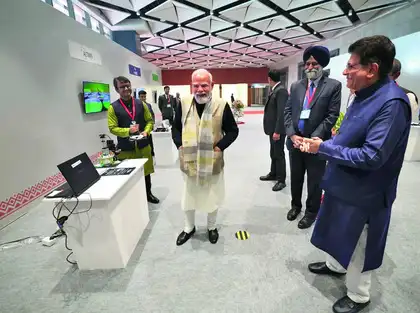
Prime Minister Narendra Modi, speaking at Bharat Mandapam in New Delhi during the 10-year anniversary of Startup India, described the journey as one of “dreams turning into reality.”
He recalled that a decade ago, India had fewer than 500 startups, with entrepreneurship largely restricted to established business families. Today, the number has crossed two lakh, empowering youth from middle-class and economically weaker backgrounds to become job creators rather than job seekers.
The Prime Minister emphasised that India’s future leadership in artificial intelligence and emerging technologies would depend on the performance of its startups, assuring innovators of continued government support.
Women, Youth, and the Next Decade
In his address, PM Modi highlighted that over 45 percent of recognised startups now have women directors or partners, reinforcing India’s position as a global leader in women-led innovation.
He urged young entrepreneurs to think boldly and work on real-life problems, stating that India’s ambition should be not just participation but global leadership in startups and technology over the next decade.
India’s startup journey over the past decade reflects more than numerical growth, it signals a shift in mindset. With low failure rates, rising participation from smaller cities and women entrepreneurs, faster IPO readiness, and strong employment generation, the ecosystem is moving toward long-term sustainability.
As India celebrates National Startup Day and a decade of Startup India, the data suggests that the country is no longer just building startups, it is building an entrepreneurial society poised to play a central role in the global innovation economy.