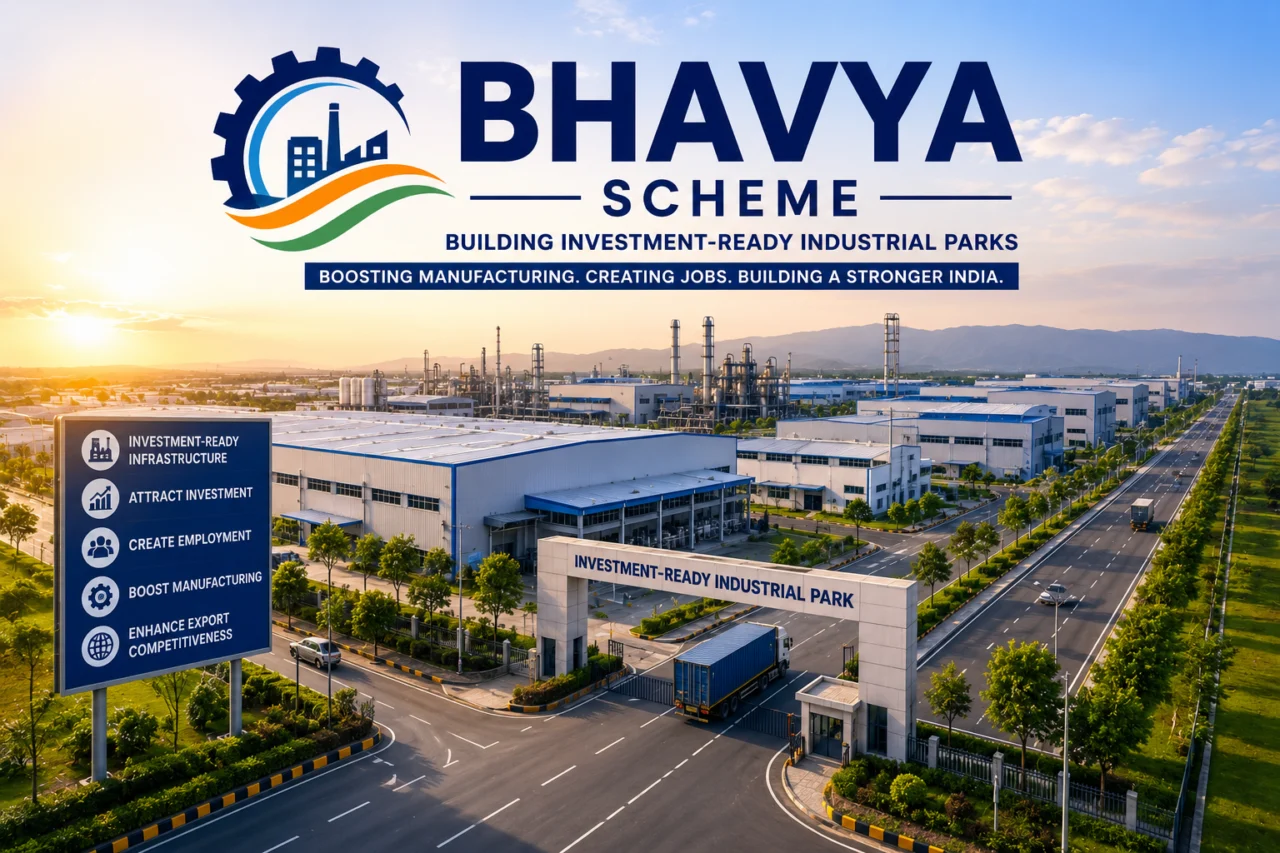
As India continues its journey towards becoming a global manufacturing powerhouse, the government is placing renewed emphasis on developing world-class industrial infrastructure capable of attracting large investments and generating employment opportunities at scale. In this direction, the Bharat Audyogik Vikas Yojana (BHAVYA) has emerged as a key initiative designed to create investment-ready industrial parks that can support rapid industrialisation and strengthen the country’s manufacturing ecosystem.
Speaking at a workshop organised by the National Industrial Corridor Development Corporation (NICDC) in New Delhi, Department for Promotion of Industry and Internal Trade (DPIIT) Secretary Amardeep Singh Bhatia outlined the government’s vision behind the scheme and stressed the need for states and Union Territories to create industrial parks that are capable of attracting investors from the very beginning.
According to Bhatia, the success of the scheme will not be measured simply by the number of industrial parks built or the amount of infrastructure created. Instead, the true measure of success will be the ability of these industrial parks to attract industries, facilitate manufacturing activities, create employment opportunities and contribute to India’s long-term economic growth.
Moving beyond infrastructure creation
For decades, industrial development in India has often focused on building physical infrastructure such as roads, utility networks, industrial plots and logistics facilities. While these remain critical components of industrialisation, the government now seeks to adopt a more comprehensive approach.
Under the BHAVYA scheme, the objective is not merely to construct industrial parks but to ensure that they are fully prepared to receive investments and enable businesses to begin operations within a short period of time.
Addressing representatives from across the country, Bhatia emphasised that industrial parks should be designed from an investor’s perspective. Investors today seek locations where land acquisition challenges are minimal, approvals are streamlined, infrastructure is already in place and supporting services are easily accessible.
He urged state governments and Union Territories to submit investor-centric proposals that clearly highlight their competitive advantages, ease of doing business initiatives and supporting industrial ecosystems.
According to him, industrial parks that can provide ready-to-use infrastructure and efficient regulatory systems will have a greater chance of attracting domestic and international investments.
Strengthening India’s manufacturing ambitions
The BHAVYA scheme comes at a time when India is actively pursuing its goal of becoming a major global manufacturing destination.
In recent years, the government has introduced several initiatives aimed at boosting domestic manufacturing, reducing import dependence and increasing exports. Programmes such as Make in India, Production Linked Incentive (PLI) schemes and the development of industrial corridors have already laid the foundation for industrial growth.
The BHAVYA scheme seeks to complement these efforts by ensuring that industries have access to high-quality manufacturing zones equipped with modern infrastructure and support services.
Officials believe that investment-ready industrial parks can significantly reduce the time required for businesses to establish manufacturing facilities. This can help attract greater investments from sectors such as electronics, automobiles, renewable energy, aerospace, defence manufacturing, pharmaceuticals and advanced technologies.
By creating an environment where industries can quickly commence operations, the scheme aims to improve India’s competitiveness in the global manufacturing landscape.
Generating employment through industrial expansion
One of the most important objectives of the BHAVYA scheme is employment generation.
Manufacturing has long been recognised as a sector capable of creating large-scale jobs across different skill levels. From factory workers and technicians to engineers, logistics personnel and support service providers, industrial development generates employment throughout the economic value chain.
Bhatia highlighted that industrial parks developed under the scheme should serve as engines of economic activity that stimulate local employment and create opportunities for surrounding communities.
As new industries establish manufacturing units, they often lead to the growth of ancillary businesses, transportation networks, warehousing facilities, housing developments and commercial services. This multiplier effect can significantly improve economic activity in regions where industrial parks are established.
The government believes that creating investment-ready industrial hubs can play a crucial role in providing employment opportunities for India’s growing workforce while supporting inclusive regional development.
Focus on long-term industrial viability
A key feature of the BHAVYA scheme is its emphasis on sustainability and long-term viability.
Bhatia noted that project evaluation under the scheme will focus on more than just infrastructure proposals. Authorities will examine whether proposed industrial parks possess genuine potential to attract industries and sustain economic activity over time.
Factors such as location advantages, connectivity, logistics support, industrial demand, availability of skilled manpower and ecosystem readiness will play an important role during project evaluation.
The objective is to ensure that industrial parks developed under the scheme become thriving manufacturing centres rather than underutilised infrastructure projects.
“The scheme seeks to create industrial parks where infrastructure readiness translates into rapid investment grounding, manufacturing activity, employment generation and export competitiveness,” Bhatia stated.
Workshop brings together states and Union Territories
The workshop organised under the aegis of DPIIT brought together more than 100 representatives from 31 States and Union Territories at Vanijya Bhawan.
The event served as an important platform for discussions on the framework of the BHAVYA scheme and strategies for strengthening industrial ecosystems across the country.
Officials from various states participated in detailed discussions on industrial development, investment attraction, quality infrastructure and testing facilities.
The gathering reflected the collaborative approach being adopted by the Centre, where states and Union Territories are expected to play a central role in identifying industrial opportunities and developing projects suited to their regional strengths.
NICDC highlights need for industrial ecosystems
Welcoming participants, NICDC Chief Executive Officer and Managing Director Rajat Kumar Saini stressed the importance of building comprehensive industrial ecosystems rather than standalone infrastructure projects.
He highlighted that successful industrial development requires a combination of robust physical infrastructure, quality testing facilities, institutional support and business-friendly policies.
According to Saini, industrial parks must evolve into integrated ecosystems where industries can access all necessary support services required for efficient operations.
Such ecosystems can improve productivity, reduce operational costs and make manufacturing destinations more attractive for investors.
His remarks reinforced the broader objective of the BHAVYA scheme, which seeks to create industrial hubs capable of sustaining long-term growth and competitiveness.
Quality infrastructure at the heart of manufacturing growth
The workshop was organised in two sessions, with the first session focusing on quality infrastructure and testing facilities.
As India seeks to increase its presence in global supply chains, product quality and compliance with international standards have become increasingly important.
Manufacturers today must meet stringent quality requirements in domestic and export markets. Testing, certification and standardisation therefore play a critical role in ensuring product acceptance and market access.
Recognising this requirement, the government is working to strengthen quality infrastructure alongside industrial development.
The first session explored how testing facilities and certification services can support industries and help improve manufacturing standards across sectors.
National test house expands testing capabilities
During the session, National Test House Director General Dr Alok Srivastav presented details of the organisation’s rapidly expanding testing and certification ecosystem.
The National Test House has been enhancing its capabilities in several emerging and strategic sectors that are expected to drive India’s future manufacturing growth.
Among the areas highlighted were drone certification, electric vehicle battery testing, aerospace component testing, solar equipment testing and organic food certification.
These sectors represent some of the fastest-growing segments of the Indian economy and require specialised testing infrastructure to ensure quality and compliance.
As industries increasingly adopt advanced technologies, access to reliable testing facilities becomes critical for maintaining standards and supporting innovation.
Bringing testing facilities closer to industry
A significant aspect of the discussions focused on improving access to testing and certification services for manufacturers.
The National Test House highlighted its collaboration with NICDC to establish testing facilities and sample collection centres within industrial corridor projects.
Traditionally, manufacturers often face delays and additional costs when testing facilities are located far from production centres. Establishing testing infrastructure closer to industrial hubs can help reduce turnaround times and improve operational efficiency.
Such facilities will allow manufacturers to access certification services without the need to transport samples over long distances, thereby supporting faster product approvals and market entry.
The initiative is expected to be particularly beneficial for emerging sectors where regular testing and compliance verification are essential.
Building a strong foundation for India’s industrial future
The BHAVYA scheme represents another important step in India’s broader strategy to strengthen manufacturing, attract investments and create employment opportunities.
By focusing on investment-ready industrial parks, the government is seeking to ensure that infrastructure development translates into tangible economic outcomes. The emphasis on investor readiness, industrial viability, quality infrastructure and testing support reflects a shift towards creating comprehensive manufacturing ecosystems rather than isolated industrial projects.
As states and Union Territories begin preparing proposals under the scheme, the success of BHAVYA will ultimately depend on its ability to convert infrastructure into thriving centres of production, innovation and employment.
With manufacturing expected to play a central role in India’s ambition of becoming a developed nation by 2047, initiatives such as BHAVYA could help lay the foundation for a more competitive, self-reliant and globally integrated industrial economy.